Hello! Welcome back to our course on mastering physiology.
In our last few lessons, we've focused on how the body breaks down and absorbs the major macronutrients—carbohydrates, proteins, and lipids. We saw that their absorption drives the initial movement of some solutes. Today, we zoom out to address a topic of massive scale and critical importance: the absorption of water and electrolytes.
Your GI tract handles an astonishing volume of fluid daily, around 8-9 liters, composed of what you drink plus copious secretions from salivary glands, the stomach, pancreas, and liver. Over 99% of this fluid must be efficiently reabsorbed to maintain hydration and homeostasis. The learning outcome for this lesson is to describe the mechanisms of water and electrolyte absorption in the small and large intestines.
The central, unifying principle of this entire process is simple yet profound: water follows solutes. Therefore, to understand water absorption, we must first understand the mechanisms of electrolyte transport, particularly for sodium.
An Overview of Fluid Balance in the Gut
Let's begin by visualizing the scale of fluid movement.
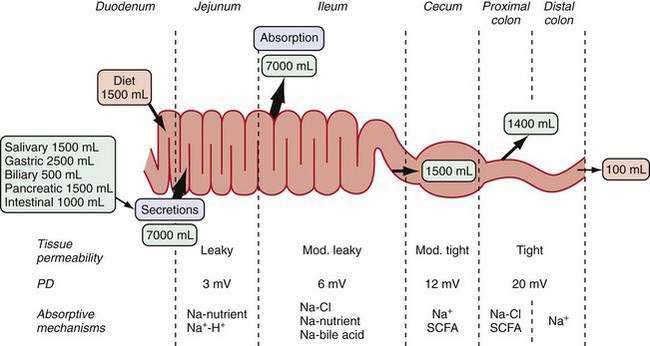
As you can see, while you might ingest 1.5 liters of fluid, your gut's internal secretions add another 7 liters. The small intestine is a powerhouse of absorption, reclaiming the vast majority of this volume. The colon then performs the crucial final recovery, leaving only about 100 mL of water to be lost in feces.
Fundamental Principles of Intestinal Transport
To move these substances from the gut lumen into the blood, intestinal epithelial cells (enterocytes) use two primary pathways.
Absorption of Water, Ions, Vitamins, and Minerals
To understand the fundamental pathways for transport, let's look at a few key slides from this presentation by the North American Society for Pediatric Gastroenterology, Hepatology and Nutrition (NASPGHAN).
Please review the slides from 'Intestinal Epithelial Cells as Gatekeepers for Ion and Fluid Movement' to 'Transepithelial Transport: Summary'. Focus on the distinction between the transcellular and paracellular pathways.
As you saw in the slides, the two pathways are:
- Transcellular Pathway: Movement through the cell. Substances cross the apical membrane (facing the lumen), move through the cytoplasm, and then cross the basolateral membrane (facing the blood). This route often involves membrane transporters and can move solutes against their concentration gradient, typically requiring energy.
- Paracellular Pathway: Movement between cells. Substances pass through the tight junctions that bind adjacent epithelial cells together. This route is passive and depends on electrochemical gradients and the "tightness" or permeability of these junctions.
The engine driving most absorptive processes is the Na+/K+-ATPase pump, located on the basolateral membrane of every enterocyte. As you'll recall from our lessons on cellular physiology, this pump uses ATP to actively transport Na+ out of the cell and K+ into the cell. This action is paramount because it creates a low intracellular Na+ concentration and an electrical gradient, which together provide the driving force for Na+ to enter the cell from the lumen via various channels and co-transporters on the apical membrane.

Absorption in the Small Intestine
The small intestine is where the bulk of water and electrolytes are absorbed. Its epithelium is considered "leaky" because its tight junctions are relatively permeable to water and small ions, facilitating large-volume paracellular transport.
Sodium (Na+) Absorption
Sodium absorption is the primary driver. It occurs via three main mechanisms in the small intestine:
- Nutrient-Coupled Na+ Absorption: We've already covered this! After a meal, the Na+-glucose cotransporter (SGLT1) and various Na+-amino acid cotransporters on the apical membrane pull Na+ into the cell along with digested nutrients. This is a major mechanism for postprandial (after-meal) Na+ absorption.
- Electroneutral NaCl Absorption: This is the primary mechanism for absorbing Na+ between meals. It involves the coordinated action of two transporters on the apical membrane:
- A Na+/H+ exchanger (NHE3), which brings Na+ into the cell in exchange for a proton (H+).
- A Cl-/HCO3- exchanger, which brings Cl- into the cell in exchange for bicarbonate (HCO3-).
The net result is the absorption of NaCl from the lumen without any net charge movement.
- Passive Na+ Influx: A smaller amount of Na+ can also move down its electrochemical gradient through the paracellular pathway.
Chloride (Cl-) and Water (H2O) Absorption
- Chloride (Cl-) is absorbed by following the electrical and chemical gradients created by Na+ absorption. It moves both transcellularly (via the Cl-/HCO3- exchanger) and paracentrally through tight junctions.
- Water (H2O) movement is entirely passive. The absorption of Na+, Cl-, and nutrients into the intercellular space behind the tight junctions makes this space hyperosmotic. This osmotic pressure pulls water from the lumen, primarily through the paracellular pathway, and also through aquaporin channels (transcellular pathway).
Digestive System 5 Ion and Water Reabsorption
This short video provides an excellent, clear animation of the electroneutral NaCl absorption mechanism, which is a core concept for both the small and large intestine.
Watch the entire video (about 3 minutes). Pay close attention to how the Na+/K+ pump on the basolateral side sets the stage, and how the Na+/H+ and Cl-/HCO3- exchangers work together on the apical side to bring NaCl into the cell.
Test your understanding!
Oral rehydration solutions, used to treat dehydration from diarrhea, contain both salt (NaCl) and glucose. Based on the mechanisms we've discussed, why is the inclusion of glucose so critical for enhancing water and electrolyte absorption?
Show answer
Glucose is critical because it utilizes the Na+-glucose cotransporter (SGLT1). By actively transporting glucose and Na+ together into the enterocyte, it powerfully drives the absorption of both solutes. This enhanced solute absorption creates a stronger osmotic gradient, which in turn leads to more rapid and effective passive absorption of water from the intestine. This mechanism remains functional even during certain types of infectious diarrhea.
Absorption in the Large Intestine
The large intestine, or colon, absorbs the final liter or so of water. Its epithelium is much "tighter" than the small intestine's, with less permeable tight junctions. This allows the colon to create steeper osmotic gradients and absorb water against a higher concentration difference, effectively "drying" the fecal matter.
Sodium (Na+) and Water (H2O) Absorption
The colon uses two main mechanisms for Na+ absorption:
- Electroneutral NaCl Absorption: This occurs in the proximal colon and is mechanistically identical to what we saw in the small intestine (NHE3 coupled with a Cl-/HCO3- exchanger).
- Electrogenic Na+ Absorption: This is a distinct and crucial feature of the distal colon. It is mediated by the Epithelial Na+ Channel (ENaC) on the apical membrane. Na+ simply moves through this channel down its steep electrochemical gradient. This process is called "electrogenic" because it involves the net movement of positive charge into the cell, making the lumen electrically negative. This mechanism is under hormonal control, most notably stimulated by aldosterone.
As always, water absorption follows the active transport of Na+ and Cl-.
Potassium (K+) Secretion
Here is a key difference: while the small intestine absorbs K+, the large intestine typically secretes K+. The electrogenic absorption of Na+ via ENaC makes the lumen negative. This negative potential provides an electrical driving force for the passive secretion of positively charged K+ from the cell into the lumen through apical potassium channels (e.g., ROMK, BK). Aldosterone, which upregulates ENaC, thus also promotes K+ secretion.
Physiology of Intestinal Absorption and Secretion - PMC
For a more detailed textual explanation of the different Na+ absorption mechanisms, particularly the electrogenic ENaC pathway in the colon, please read the following section from this review article.
Read the section titled 'Intestinal Na+ absorption'. Focus on the descriptions of the three main mechanisms, and pay special attention to the role of ENaC, its location in the colon, and its regulation by aldosterone.
Absorption of Major Divalent Cations
While Na+, K+, and Cl- are the major players in water movement, the absorption of divalent cations like calcium and magnesium is also physiologically vital. Their absorption involves both paracellular and transcellular routes.
- Calcium (Ca2+): Absorption occurs via two main routes.
- Transcellular: A regulated, active process primarily in the duodenum. Ca2+ enters the cell through apical TRPV6 channels, is buffered by the protein calbindin, and is pumped out across the basolateral membrane by a Ca2+-ATPase. This entire process is upregulated by Vitamin D.
- Paracellular: A passive process that occurs throughout the small intestine, driven by the concentration gradient.
- Magnesium (Mg2+): Absorbed mainly in the jejunum and ileum through both passive paracellular movement and active transcellular transport via TRPM6 and TRPM7 channels.
These mechanisms are complex and tightly regulated, reflecting the critical roles these minerals play in the body.
Conclusion
Today we explored the massive task of water and electrolyte reclamation performed by the intestines. We established that the entire process hinges on one fundamental principle: water passively follows osmotically active solutes.
Key Takeaways:
- Driving Force: The basolateral Na+/K+-ATPase creates the essential electrochemical gradient for Na+ entry from the gut lumen.
- Pathways: Solutes and water move via transcellular (through the cell) and paracellular (between cells) routes.
- Small Intestine: Characterized by "leaky" tight junctions, it is the site of bulk absorption. Na+ is absorbed mainly via nutrient-coupled transporters and electroneutral NaCl exchange. Water and K+ follow passively.
- Large Intestine: Characterized by "tight" tight junctions, it performs the final water recovery. It uses electroneutral NaCl exchange and a unique electrogenic Na+ absorption mechanism via the ENaC channel, which is regulated by aldosterone. This electrogenic Na+ absorption drives potassium secretion.
Preview of the Next Lesson:
Having detailed what is absorbed and how, we now turn our attention to the physical processes that make it all possible. Our next lesson will cover gastrointestinal motility, exploring the patterns of muscle contraction like peristalsis and segmentation that mix food with enzymes and propel it along the tract, ensuring adequate time and exposure for the absorptive processes we've discussed.