Hello! Let's continue our journey through the nephron.
In our last lesson, we explored the proximal convoluted tubule (PCT), the "workhorse" of reabsorption. We saw how it reclaims about two-thirds of the filtered water and solutes, but importantly, the fluid leaving the PCT is still iso-osmotic, with a concentration of about 300 mOsm/L, the same as plasma. This begs a critical question: if the kidney is to excrete excess water or conserve it, how can it produce urine that is either very dilute or very concentrated?
The answer lies in the segment we will study today: the Loop of Henle. This is where the kidney performs one of its most elegant feats of physiological engineering. Today's learning outcome is to explain the function of the loop of Henle in generating the medullary osmotic gradient via the countercurrent multiplier mechanism. We will see how the unique structure and transport properties of the loop create a profoundly hyperosmotic environment deep in the renal medulla, a gradient that is essential for concentrating urine.
1. The Goal: A Hyperosmotic Medulla
Before we dive into the "how," let's establish the "what." The primary function of the Loop of Henle is not simply to reabsorb more filtrate. Its main purpose is to generate a steep osmotic gradient in the interstitial fluid of the renal medulla.
- In the cortex, the interstitium is iso-osmotic, around 300 mOsm/L.
- As we move deeper into the medulla, the interstitium becomes progressively more concentrated, reaching up to 1200 mOsm/L at the tip of the renal pyramids.
This salty medullary environment is the key to the kidney's ability to reabsorb water from the collecting ducts later on. The mechanism that builds this gradient is called the countercurrent multiplier. The name itself gives us clues: "countercurrent" refers to the opposing direction of fluid flow in the two limbs of the loop, and "multiplier" suggests that a small effect is amplified into a large one.
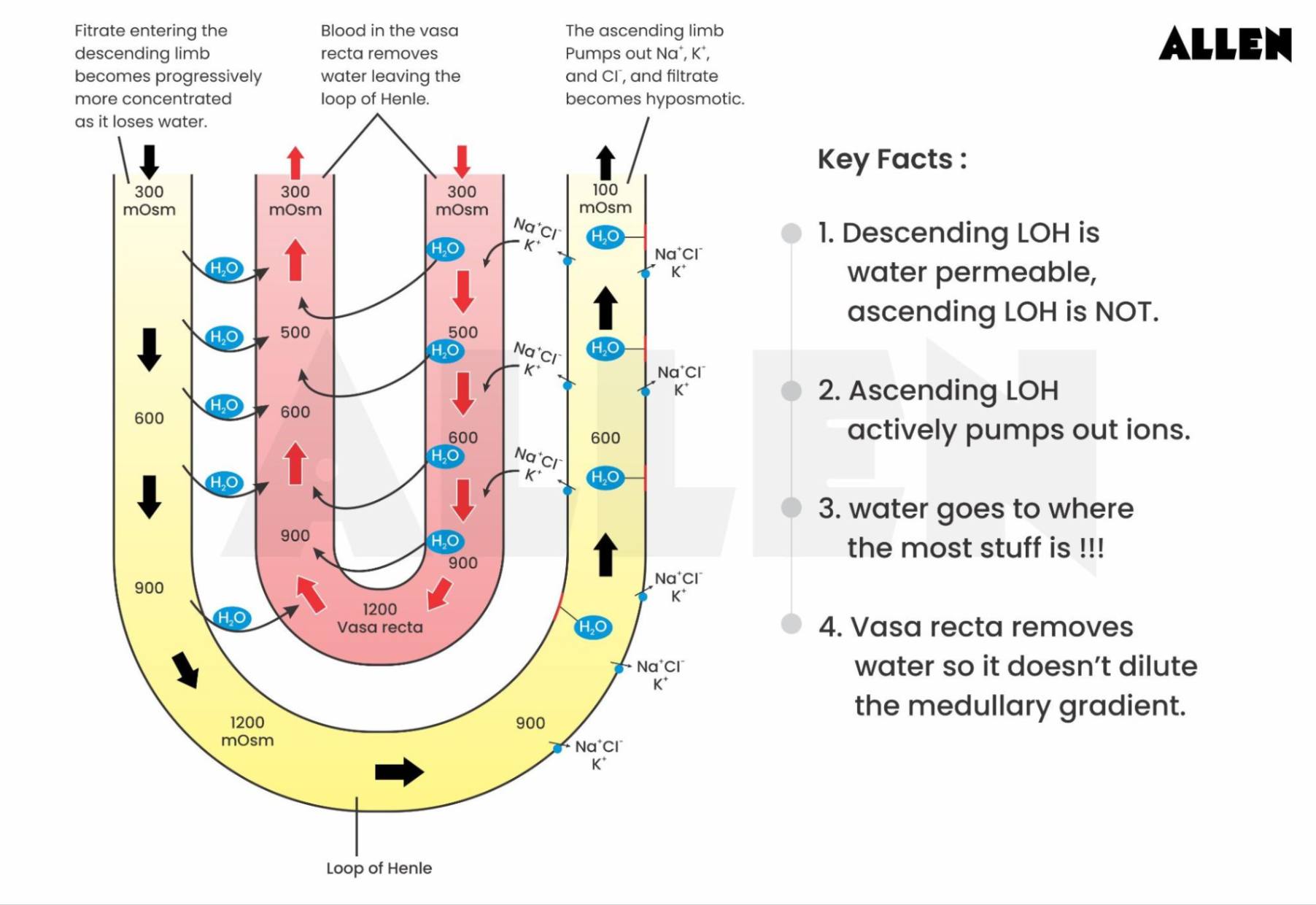
2. The Key Players and Their Properties
The countercurrent multiplier system relies on the distinct and opposing properties of the two limbs of the Loop of Henle.
The Ascending Limb: The Engine
The thick ascending limb (TAL) is the active component of the system. It is the "engine" that drives the entire process. Its key properties are:
- Active Solute Pumping: The cells of the TAL actively transport solutes—specifically Na+, K+, and Cl⁻—from the tubular fluid into the surrounding interstitium. This is primarily accomplished by the Na+-K+-2Cl⁻ cotransporter (NKCC2) on the apical membrane. This process is so powerful that it moves solutes out of the tubule against a concentration gradient.
- Impermeability to Water: Critically, the TAL is impermeable to water. There are no aquaporin channels.
The result: As fluid flows up the ascending limb, salts are pumped out, but water is left behind. This makes the surrounding interstitium salty (hyperosmotic) and the tubular fluid dilute (hyposmotic).
The Descending Limb: The Equilibrator
The thin descending limb has precisely the opposite properties:
- High Permeability to Water: Its cells are studded with Aquaporin-1 (AQP1) channels, making it very permeable to water.
- Impermeability to Solutes: It has very few channels or transporters for Na+ and Cl⁻.
The result: As fluid flows down the descending limb through the now-salty interstitium (created by the ascending limb), water moves passively out of the tubule via osmosis, concentrating the solutes that are left behind. The fluid inside the descending limb equilibrates with the interstitial fluid at each level.
To see these cellular mechanisms in detail, let's turn to a video explanation.
The following video from Ninja Nerd clearly illustrates the distinct transport properties of the ascending and descending limbs that are fundamental to the countercurrent mechanism.
Please watch from 07:40 to 14:40. First, focus on the ascending limb (07:40 - 11:05) and the action of the NKCC2 transporter making the interstitium salty. Then, observe how the descending limb responds (11:05 - 14:40) by losing water into this salty environment.
3. Putting It All Together: The Multiplier Effect
Now we have the two key components: a salt-pumping ascending limb and a water-permeable descending limb. How does the "countercurrent" flow of fluid multiply the small osmotic difference created by the pumps into the large vertical gradient?
Let's build the gradient conceptually in a step-by-step process.
-
The "Single Effect": Imagine the loop is filled with 300 mOsm/L fluid. The ascending limb starts pumping salts out. It creates a horizontal osmotic gradient of 200 mOsm/L between the tubular fluid (which becomes 200) and the interstitium (which becomes 400). The descending limb, being water-permeable, immediately equilibrates with the interstitium and also becomes 400 mOsm/L.
-
Flow: Now, new 300 mOsm/L fluid from the PCT enters the descending limb, pushing the existing column of fluid along. The concentrated 400 mOsm/L fluid at the bottom of the descending limb moves around the hairpin turn into the ascending limb.
-
Multiply: The ascending limb pumps again. But this time, the fluid it's working on is already concentrated at 400 mOsm/L. It pumps out more salt, establishing another 200 mOsm/L gradient. The fluid in the ascending limb becomes 300 mOsm/L, and the interstitium at that level reaches 500 mOsm/L. In response, the fluid in the descending limb at that level equilibrates to 500 mOsm/L.
-
Repeat: With each cycle of flow and pumping, the process repeats. The ascending limb is continually fed more concentrated fluid from the descending limb, allowing it to progressively build a higher and higher concentration in the interstitium at the bottom of the loop.
This iterative process, where the countercurrent flow "multiplies" the single pumping effect, is the essence of the mechanism.
This can be a tricky concept to visualize. The following video provides an excellent animated, step-by-step breakdown of this multiplication process.
Countercurrent Multiplier Mechanism of Urine Concentration in Kidney | Countercurrent Mechanism
This video from Nonstop Neuron provides an outstanding conceptual walkthrough of how the gradient is built up layer by layer. It simplifies the process into discrete steps, making the 'multiplier' effect much easier to grasp.
Watch from 06:18 to 13:15. Follow the step-by-step buildup of the osmotic gradient. The simplified two-compartment model introduced at 09:56 is particularly helpful for understanding the core principle.
Test your understanding!
A powerful new diuretic drug is developed that completely blocks the NKCC2 cotransporter in the thick ascending limb. What effect would this have on the osmolarity of the medullary interstitium?
Show answer
Blocking the NKCC2 cotransporter would shut down the "engine" of the countercurrent multiplier. The thick ascending limb would no longer be able to pump solutes into the interstitium. Without this active salt reabsorption, the medullary interstitium would lose its hyperosmolarity and gradually equilibrate with the plasma, falling to around 300 mOsm/L. The vertical osmotic gradient would be eliminated.
4. Preserving the Gradient: The Vasa Recta as a Countercurrent Exchanger
We've now established how the Loop of Henle builds this impressive osmotic gradient. However, the cells of the medulla still need a blood supply. If blood simply flowed straight down into the medulla and back out, the high blood flow would "wash out" the solutes and destroy the gradient.
The kidney solves this problem with another countercurrent system: the vasa recta. These are long, hairpin-shaped capillaries that run parallel to the Loops of Henle. They function as countercurrent exchangers.
- As blood flows down the descending limb of the vasa recta, it enters the hyperosmotic medulla. Solutes (NaCl and urea) diffuse into the blood, and water moves out.
- As the blood loops around and flows up the ascending limb, it moves into a progressively less salty interstitium. Now the gradients are reversed: solutes diffuse out of the blood and back into the interstitium, while water (including the water reabsorbed from the Loop of Henle) moves into the blood.
The key is that the vasa recta have sluggish blood flow and are freely permeable to both solutes and water. This allows them to passively equilibrate with the surrounding interstitium. Because they pick up solutes on the way down and release them on the way up, they don't carry the solutes away. Their net effect is to remove the reabsorbed water while leaving the precious medullary osmotic gradient intact.
It is critical to distinguish between the two mechanisms:
- Countercurrent Multiplier (Loop of Henle): Uses energy to create the gradient.
- Countercurrent Exchanger (Vasa Recta): Passively maintains the gradient, preventing washout.
The counter-current mechanisms in the kidney
For a clear textual distinction between these two crucial concepts, refer to the following article from 'Deranged Physiology'.
Please read the section titled 'Countercurrent multiplication and countercurrent exchange'. It provides an excellent, concise explanation of why the vasa recta are exchangers, not multipliers, and why they are essential for preserving the gradient.
Conclusion
Today we have unraveled the elegant mechanism of the countercurrent multiplier. We've seen how the opposing properties of the ascending and descending limbs of the Loop of Henle, coupled with the countercurrent flow of tubular fluid, work together to generate a hyperosmotic gradient in the renal medulla.
Key Takeaways:
- The function of the Loop of Henle is to create a medullary osmotic gradient, with osmolarity increasing from 300 mOsm/L in the cortex to ~1200 mOsm/L in the deep medulla.
- The thick ascending limb is the engine. It actively pumps NaCl out but is impermeable to water, diluting the tubular fluid and making the interstitium salty.
- The thin descending limb is the equilibrator. It is impermeable to NaCl but highly permeable to water, which moves out via osmosis, concentrating the tubular fluid.
- The countercurrent flow of fluid through the loop multiplies the small horizontal gradient created by the pumps into a large vertical gradient.
- The vasa recta act as countercurrent exchangers, supplying blood to the medulla and removing reabsorbed water without washing out the osmotic gradient.
Preview of the Next Lesson:
Now that we have successfully built this medullary gradient, what is it for? In our next lesson, we will move to the distal tubule and collecting duct. We will see how these segments, under the control of hormones like Antidiuretic Hormone (ADH), utilize this gradient to perform the kidney's final and most crucial task: regulating the final concentration of urine to maintain the body's water balance.