Hello! Welcome back to our journey through renal physiology.
In our last lesson, we explored the dynamic forces and sophisticated autoregulatory mechanisms that determine the Glomerular Filtration Rate (GFR). We established that GFR is the volume of fluid filtered by your kidneys each minute, a cornerstone of renal function. Now, we'll address the logical next question: How do we actually measure this vital parameter?
Today's lesson will introduce you to the powerful concept of renal clearance. Your learning outcome is to calculate renal clearance and explain its application in estimating GFR and renal plasma flow. We will derive the clearance equation from fundamental principles and then see how, by choosing specific substances, we can use this concept as a brilliant tool to quantify kidney function.
1. The Concept of Renal Clearance
At its core, renal clearance is a way to quantify how effectively the kidneys remove a substance from the blood plasma. The formal definition is a bit abstract but powerful:
Renal Clearance of a substance (X) is the theoretical volume of plasma that is completely "cleared" of that substance per unit of time.
It's not the amount of substance removed, but the volume of plasma that would be left entirely free of that substance. The units are typically milliliters per minute (mL/min).
To understand how this is calculated, we can use a simple conservation principle: the amount of a substance that leaves the blood and appears in the urine must equal the amount that was removed from the plasma.
- Amount excreted per minute = (Urine concentration of X) × (Urine flow rate) =
- Amount cleared from plasma per minute = (Plasma concentration of X) × (Volume of plasma cleared) =
Since these two amounts are equal:
By rearranging this equation, we arrive at the general formula for renal clearance:
Where:
- = Clearance of substance X (mL/min)
- = Urine concentration of X (e.g., mg/mL)
- = Urine flow rate (mL/min)
- = Plasma concentration of X (e.g., mg/mL)
To see this foundational concept and the derivation of the equation explained, please watch the following video.
Renal Clearance: Analysis of Kidney Function, GFR, RPF and the Filtered Load
This first video from Pete Meighan introduces the concept of renal clearance, what it represents, and how the fundamental equation is derived and used.
Watch the segments from 00:00 to 00:51 and from 03:37 to 04:37. The first part defines clearance conceptually, and the second part introduces the clearance equation with a numerical example.
Test your understanding!
A patient's urine is collected over one hour, totaling 60 mL. A lab analysis shows the following:
- Plasma concentration of urea (): 0.2 mg/mL
- Urine concentration of urea (): 15 mg/mL
Calculate the renal clearance of urea.
Show answer
First, convert the urine flow rate to mL/min: .
Now, apply the clearance formula:
The renal clearance of urea is 75 mL/min.
2. Application 1: Using Clearance to Measure GFR
The true power of the clearance concept comes from applying it to substances that the kidney handles in specific ways. The most important application is measuring GFR.
Consider a substance that has these ideal properties:
- It is freely filtered at the glomerulus.
- It is not reabsorbed by the tubules.
- It is not secreted by the tubules.
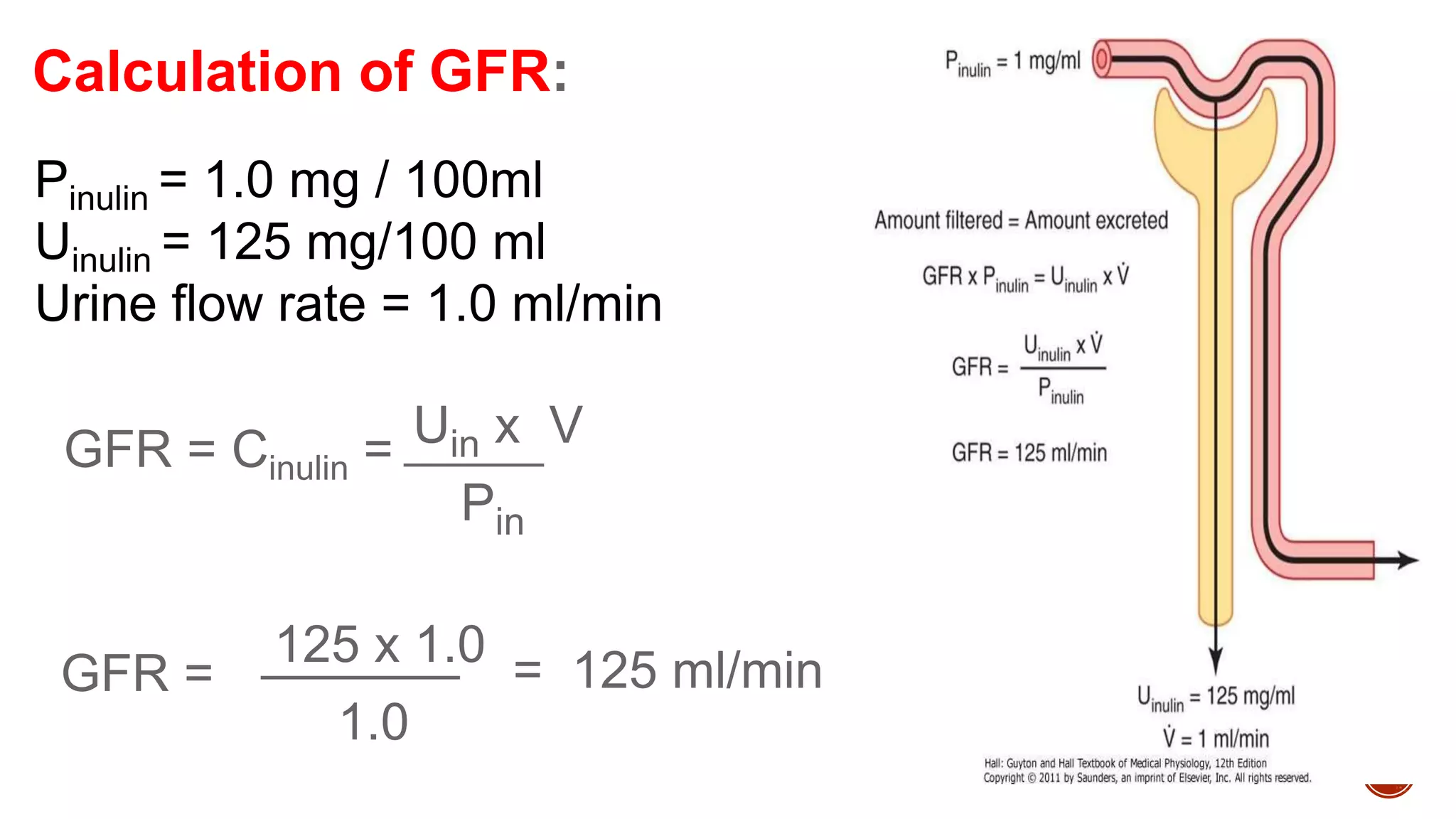
For such a substance, every single molecule that is filtered into Bowman's space will end up in the final urine. Therefore, the rate at which the substance is filtered (Filtered Load) must equal the rate at which it is excreted (Excretion Rate).
Let's formalize this with equations you've seen before:
- Filtered Load =
- Excretion Rate =
Setting them equal:
Now, solve for GFR:
Notice something? The right side of this equation is identical to the formula for renal clearance! This means that for a substance that is only filtered, its clearance is equal to the GFR.
Inulin: The Gold Standard
The classic substance that perfectly fits these criteria is inulin, a plant polysaccharide. By infusing inulin and measuring its plasma and urine concentrations, we can get a precise measurement of GFR.
Creatinine: The Clinical Standard
While inulin is perfect in theory, it is impractical for routine clinical use. Instead, we use creatinine, an endogenous breakdown product of muscle metabolism.
- Advantages: It's already in the body and produced at a relatively constant rate.
- Disadvantage: It is freely filtered but also slightly secreted by the proximal tubule. This means more creatinine ends up in the urine than was filtered. As a result, the clearance of creatinine () slightly overestimates the true GFR (by about 10-20%). For most clinical purposes, this is an accepted approximation.
The following resource provides a rigorous, step-by-step model for understanding how renal handling determines clearance, which should resonate with your preference for theoretical mechanisms.
A Didactic Approach to Renal Clearance
The article 'A Didactic Approach to Renal Clearance' builds the concept of clearance from the ground up. We will focus on the sections that formalize the key terms and then develop the model for a substance that is only filtered.
Please read 'Step 1: Define Filtered Load and Excretion Rate' to solidify these concepts. Then, read 'Step 3: Renal Clearance as the S-free Tubular Reabsorption Rate', which explains why, for a substance like inulin that is not reabsorbed or secreted, the clearance equals the GFR.
3. Application 2: Using Clearance to Estimate Renal Plasma Flow (RPF)
We can apply a similar logic to measure another crucial parameter: Renal Plasma Flow (RPF), the total volume of plasma that flows through the kidneys per minute.
For this, we need a substance with a different set of ideal properties:
- It is freely filtered.
- It is completely secreted from the plasma that continues into the peritubular capillaries.
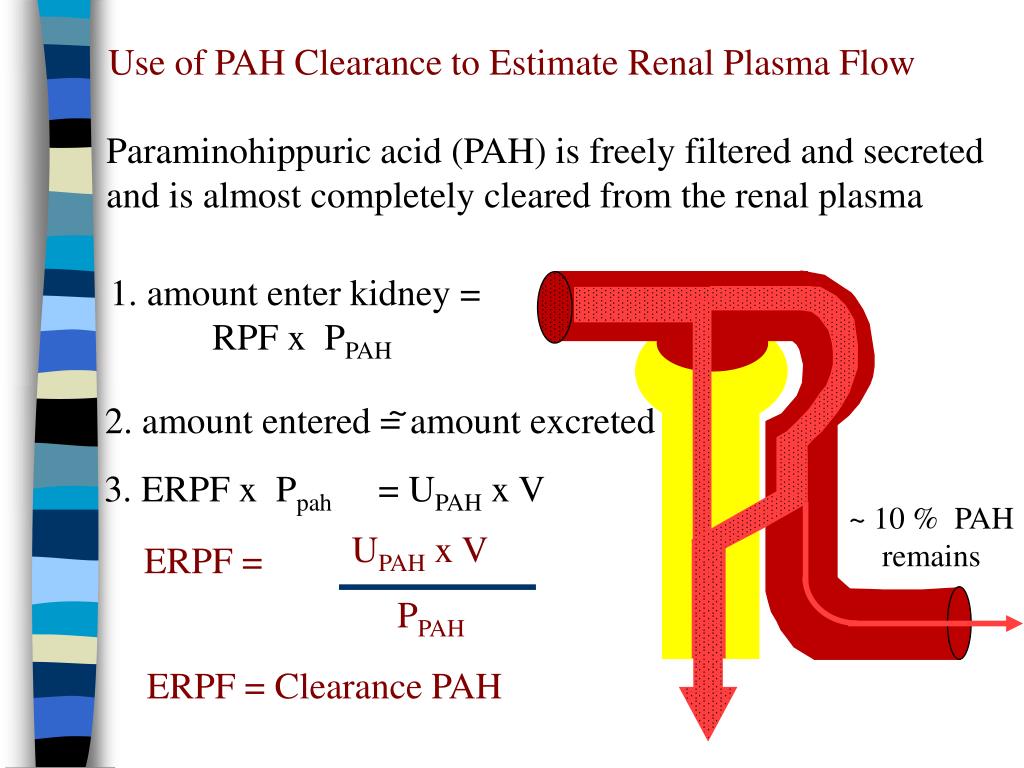
If a substance is handled this way, virtually all of it is removed from the plasma in a single pass through the kidney. Therefore, the rate at which the substance enters the kidney via the renal artery must equal the rate at which it is excreted in the urine.
- Rate of entry into kidney =
- Rate of excretion =
Setting them equal:
And solving for RPF:
For a substance that is completely cleared from the plasma, its clearance is equal to the RPF.
PAH: The Substance for RPF
The substance that approximates these properties is para-aminohippuric acid (PAH). At low plasma concentrations, PAH is so efficiently secreted that about 90% of it is removed from the renal plasma. Because the extraction isn't 100%, PAH clearance technically measures the effective renal plasma flow (eRPF), which is a very close estimate of the true RPF.
This video provides a great summary of how we use these specific substances—inulin for GFR and PAH for RPF—based on how the kidney handles them.
Renal Clearance: Analysis of Kidney Function, GFR, RPF and the Filtered Load
Let's return to the video from Pete Meighan to see a clear explanation of how the principles we've discussed are applied to inulin and PAH.
Watch from 06:45 to 09:58. Focus on how the specific handling of inulin (filtered only) makes its clearance equal to GFR, and how the handling of PAH (filtered and secreted) makes its clearance an estimate of RPF.
From RPF, we can also easily calculate the total Renal Blood Flow (RBF) if we know the hematocrit (the fraction of blood volume occupied by red blood cells):
Conclusion
In this lesson, we demystified the concept of renal clearance and established it as a cornerstone of quantitative physiology. We have seen that it is not just an abstract calculation, but a versatile tool that gives us a window into the kidney's function.
Key Takeaways:
- Renal clearance () is the theoretical volume of plasma completely cleared of a substance per minute.
- The clearance value of a substance depends entirely on how it is handled by the nephron (filtration, reabsorption, secretion).
- If a substance is only filtered (e.g., inulin), its clearance equals the GFR. Creatinine is a practical but less perfect endogenous proxy.
- If a substance is filtered and completely secreted (e.g., PAH), its clearance approximates the RPF.
- This gives us three key relationships:
C_x < GFRimplies net reabsorption of X.C_x = GFRimplies X is filtered only (like inulin).C_x > GFRimplies net secretion of X.
Preview of the Next Lesson:
We have now established how to measure the bulk flow of filtrate (GFR) and how the overall handling of a substance affects its clearance. In the next lesson, we will begin our journey down the nephron itself to examine the specific cellular mechanisms responsible for this handling. We will start with the workhorse of the nephron: the proximal tubule, and explore the mechanisms of solute and water reabsorption that occur there.