Hello! Welcome to your next lesson in respiratory physiology.
In our last session, we explored the fundamental mechanical properties of the respiratory system, establishing that the point of equilibrium between the inward recoil of the lungs and the outward recoil of the chest wall is called the Functional Residual Capacity (FRC). We focused on compliance and elastance as the key determinants of how the system behaves under pressure.
Today, we will build directly upon that foundation. Your learning outcome is to define the standard lung volumes and capacities. We will give a name and a value to the different amounts of air moved during breathing, using FRC as a central reference point. This provides us with the essential vocabulary to quantitatively describe ventilation and forms the basis for understanding both normal respiratory function and the changes that occur in disease.
1. Visualizing the Compartments of Lung Air
Before we dive into formal definitions, it's helpful to have a visual model. The total amount of air your lungs can hold can be divided into distinct, non-overlapping compartments called volumes. When we combine two or more of these volumes, we get a capacity.
Spirometry is the technique used to measure the movement of air during breathing. The resulting graph, a spirogram, provides a classic way to visualize these volumes and capacities.
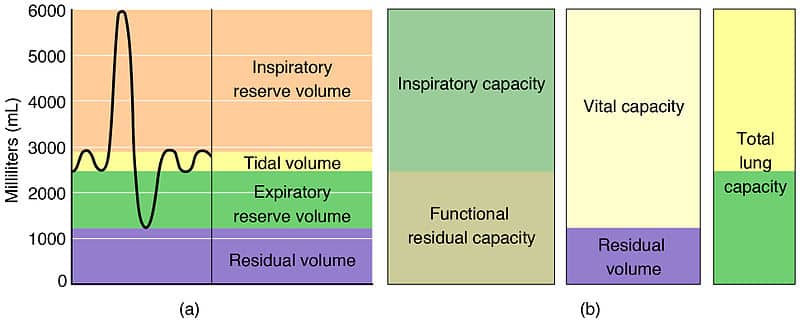
Keep this diagram in mind as we proceed. We will first define the four fundamental volumes, and then see how they combine to form the four capacities.
2. The Four Fundamental Lung Volumes
Lung volumes are the four primary, mutually exclusive divisions of the total lung volume. For the most precise and officially recognized definitions, we will refer to a joint statement by the American Thoracic Society (ATS) and European Respiratory Society (ERS).
The article 'Lung volumes and capacities' on Deranged Physiology provides an excellent summary of this topic, including direct quotes of the official definitions. We will use it to establish a precise understanding of each term.
Please read the section titled 'Static lung volumes and capacities' for the official definitions of the four volumes. Then, read the short individual sections for Tidal Volume, Inspiratory Reserve Volume, Expiratory Reserve Volume, and Residual Volume to understand their physiological context.
Let's summarize these key definitions:
-
Tidal Volume (TV or VT): This is the volume of air inhaled or exhaled during a single, quiet respiratory cycle. It's your normal breath at rest. While often cited as ~500 mL or 7 ml/kg, it is quite variable depending on metabolic need and even the conscious act of being measured.
-
Inspiratory Reserve Volume (IRV): This is the maximum additional volume of air that can be forcibly inhaled after the end of a normal tidal inspiration. This is the "reserve" you tap into when taking a very deep breath.
-
Expiratory Reserve Volume (ERV): This is the maximum additional volume of air that can be forcibly exhaled after the end of a normal tidal expiration. This is the reserve you use to blow out candles on a cake. As you read, this volume is particularly affected by posture, decreasing significantly when a person is lying down.
-
Residual Volume (RV): This is the volume of air that remains in the lungs even after a maximal, forceful exhalation. This air cannot be voluntarily expelled. Its existence is crucial because it prevents the complete collapse of the alveoli at the end of expiration. This volume cannot be measured by simple spirometry.
3. The Four Lung Capacities
Capacities are measurements that are the sum of two or more lung volumes. They describe the functional combinations of the basic volumes.
-
Inspiratory Capacity (IC): This is the maximum volume of air that can be inhaled starting from the end of a normal, quiet expiration. It represents the total inspiratory ability from your resting state.
-
Functional Residual Capacity (FRC): This is the volume of air remaining in the lungs at the end of a normal, quiet expiration. This is a critical concept that links back to our last lesson. The FRC represents the volume at which the respiratory system is at its mechanical equilibrium—where the inward elastic recoil of the lungs is perfectly balanced by the outward elastic recoil of the chest wall.
Because FRC includes RV, it cannot be measured by simple spirometry. -
Vital Capacity (VC): This is the maximum volume of air that can be exhaled after a maximal inhalation. It represents the total "usable" volume of the lungs that can be voluntarily controlled.
You can also think of it as the sum of Inspiratory Capacity and Expiratory Reserve Volume (). -
Total Lung Capacity (TLC): This is the total volume of air in the lungs after a maximal inhalation. It is the sum of all four lung volumes.
Like FRC, TLC includes the Residual Volume and thus cannot be measured by simple spirometry.
To solidify these relationships, let's review a concise table of definitions and the component volumes.
Lung Volumes & Capacities - TeachMe Physiology
The article from TeachMe Physiology provides clear, tabulated summaries of these volumes and capacities.
Review the two tables under the 'Definitions' heading, one for 'Lung Volumes' and one for 'Lung Capacities'. Pay close attention to the 'Expression' column in the capacities table to reinforce which volumes make up each capacity.
Test your understanding!
A person's spirometry test reveals the following:
- Vital Capacity (VC) = 4500 mL
- Tidal Volume (TV) = 500 mL
- Expiratory Reserve Volume (ERV) = 1000 mL
Based on these values, what is this person's Inspiratory Reserve Volume (IRV)?
Show answer
We know that Vital Capacity is the sum of three volumes:
We can rearrange this equation to solve for IRV:
Plugging in the given values:
The person's Inspiratory Reserve Volume is 3000 mL.
4. Normal Values and Measurement
While absolute lung volumes vary widely with age, sex, height, and ethnicity, it's useful to have a general idea of their relative proportions. Using values indexed to body mass (ml/kg) provides a more standardized view.
| Volume/Capacity | Definition | Components | Typical Value (ml/kg) |
|---|---|---|---|
| Volumes | |||
| Tidal Volume (TV) | Air moved in a normal breath | - | ~7 |
| Inspiratory Reserve (IRV) | Max air inhaled beyond normal | - | ~45 |
| Expiratory Reserve (ERV) | Max air exhaled beyond normal | - | ~15 |
| Residual Volume (RV) | Air left after max exhalation | - | ~15 |
| Capacities | |||
| Inspiratory (IC) | Max air inhaled from rest | TV + IRV | ~52 |
| Functional Residual (FRC) | Air left after normal exhalation | ERV + RV | ~30 |
| Vital (VC) | Max air moved in one breath | IRV + TV + ERV | ~67 |
| Total Lung (TLC) | Total air in lungs after max inhalation | IRV + TV + ERV + RV | ~82 |
Note: These values are approximations based on the table in the Deranged Physiology resource (LINK).
As mentioned, any volume or capacity that includes the Residual Volume (RV) cannot be measured by simple spirometry. To measure FRC and TLC, indirect methods are needed, such as helium dilution or body plethysmography. These techniques work by calculating the unknown volume (FRC) based on either the dilution of a known concentration of an inert gas (helium) or by applying Boyle's Law in a sealed chamber (plethysmography).
Conclusion
Today we have systematically defined the language of ventilation. We have broken down the total volume of the lungs into four fundamental volumes and four composite capacities.
Key Takeaways:
- The four lung volumes are Tidal Volume (TV), Inspiratory Reserve Volume (IRV), Expiratory Reserve Volume (ERV), and Residual Volume (RV). They are distinct and do not overlap.
- The four lung capacities are combinations of volumes: Inspiratory Capacity (IC), Functional Residual Capacity (FRC), Vital Capacity (VC), and Total Lung Capacity (TLC).
- FRC is a crucial physiological landmark, representing the lung volume at the end of quiet expiration where the respiratory system is at mechanical equilibrium.
- Any volume or capacity that includes the Residual Volume (i.e., RV, FRC, TLC) cannot be measured by simple spirometry and requires other techniques.
Preview of the Next Lesson:
Now that we have a firm grasp of the volumes of air we move, the next logical step is to analyze the composition of that air within the functional units of the lung. In our next lesson, we will learn how to apply the alveolar gas equation to determine alveolar oxygen tension. This will be our first step in moving from the mechanics of ventilation to the physiology of gas exchange.