Hello! Welcome to your next lesson on respiratory physiology.
In our last session, we explored how hemoglobin transports oxygen and how its affinity for O₂ is modulated by local tissue conditions. A key takeaway was the Bohr effect, where increased CO₂ and H⁺ in active tissues cause hemoglobin to release oxygen more readily. Today, we turn our attention to the other side of that equation: how that same CO₂ is transported from the tissues back to the lungs to be exhaled.
Your learning outcome for this lesson is to explain the primary mechanisms of carbon dioxide transport in the blood, including the role of carbonic anhydrase. We will see that this process is elegantly integrated with oxygen transport and is fundamental to maintaining the body's acid-base balance.
1. The Journey of Carbon Dioxide: From Cell to Blood
As a primary waste product of aerobic metabolism, carbon dioxide is constantly produced within your body's cells. This production raises the partial pressure of CO₂ (PCO₂) inside the cells to approximately 46 mmHg. In contrast, the arterial blood arriving at the tissues has a PCO₂ of about 40 mmHg. This pressure gradient is the driving force that causes CO₂ to diffuse out of the cells, through the interstitial fluid, and into the blood within the systemic capillaries.
Once in the blood, CO₂ is transported to the lungs in three distinct forms. We will explore each of these in detail.
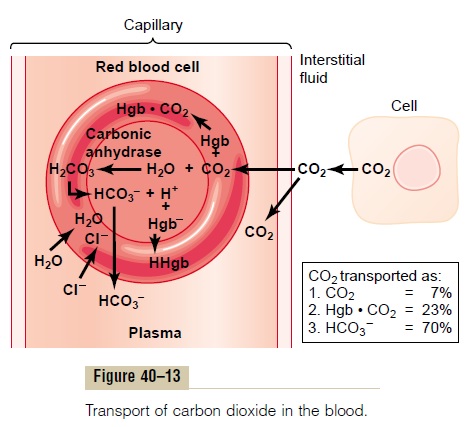
2. The Three Forms of CO₂ Transport
While some CO₂ travels simply dissolved in the blood, the majority is converted into other chemical forms for more efficient transport. The approximate distribution, as shown in the diagram above, is:
- Dissolved CO₂ (~7%)
- Carbaminohemoglobin (~23%)
- Bicarbonate ions (HCO₃⁻) (~70%)
Let's examine the mechanism for each.
A. Dissolved CO₂ (~7%)
Carbon dioxide is about 20 times more soluble in plasma than oxygen. However, due to the large volumes of CO₂ produced by the body, this dissolved fraction still only accounts for a small portion of the total CO₂ transported. Similar to oxygen, it is the PCO₂ of this dissolved gas that creates the partial pressure gradient for diffusion between the blood and the alveoli.
B. Carbaminohemoglobin (~23%)
About a quarter of the CO₂ binds directly to hemoglobin. This binding occurs on the terminal amine groups of the globin protein chains, not on the heme iron where oxygen binds. Therefore, CO₂ and O₂ do not compete for the same binding site. The compound formed is called carbaminohemoglobin.
An important feature of this interaction is that deoxygenated hemoglobin (hemoglobin that has released its O₂) has a higher affinity for CO₂ than oxygenated hemoglobin. This phenomenon contributes to the Haldane effect, which we will discuss further. This means that in the tissues, where O₂ is being released, hemoglobin readily picks up CO₂. Conversely, in the lungs, where hemoglobin becomes saturated with O₂, it readily releases CO₂.
C. Bicarbonate Ions (HCO₃⁻) (~70%)
The vast majority of carbon dioxide is transported in the blood as bicarbonate ions. This chemical conversion is the most complex but also the most crucial mechanism, and it relies heavily on the environment inside the red blood cell (RBC).
Gas Transport – Pulmonary Physiology for Pre-Clinical ...
To understand this primary transport mechanism, let's read a detailed breakdown of the steps involved. This text explains the critical role of carbonic anhydrase and the subsequent ion exchange.
Please read the section titled 'Transport as Bicarbonate (About 70 Percent)'. Pay close attention to the sequence of events: the reaction catalyzed by carbonic anhydrase, the dissociation of carbonic acid, the buffering of H+ by hemoglobin, and the chloride shift.
Let's consolidate the key steps of bicarbonate formation that occur within the red blood cell:
-
Hydration of CO₂: CO₂ diffuses from the plasma into the RBC. Inside, it combines with water ().
-
Carbonic Anhydrase Action: This hydration reaction () is very slow in plasma but is accelerated thousands of times inside the RBC by the enzyme carbonic anhydrase. This is the key to forming large quantities of bicarbonate rapidly.
-
Dissociation: The product, carbonic acid (), is unstable and immediately dissociates into a hydrogen ion () and a bicarbonate ion ().
-
Handling the Products:
- Hydrogen Ions (H⁺): The liberated ions are potent acids. To prevent a drastic drop in intracellular pH, they are buffered by binding to hemoglobin molecules. This binding of to hemoglobin is precisely the mechanism of the Bohr effect we discussed in the last lesson—it stabilizes the T-state of hemoglobin, reducing its affinity for O₂ and promoting oxygen delivery to the tissues.
- Bicarbonate Ions (HCO₃⁻): As accumulates inside the RBC, it is transported out into the plasma in exchange for a chloride ion () via a protein called the bicarbonate-chloride exchanger (or Band 3 protein). This one-for-one exchange, known as the chloride shift or Hamburger effect, maintains electrical neutrality within the RBC.
As a result, venous blood not only carries more CO₂ (as in the plasma) but also has a higher plasma chloride concentration inside its red blood cells compared to arterial blood.
Test your understanding!
Imagine a drug that selectively inhibits only the carbonic anhydrase enzyme within red blood cells. How would this affect the blood's capacity to transport CO₂? What would be the primary form of CO₂ transport remaining?
Show answer
Inhibiting carbonic anhydrase would dramatically reduce the blood's capacity to transport CO₂. The conversion of CO₂ to bicarbonate would slow to a crawl, as this reaction is uncatalyzed in plasma. The bicarbonate pathway, which accounts for ~70% of transport, would be largely disabled. The primary forms of transport remaining would be dissolved CO₂ (~7%) and CO₂ bound to hemoglobin as carbaminohemoglobin (~23%). This is the mechanism of action for diuretic drugs like acetazolamide.
3. Release of CO₂ in the Lungs
When venous blood reaches the pulmonary capillaries, the entire process reverses. The PCO₂ in the alveolar air is low (~40 mmHg), while in the arriving venous blood it is higher (~46 mmHg). This gradient drives the diffusion of CO₂ from the blood into the alveoli.
According to Le Châtelier's principle, as dissolved CO₂ leaves the plasma, the chemical equilibria shift to replenish it:
- Chloride Shift Reverses: moves from the plasma back into the RBCs in exchange for .
- Reforming CO₂: Inside the RBC, combines with (which is released from hemoglobin as it binds O₂) to form . Carbonic anhydrase then rapidly converts the back into and .
- Unloading from Hemoglobin: The high PO₂ in the lungs causes oxygen to bind to hemoglobin. This oxygenation of hemoglobin decreases its affinity for CO₂, causing the release of CO₂ from carbaminohemoglobin.
- Diffusion into Alveoli: The newly generated CO₂ increases the PCO₂ within the RBC and plasma, driving its diffusion into the alveoli, from where it is exhaled.
This entire process is enhanced by the Haldane effect: oxygenated blood has a reduced capacity to carry CO₂. As hemoglobin loads oxygen in the lungs, it releases both H⁺ and CO₂, promoting the formation and subsequent exhalation of CO₂.
Conclusion
Today, we've unraveled the elegant and efficient system for transporting carbon dioxide, the body's main metabolic waste product. This system is not just about waste removal; it's intricately linked with oxygen delivery and acid-base homeostasis.
Key Takeaways:
- CO₂ is transported in the blood in three forms: dissolved gas (~7%), bound to hemoglobin as carbaminohemoglobin (~23%), and as bicarbonate ions (~70%).
- The conversion of CO₂ to bicarbonate is the dominant mechanism. It occurs primarily inside red blood cells, where the enzyme carbonic anhydrase dramatically accelerates the reaction.
- The chloride shift allows the large amounts of bicarbonate produced in RBCs to be transported in the plasma while maintaining electrical neutrality.
- The processes of CO₂ loading in the tissues and unloading in the lungs are reciprocally linked to O₂ transport through the Bohr and Haldane effects, ensuring efficient gas exchange that matches metabolic needs.
Preview of the Next Lesson:
We've now seen how O₂ and CO₂ are transported. But what controls the rate and depth of breathing that governs this exchange? The levels of CO₂ and H⁺ we discussed today are, in fact, the most powerful chemical signals that drive our respiratory system. In the first lesson of our next module, we will begin to explore this by describing the neural control of breathing by respiratory centers in the brainstem.