Hello! Welcome back to your study of endocrine physiology.
In our last lesson, we examined the thyroid gland, focusing on how its hormones act as the body's primary long-term regulators of metabolic rate. Today, we shift from long-term metabolic control to the crucial, minute-to-minute regulation of energy availability in the blood. Our objective is to describe the regulation of blood glucose by insulin and glucagon. We will explore the opposing but complementary roles of these two pancreatic hormones in maintaining energy homeostasis, a topic fundamental to all of physiological function.
The Central Role of Glucose and the Endocrine Pancreas
Glucose is the primary energy currency for most cells in the body, and it is the only significant fuel the brain can use under normal conditions. Consequently, its concentration in the blood must be tightly maintained within a narrow range (approximately 4-5 mmol/L or 70-110 mg/dL). Deviations in either direction have serious consequences. The master regulator of this balance is the endocrine pancreas.
To begin, let's establish the fundamental importance of glucose and introduce the key hormonal players from the pancreas.
Glucose Regulation – Human Physiology
This text from a human physiology open textbook provides a solid foundation, outlining why glucose is so critical and introducing the specific cells in the pancreas that regulate it.
Please read the sections titled 'Glucose Storage, Usage and Regulation' and 'Endocrine Pancreas'. Focus on: The normal physiological range of blood glucose. The roles of the liver, muscle, and adipose tissue in glucose storage. The specific cell types in the Islets of Langerhans—alpha (α) and beta (β) cells—and the hormones they produce.
As you've just read, the Islets of Langerhans are small clusters of endocrine cells within the pancreas. For our purposes, the two most important are:
- Beta (β) cells, which produce insulin.
- Alpha (α) cells, which produce glucagon.
These two hormones are antagonists; their coordinated secretion is what maintains blood glucose homeostasis. Let's examine each one's role, starting with insulin.
Insulin: The Hormone of Energy Storage (Anabolic)
Insulin is the dominant hormone in the absorptive state (the period after a meal when nutrients are being absorbed). Its primary function is to direct the body to use and store the incoming energy, thereby lowering blood glucose levels.
Insulin Secretion Mechanism
The primary stimulus for insulin secretion is a rise in blood glucose concentration. The pancreatic beta cell is exquisitely sensitive to this change, responding with a precise, multi-step process.

Let's walk through this crucial mechanism:
- Glucose Entry: Glucose from the blood enters the beta cell via the GLUT-2 transporter. This transporter does not depend on insulin and allows glucose entry proportional to its concentration in the blood.
- Metabolism and ATP Production: Inside the cell, glucose is metabolized through glycolysis and the Krebs cycle, leading to the production of ATP. The intracellular ATP/ADP ratio increases.
- Channel Closure: This high ATP level causes ATP-sensitive K+ channels on the cell membrane to close.
- Depolarization: The closure of K+ channels reduces the outward flow of positive charge (K+ ions), causing the cell membrane to depolarize.
- Calcium Influx: The depolarization opens voltage-gated Ca2+ channels, leading to an influx of Ca2+ into the cell.
- Exocytosis: The sharp rise in intracellular Ca2+ triggers the fusion of vesicles containing pre-synthesized insulin with the cell membrane, releasing insulin into the bloodstream via exocytosis.
Actions of Insulin
Once secreted, insulin circulates and acts on its main target tissues: liver, skeletal muscle, and adipose tissue. Its overall effect is anabolic, meaning it promotes the synthesis of large molecules for storage.
Glucose Regulation – Human Physiology
Now that we've covered the secretion mechanism, let's explore the widespread effects of insulin during the absorptive, or 'fed,' state. This reading details the other factors that regulate insulin release and how insulin directs your body to use and store incoming nutrients.
Please read 'Regulatory Inputs That Control Insulin Release' and 'Function of Insulin'. Pay close attention to how insulin affects these three key tissues: Adipose tissue and skeletal muscle: Note the role of the GLUT4 transporter. Liver: Understand how insulin promotes both glucose utilization and storage (glycogenesis).
To summarize insulin's key actions:
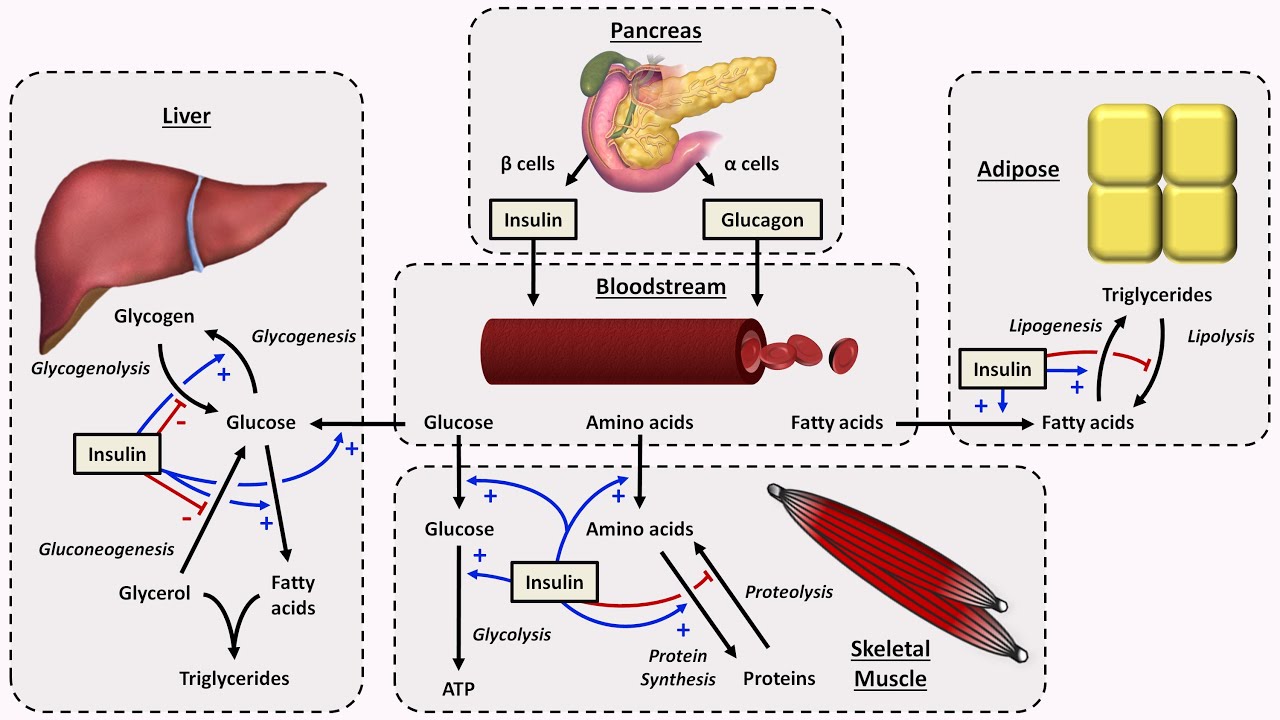
- In Skeletal Muscle and Adipose Tissue: Insulin stimulates the translocation of GLUT-4 transporters to the cell membrane. This dramatically increases glucose uptake from the blood.
- In the Liver: Insulin promotes glucose uptake and "trapping" by activating the enzyme glucokinase. It then stimulates:
- Glycogenesis: Synthesis of glycogen for storage.
- Glycolysis: Breakdown of glucose for energy.
- It simultaneously inhibits glucose production by suppressing glycogenolysis and gluconeogenesis.
- In Adipose Tissue: Insulin promotes the conversion of excess glucose into fatty acids and their storage as triglycerides (lipogenesis).
- General Effect: Insulin also promotes the uptake of amino acids into cells and stimulates protein synthesis.
Glucagon: The Hormone of Energy Release (Catabolic)
Glucagon is the dominant hormone in the post-absorptive state (the fasting state, e.g., overnight or between meals). Its primary function is to mobilize stored energy to raise blood glucose levels, ensuring the brain has a constant supply.
Glucagon Secretion and Actions
The primary stimulus for glucagon secretion from pancreatic alpha cells is a decrease in blood glucose (hypoglycemia). Glucagon's actions are essentially the mirror opposite of insulin's and are primarily directed at the liver.
Glucose Regulation – Human Physiology
Let's now turn to insulin's counterpart. This reading covers the regulation of glucagon and its crucial role in mobilizing stored glucose during the 'fasting' state.
Please read 'Regulation of Glucagon Release' and 'Function of Glucagon'. Focus on how glucagon's actions in the liver and adipose tissue serve to increase blood glucose levels.
To summarize glucagon's key actions:
- In the Liver (Main Target): Glucagon is powerfully catabolic. It stimulates:
- Glycogenolysis: The breakdown of stored glycogen into glucose, which is then released into the blood.
- Gluconeogenesis: The synthesis of new glucose from non-carbohydrate precursors, such as amino acids (from muscle) and glycerol (from fat).
- In Adipose Tissue: Glucagon stimulates lipolysis, the breakdown of triglycerides into free fatty acids and glycerol. The fatty acids can be used by many tissues for energy, and the glycerol is sent to the liver to be used for gluconeogenesis.
Test your understanding!
After a large, protein-rich meal (with very few carbohydrates), blood levels of amino acids rise significantly. Interestingly, these amino acids stimulate the secretion of both insulin and glucagon. From a theoretical standpoint, why is the secretion of glucagon in this context physiologically important?
Show answer
Insulin secretion is necessary to promote the uptake of the absorbed amino acids into muscle for protein synthesis. However, if only insulin were released, its powerful glucose-lowering effect (promoting glucose uptake by muscle and fat) could cause hypoglycemia, as there was little carbohydrate in the meal to replenish blood glucose. The simultaneous release of glucagon counteracts this. Glucagon stimulates the liver to produce glucose via gluconeogenesis (using the absorbed amino acids as a substrate), thus preventing the hypoglycemia that insulin would otherwise cause. This elegant dual-response maintains glucose homeostasis.
Integrated Control of Glucose Homeostasis
Insulin and glucagon do not function as simple on/off switches. Rather, it is the ratio of insulin to glucagon that directs the overall metabolic state of the body.
- After a meal (high blood glucose): The insulin/glucagon ratio is high. Metabolism is anabolic (storage).
- During fasting (low blood glucose): The insulin/glucagon ratio is low. Metabolism is catabolic (mobilization).
The following diagram provides an excellent summary of this integrated system, showing how insulin and glucagon direct metabolic traffic in the body's key tissues.
Conclusion
Today, we've dissected the elegant push-pull system that maintains blood glucose, one of the body's most critical regulated variables. We saw how the pancreatic beta and alpha cells act as sophisticated sensors, releasing insulin and glucagon to direct the body's metabolic engine between states of energy storage and energy release.
Key Takeaways:
- Blood glucose is tightly regulated by the antagonistic hormones insulin and glucagon, secreted by the pancreas.
- Insulin, released from beta cells in response to high blood glucose, is an anabolic hormone. It promotes glucose uptake (via GLUT-4 in muscle/fat), utilization, and storage as glycogen (in liver/muscle) and fat.
- Glucagon, released from alpha cells in response to low blood glucose, is a catabolic hormone. It acts primarily on the liver to stimulate glycogenolysis and gluconeogenesis, releasing glucose into the blood.
- The insulin-to-glucagon ratio determines the body's overall metabolic state, shifting between an absorptive (storage) phase and a post-absorptive (mobilization) phase.
Preview of the Next Lesson:
Having explored the regulation of the body's primary energy substrate, we will next turn our attention to the regulation of key minerals. In the upcoming lesson, we will examine how a different set of hormones—parathyroid hormone, vitamin D, and calcitonin—work together to maintain calcium and phosphate homeostasis, which is vital for everything from neuronal function to bone structure.