Hello! Welcome back to our final lesson in the endocrine module.
In our previous session, we examined the Hypothalamic-Pituitary-Adrenal (HPA) axis. We saw how a hierarchical chain of command, regulated by negative feedback, controls the secretion of cortisol. Today, we'll apply these same principles—hypothalamic control, pituitary stimulation, and negative feedback—to the reproductive system.
This lesson will address the learning outcome: Describe the regulation of the hypothalamic-pituitary-gonadal axis in males (testosterone). We will dissect the hormonal cascade that governs testosterone production and spermatogenesis, and then explore the sophisticated feedback mechanisms that maintain hormonal balance.
The Hypothalamic-Pituitary-Gonadal (HPG) Axis: An Overview
Just like the HPA axis, the male HPG axis is a three-tiered system.
- Hypothalamus: Secretes Gonadotropin-Releasing Hormone (GnRH).
- Anterior Pituitary: Responds to GnRH by secreting two gonadotropins: Luteinizing Hormone (LH) and Follicle-Stimulating Hormone (FSH).
- Gonads (Testes): Respond to LH and FSH to produce testosterone and support sperm production.
Let's start with a clear, foundational overview of this pathway and its key hormonal interactions.
Normal and Disordered Feedback Loops - Male
This short text from the University of Cincinnati provides a concise summary of the male HPG axis. It will quickly introduce you to all the key players and their primary roles.
Please read the entire text. As you read, focus on creating a simple mental map of the axis: What does GnRH do? What are the distinct roles of LH and FSH at the testes? What are the two key products from the testes that create negative feedback?
Now that you have a general outline, let's visualize it and solidify the roles of the key cells in the testes.

Based on the reading and the diagram, we can establish the primary stimulatory pathway:
- Pulsatile GnRH Secretion: The hypothalamus releases GnRH in distinct pulses. This pulsatility is fundamental for maintaining the pituitary's responsiveness. Continuous, non-pulsatile GnRH would paradoxically lead to the shutdown of the axis by downregulating GnRH receptors on the pituitary.
- Pituitary Gonadotropins: GnRH stimulates gonadotroph cells in the anterior pituitary to release LH and FSH.
- Testicular Function:
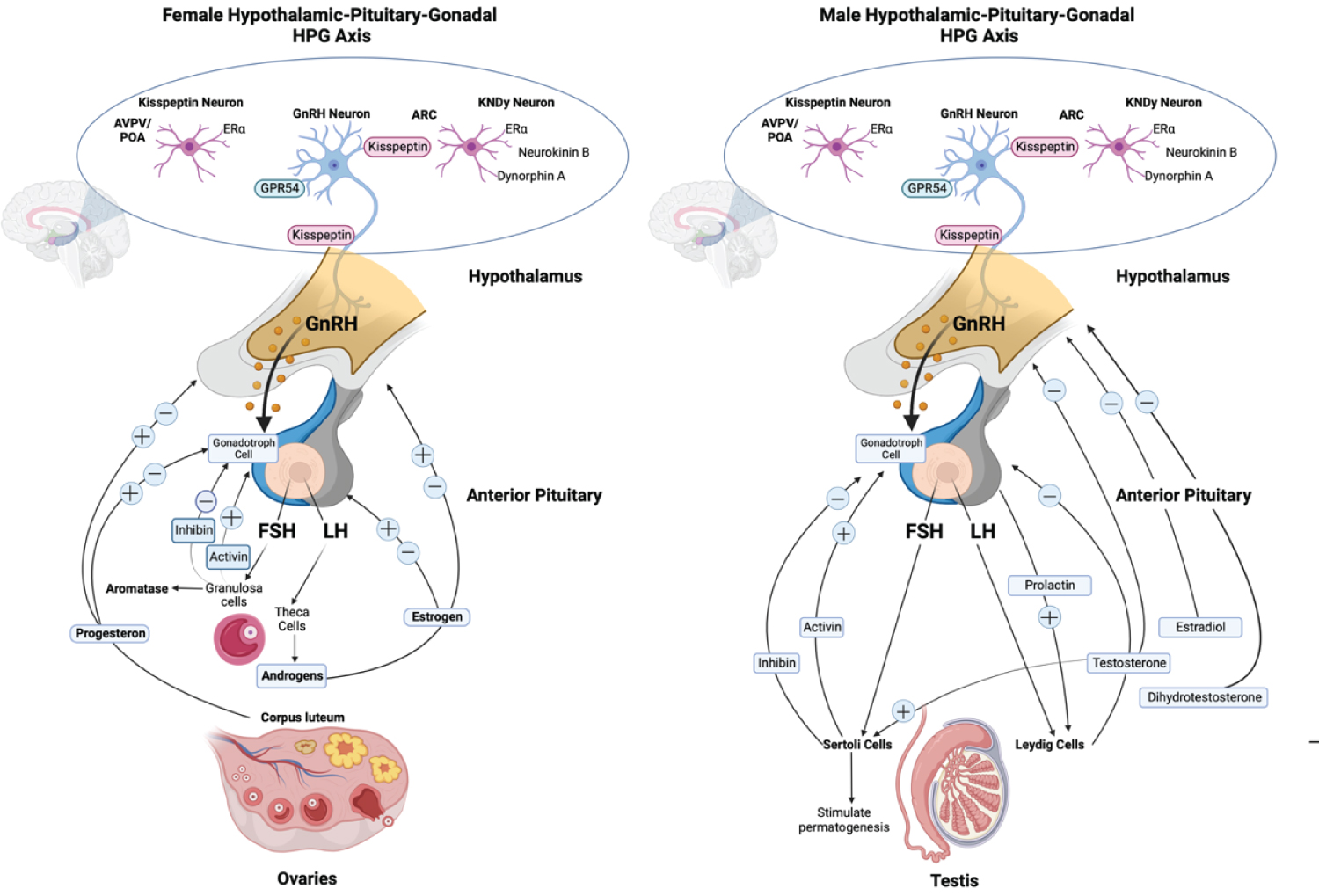
- LH acts on Leydig cells, which are located in the interstitial tissue between the seminiferous tubules. Its primary function is to stimulate the synthesis and secretion of testosterone.
- FSH acts on Sertoli cells, which are located within the seminiferous tubules and are essential for spermatogenesis. FSH stimulates Sertoli cells to support sperm development and to secrete inhibin and androgen-binding protein (ABP). ABP is crucial as it binds to testosterone, keeping its concentration high within the tubules where it is needed for sperm maturation.
Negative Feedback: The Self-Regulating Loops
To maintain stable hormone levels and reproductive function, the HPG axis relies on two critical negative feedback loops.
-
Testosterone Feedback: Testosterone is the primary regulator. It circulates in the blood and acts on both the hypothalamus and the anterior pituitary to suppress gonadotropin secretion.
- At the Hypothalamus: Testosterone slows the frequency of GnRH pulses.
- At the Pituitary: It reduces the sensitivity of gonadotroph cells to GnRH, leading to decreased secretion of both LH and FSH, with a more pronounced effect on LH.
-
Inhibin Feedback: Inhibin, produced by the Sertoli cells in response to FSH, provides a more specific feedback loop. It acts directly on the anterior pituitary to selectively inhibit the secretion of FSH, with little effect on LH. This allows the body to regulate spermatogenesis (via FSH) somewhat independently of testosterone production (via LH).
Test your understanding!
A male athlete uses anabolic steroids, which are synthetic analogs of testosterone.
- What would happen to his endogenous levels of GnRH, LH, and FSH?
- What effect would this have on his natural testosterone production and on the size of his testes?
Show answer
- The high levels of exogenous anabolic steroids would mimic high levels of natural testosterone, creating powerful negative feedback. This would severely suppress the secretion of GnRH from the hypothalamus and, consequently, LH and FSH from the pituitary.
- With suppressed LH, the Leydig cells would not be stimulated, leading to a shutdown of the body's own testosterone production. The lack of both LH and FSH stimulation would cause the testes to atrophy (shrink) due to the loss of both Leydig cell and Sertoli cell support.
The Upstream Controller: Kisspeptin and the GnRH Pulse Generator
A key question that puzzled physiologists for years was how testosterone could inhibit GnRH neurons when these neurons have very few androgen receptors. The discovery of kisspeptin provided the answer.
Kisspeptin is a neuropeptide produced by a group of neurons in the hypothalamus, now understood to be the master controller of GnRH release. These neurons integrate various signals—including negative feedback from sex steroids—and translate them into the pulsatile release of GnRH.
Physiology of GnRH and Gonadotrophin Secretion - NCBI
To understand the modern view of HPG axis regulation, we need to explore the neuroendocrine mechanisms that control GnRH. This chapter from the NCBI Bookshelf provides a detailed explanation of the pivotal role of GnRH pulsatility and the kisspeptin system.
This reading is broken into three parts. Please read the following subsections: 'GnRH Secretion and Pulsatility': Focus on why a pulsatile pattern of GnRH is essential for gonadotropin secretion. 'Discovery of KNDy Neuronal Network': Understand that kisspeptin, neurokinin B, and dynorphin are co-localized in what are called KNDy neurons, and that this network is the critical intermediary for steroid feedback. 'Testosterone Feedback': This is the most important section. Note how it explicitly states that KNDy neurons, not GnRH neurons, express androgen receptors and thus mediate testosterone's negative feedback. Take your time with this material, as it represents the deep theoretical mechanism you are interested in.
This reading brings us to the cutting edge of reproductive physiology. Let's synthesize this complex but elegant system.
- The KNDy Network: In the arcuate nucleus of the hypothalamus, a population of neurons co-expresses Kisspeptin, Neurokinin B (NKB), and Dynorphin. They are known as KNDy neurons.
- Pulse Generation: These neurons form a network that acts as the "GnRH pulse generator."
- NKB acts on the KNDy neurons themselves to stimulate kisspeptin release (an accelerator).
- Dynorphin, an opioid peptide, acts to inhibit the KNDy neurons (a brake).
- The interplay between NKB and Dynorphin creates a rhythmic, pulsatile release of kisspeptin.
- Kisspeptin's Action: Kisspeptin is the most potent known stimulator of GnRH neurons. The pulses of kisspeptin drive the pulses of GnRH, which in turn drive the pulses of LH and FSH.
- Mediating Negative Feedback: Crucially, the KNDy neurons possess androgen receptors. Testosterone exerts its negative feedback by inhibiting these KNDy neurons. This reduces kisspeptin stimulation of GnRH neurons, slowing the GnRH pulse frequency and thereby suppressing the entire axis. This elegant mechanism explains how testosterone controls GnRH release without acting on GnRH neurons directly.
Integration with Other Body Systems
Like the HPA axis, the HPG axis does not operate in isolation. Its function is modulated by other physiological states. The KNDy neurons are a key hub for integrating these signals.
- Stress: The HPA axis inhibits the HPG axis. High levels of glucocorticoids (cortisol) can suppress the axis at the level of the hypothalamus (inhibiting KNDy/GnRH neurons), pituitary, and testes. This is a key reason why chronic physical or psychological stress can impair reproductive function.
- Metabolism: Energy balance is crucial for reproduction. Hormones like leptin (from fat cells) provide a permissive signal to KNDy neurons, indicating that the body has sufficient energy reserves to support reproduction. In states of starvation or negative energy balance, low leptin levels can contribute to shutting down the HPG axis.
- Prolactin: High levels of prolactin (hyperprolactinemia) are a well-known inhibitor of the HPG axis, primarily by suppressing GnRH secretion, likely through actions involving the kisspeptin system.
Conclusion
In this lesson, we have described the complete regulatory framework of the male hypothalamic-pituitary-gonadal axis. We started with the foundational three-tiered hormonal cascade and then layered on the modern understanding of its neuroendocrine control by the kisspeptin system.
Key Takeaways:
- The male HPG axis follows the sequence: GnRH (hypothalamus) → LH/FSH (pituitary) → Testosterone/Inhibin (testes).
- LH stimulates Leydig cells to produce testosterone, while FSH stimulates Sertoli cells to support spermatogenesis and produce inhibin.
- The axis is controlled by two negative feedback loops: testosterone inhibits the hypothalamus and pituitary (suppressing LH > FSH), while inhibin selectively inhibits the pituitary's release of FSH.
- The pulsatile release of GnRH is driven by the KNDy neuronal network, which acts as the master pulse generator.
- Testosterone's negative feedback is primarily mediated through the inhibition of these KNDy/kisspeptin neurons, which possess androgen receptors.
Preview of the Next Lesson:
We will conclude our study of the endocrine system by examining the female reproductive axis. While it involves the same hormones (GnRH, LH, FSH), you will see how the system is adapted to produce a monthly cycle. The next lesson will be: Explain the hormonal changes during the follicular, ovulatory, and luteal phases of the female menstrual cycle. We will explore how the HPG axis in females incorporates not only negative feedback but also a crucial positive feedback loop to trigger ovulation.