Hello! Welcome back to our module on Endocrine Physiology and Regulation.
In our last lesson, we established the fundamental differences between peptide and steroid hormones, focusing on their synthesis, transport, and mechanisms of action. This foundation is crucial because it explains how hormones work. Today, we shift our focus to how their levels are controlled. The endocrine system doesn't just release hormones; it does so with exquisite precision to maintain physiological balance, or homeostasis.
The learning outcome for this lesson is to explain the principle of negative feedback in the regulation of hypothalamic-pituitary hormone axes. We will explore the "chain of command" that runs from the brain to peripheral glands and the elegant feedback systems that keep this entire network in check. This is one of the most important organizational principles in all of physiology.
The Hypothalamic-Pituitary Axis: The Master Control System
Many of the body's most critical hormones are not released in isolation but are part of a three-level hierarchical system known as an axis. This structure provides multiple points of regulation, allowing for very fine control.
The general structure is as follows:
- Hypothalamus: A region of the brain that releases a releasing hormone (or inhibiting hormone).
- Anterior Pituitary Gland: This gland responds to the hypothalamic hormone by releasing a tropic hormone (also called a stimulating hormone).
- Peripheral Endocrine Gland: This gland (e.g., the adrenal gland, thyroid gland, or gonads) responds to the pituitary's tropic hormone by releasing the final hormone, which then travels throughout the body to produce its physiological effects.
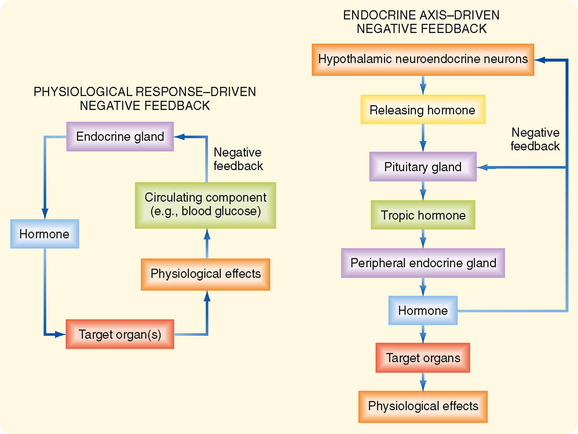
This hierarchical structure sets the stage for the main regulatory principle: negative feedback.
The Principle of Negative Feedback
Think of a thermostat in your home. When the temperature rises above a set point, the air conditioner turns on. When the temperature drops back to the set point, the thermostat signals the air conditioner to turn off. Negative feedback in the endocrine system works in precisely the same way: the final product of a pathway inhibits the earlier steps of the pathway. It is a self-regulating, stabilizing mechanism.
In the context of a hypothalamic-pituitary axis, this feedback can occur at different levels.
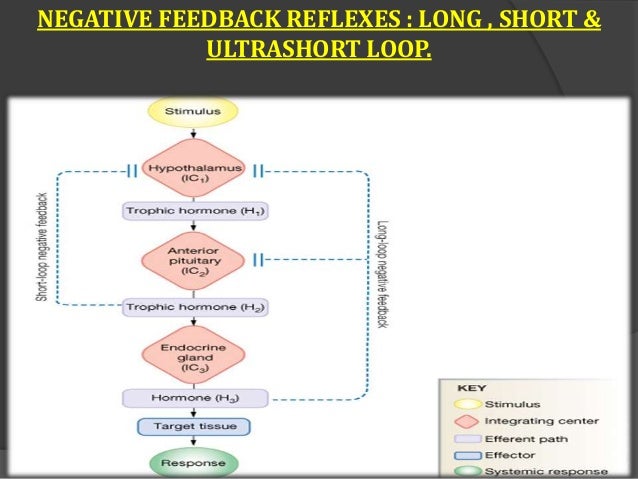
Let's formally define these loops.
Anatomy and Physiology of the Hypothalamus and Pituitary
The following text from the Tufts University Pressbook, 'Anatomy and Physiology of the Hypothalamus and Pituitary', provides a clear definition and examples of the different types of feedback loops.
Please read the section titled 'Feedback Control Mechanisms between the Hypothalamus, Anterior Pituitary, and Target Organs'. Focus on understanding the definitions and examples for: Long-loop feedback Short-loop feedback Ultrashort-loop feedback
Based on your reading, let's summarize the key definitions:
- Long-loop negative feedback: The hormone secreted by the peripheral endocrine gland (Hormone 3 in the flowchart) "feeds back" to inhibit the secretion of hormones from the hypothalamus and/or the anterior pituitary. This is the most common and physiologically significant form of feedback in these axes.
- Short-loop negative feedback: The hormone secreted by the anterior pituitary (Hormone 2) feeds back to inhibit the secretion of hormone from the hypothalamus.
- Ultrashort-loop negative feedback: The hypothalamic releasing hormone (Hormone 1) inhibits its own synthesis and secretion.
The Major Hypothalamic-Pituitary Axes
To make this principle concrete, let's examine the three major axes that are governed by negative feedback. You will see this pattern repeated again and again in your study of endocrinology.
The Endocrine System: An Overview
This article from an overview of the endocrine system provides excellent, concise descriptions of the three primary axes. It clearly lays out the hormones involved and their feedback relationships.
Please read the three subsections titled 'The HPA Axis', 'The HPG Axis', and 'The HPT Axis'. For each axis, identify the three levels of hormones and the primary long-loop negative feedback signal.
Let's break down these three classic examples.
1. The Hypothalamic-Pituitary-Adrenal (HPA) Axis
This axis is the body's primary system for managing stress.
- Hypothalamus secretes Corticotropin-Releasing Hormone (CRH).
- Anterior Pituitary responds to CRH by secreting Adrenocorticotropic Hormone (ACTH).
- Adrenal Cortex responds to ACTH by secreting Cortisol.
Negative Feedback: Cortisol exerts powerful long-loop negative feedback, suppressing the release of both CRH from the hypothalamus and ACTH from the pituitary.
2. The Hypothalamic-Pituitary-Thyroid (HPT) Axis
This axis controls the body's metabolic rate.
- Hypothalamus secretes Thyrotropin-Releasing Hormone (TRH).
- Anterior Pituitary responds to TRH by secreting Thyroid-Stimulating Hormone (TSH).
- Thyroid Gland responds to TSH by secreting the Thyroid Hormones (Thyroxine/T4 and Triiodothyronine/T3).
Negative Feedback: T3 and T4 exert long-loop negative feedback, inhibiting the secretion of TRH and TSH.
3. The Hypothalamic-Pituitary-Gonadal (HPG) Axis
This axis controls reproduction and sexual characteristics.
- Hypothalamus secretes Gonadotropin-Releasing Hormone (GnRH).
- Anterior Pituitary responds to GnRH by secreting Luteinizing Hormone (LH) and Follicle-Stimulating Hormone (FSH).
- Gonads (Testes in males, Ovaries in females) respond to LH and FSH by secreting sex hormones (e.g., Testosterone in males, Estrogen and Progesterone in females).
Negative Feedback: Testosterone (in males) and Progesterone/Estrogen (in females) exert long-loop negative feedback on the hypothalamus and pituitary.
Test your understanding!
A patient has a condition called "primary hypothyroidism," where the thyroid gland cannot produce thyroid hormones (T3/T4), despite being stimulated. Based on your understanding of the HPT axis and long-loop negative feedback, what would you predict the blood levels of TSH and TRH to be in this patient (high, low, or normal)?
Show answer
The levels of TSH and TRH would be high. The low levels of T3/T4 from the failing thyroid gland mean there is no long-loop negative feedback to the pituitary and hypothalamus. The lack of this inhibitory signal leads to an overproduction of TRH and TSH as the body attempts to stimulate the non-responsive thyroid gland. Understanding this logic is key to interpreting endocrine tests.
An Exception that Proves the Rule: Positive Feedback
While negative feedback is the rule for maintaining stability, there is a crucial exception: positive feedback. In a positive feedback loop, the product of a pathway stimulates its own production, creating an explosive, self-amplifying cycle. This is inherently destabilizing and is used only for processes that must be driven rapidly to completion.
The classic physiological example occurs in the female HPG axis. As you read in the HPG axis section, just before ovulation, high levels of estrogen switch from inhibiting the pituitary and hypothalamus to stimulating them. This causes a massive surge in LH release, which is the direct trigger for ovulation. Once ovulation occurs, the system reverts to negative feedback.
Conclusion
In this lesson, we demystified the body's primary hormonal control system. We saw how the hierarchical structure of the hypothalamic-pituitary axes provides a framework for elegant and robust regulation, with negative feedback being the cornerstone of this control.
Key Takeaways:
- Hormonal regulation is often achieved through a three-tiered hypothalamic-pituitary-peripheral gland axis.
- Negative feedback is the fundamental principle of homeostasis, where the final hormone of an axis inhibits its own production at the level of the hypothalamus and pituitary (long-loop feedback).
- Understanding these feedback loops is not just a theoretical exercise; it provides the logical basis for diagnosing endocrine disorders by analyzing hormone levels.
- Positive feedback is a rare, destabilizing mechanism used to drive processes like ovulation to completion.
Preview of the Next Lesson:
We have now covered the general principles of hormone action and regulation. In our next lesson, we will apply this knowledge to our first specific endocrine system: the thyroid gland. We will take a deep dive into the HPT axis and learn about the synthesis, secretion, and systemic actions of thyroid hormones.