Hello! Let's dive into the next topic in our exploration of vascular physiology.
In our last lesson, we identified the arterioles as the primary resistance vessels in the circulatory system, responsible for the largest drop in blood pressure. This positions them as critical "gatekeepers" that control blood flow into the capillary beds. Today, we'll explore the sophisticated local mechanisms that operate these gates.
The learning outcome for this lesson is to explain the mechanisms of local blood flow regulation, including metabolic and myogenic autoregulation. We will examine how individual tissues can independently adjust their own blood supply to match their immediate needs, a process known as autoregulation. This is distinct from the body-wide (extrinsic) control systems we will discuss later. By the end of this lesson, you will understand the two core theoretical principles that allow an organ to "ask for" the blood flow it requires.
1. Intrinsic vs. Extrinsic Control
The regulation of blood vessel diameter, and thus blood flow, occurs at two main levels:
- Intrinsic (Local) Control: Mechanisms that originate within a tissue or organ itself, allowing it to self-regulate its blood flow. This is the focus of today's lesson.
- Extrinsic Control: Mechanisms that originate outside the organ, primarily via the nervous system (neural control) and endocrine system (hormonal control). These systems regulate whole-body hemodynamics, such as maintaining mean arterial pressure.
This diagram provides an excellent overview, separating the intrinsic factors we'll study today from the extrinsic factors we'll cover in future lessons.
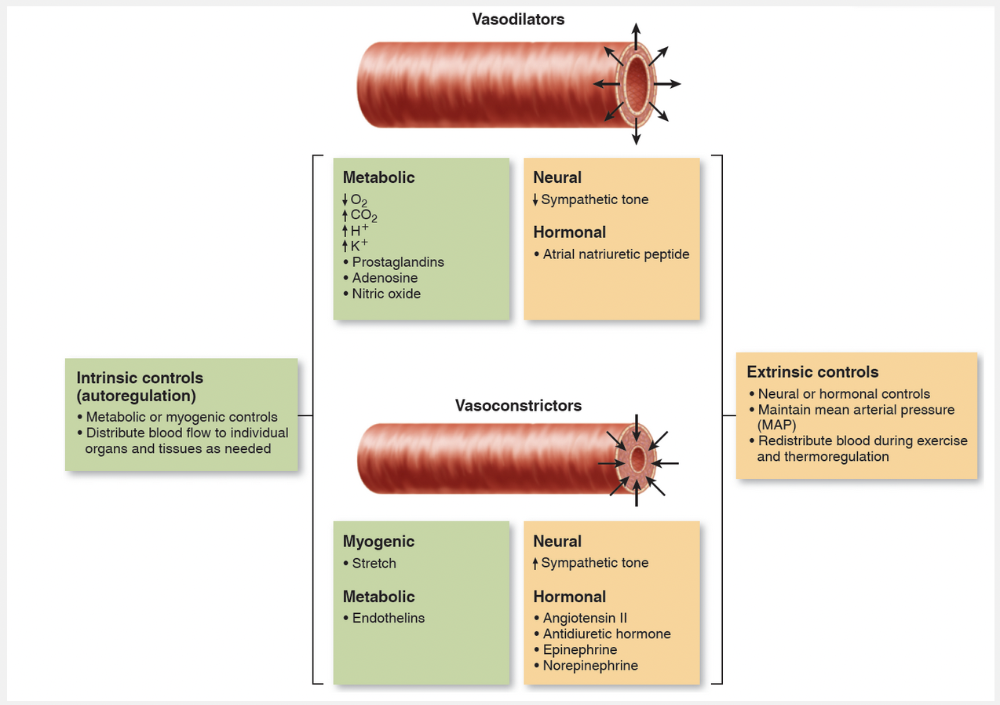
The primary purpose of intrinsic control is to match blood flow to the metabolic activity of the tissue. A resting muscle needs far less oxygen and fuel than the same muscle during strenuous exercise. Local control ensures this dynamic matching occurs efficiently.
2. Metabolic Autoregulation: Matching Flow to Function
The most intuitive form of local control is metabolic autoregulation. The core idea is simple: active tissues produce waste products and consume oxygen. These chemical changes in the local environment act as signals that cause nearby arterioles to dilate, increasing blood flow.
Homeostatic Regulation of the Vascular System
To start, let's get a clear definition of metabolic control and the key chemical signals involved. The following resource provides a straightforward introduction.
Please read the section titled 'Chemical Signals Involved in Autoregulation.' Focus on the list of factors and their effect (vasodilation) on the precapillary sphincters and arterioles.
As you've just read, several substances produced during metabolism have a powerful vasodilatory effect. When a tissue's metabolic rate increases:
- Oxygen () levels decrease as it is consumed by mitochondria.
- Carbon dioxide () levels increase as it is produced.
- Hydrogen ion () concentration increases (pH decreases), often due to lactic acid and CO2 production.
- Potassium ion () levels increase in the interstitial fluid as it moves out of muscle cells during repeated action potentials.
- Adenosine is released, particularly in heart muscle, when ATP is broken down.
- Nitric Oxide (NO) is a potent vasodilator released by endothelial cells in response to various chemical and physical stimuli.
This creates a classic negative feedback loop:
- Increased tissue metabolism.
- Increased production of vasodilator metabolites and decreased local .
- Vasodilation of local arterioles.
- Increased blood flow, which delivers more and washes out the metabolites.
- The stimulus for vasodilation is removed, and vessel tone returns toward its basal state.
This mechanism neatly explains two related phenomena:
- Active Hyperemia: The increase in blood flow that occurs in response to an increase in tissue metabolic activity. For example, blood flow to the gastrointestinal tract increases significantly after a meal.
- Reactive Hyperemia: The transient increase in blood flow that occurs after a period of ischemia (interrupted blood flow). During the occlusion, vasodilator metabolites accumulate. Upon release of the occlusion, the dilated vessels allow a surge of blood flow until the metabolites are washed away.
Now, let's explore this concept with greater theoretical depth.
Regulation of Vascular Tone and Oxygenation
The following text from an NCBI Bookshelf article elaborates on the metabolic theory, framing it around the primary regulated variable: tissue oxygenation.
Please read the section '3.2.2. Metabolic.' Focus on how the theory explains the coordination between resistance vessels (arterioles) and exchange vessels (capillaries) to maintain adequate tissue pO2.
This reading reinforces that the ultimate goal of metabolic autoregulation is not to regulate blood flow for its own sake, but to maintain adequate tissue oxygenation to meet metabolic demand.
3. Myogenic Autoregulation: Responding to Pressure
The second major intrinsic mechanism is fundamentally different. It's not based on chemistry, but on the intrinsic physical properties of vascular smooth muscle itself.
The myogenic response is the reaction of smooth muscle to being stretched. When blood pressure rises and stretches the wall of an arteriole, the smooth muscle contracts. Conversely, when pressure falls and stretch is reduced, the smooth muscle relaxes.
Homeostatic Regulation of the Vascular System
Let's first get a clear definition of this mechanism from the Lumen Learning resource.
Please read the section titled 'The Myogenic Response.' Note its primary role as a protective function.
This mechanism's primary function is to maintain a constant blood flow in the face of changing arterial pressure.
- If systemic blood pressure increases, the myogenic response causes vasoconstriction, which increases resistance to prevent a surge in flow to the delicate capillaries downstream.
- If systemic blood pressure decreases, the myogenic response causes vasodilation, which decreases resistance to maintain adequate flow.
For a deeper understanding of the underlying principle, let's turn to the more advanced resource.
Regulation of Vascular Tone and Oxygenation
This text connects the myogenic response to a fundamental law of physics, the Law of LaPlace, providing a powerful theoretical explanation for this behavior.
Please read the section '3.2.1. Myogenic.' Pay close attention to the explanation involving the Law of LaPlace.
As the text explains, the Law of LaPlace for a cylinder states that wall tension () is proportional to the transmural pressure () and the vessel radius ().
The myogenic theory proposes that vascular smooth muscle tries to maintain a constant wall tension.
- If pressure () increases, the vessel must decrease its radius () to keep tension () from increasing excessively. This results in vasoconstriction.
- If pressure () decreases, the vessel increases its radius () to maintain tension. This results in vasodilation.
This elegant mechanism allows organs like the brain and kidneys to maintain remarkably stable blood flow even when mean arterial pressure fluctuates between approximately 60 and 160 mmHg.
Test your understanding!
Imagine a person is exercising their right bicep by curling a dumbbell. In the arterioles of the exercising right bicep, what changes would you expect due to metabolic autoregulation? Simultaneously, in the resting left bicep, what would the myogenic mechanism be doing if the person's overall blood pressure increases slightly during the exercise?
Show answer
-
Exercising Right Bicep (Metabolic Control Dominates): The active muscle would be rapidly consuming and producing , lactic acid (), and adenosine. These vasodilator metabolites would cause significant vasodilation of the arterioles in the right bicep to increase blood flow (active hyperemia).
-
Resting Left Bicep (Myogenic Control is Apparent): The left bicep is not metabolically active, so there is no strong metabolic signal for vasodilation. If the person's overall arterial pressure increases due to the exertion, the arterioles in the resting left arm will be stretched. The myogenic response will trigger vasoconstriction in these vessels to prevent an unnecessary increase in blood flow to the resting tissue.
4. Interplay of Mechanisms: A Dynamic Duo
In reality, metabolic and myogenic mechanisms don't operate in isolation. They are constantly interacting, sometimes synergistically and sometimes in opposition. The final balance between them determines the vessel's diameter.
Regulation of Vascular Tone and Oxygenation
Understanding how these two systems interact is key to a complete picture of local control. This final reading explores their relative impact under different physiological conditions.
Please read the section '3.3. RELATIVE IMPACT OF MYOGENIC AND METABOLIC MECHANISMS.' Focus on the conclusion drawn in each scenario (reactive hyperemia, venous pressure elevation, arterial pressure reduction) about which mechanism seems to prevail.
This section provides critical insights into the dynamic relationship:
- When arterial pressure is reduced, both mechanisms predict vasodilation, so they work together to restore blood flow.
- However, evidence suggests that when there is a conflict, metabolic control often overrides myogenic control. For example, if a tissue is highly active (high metabolic demand), the powerful vasodilator signals will overcome the myogenic tendency to constrict in response to a rise in pressure.
A useful way to think about it is that the myogenic mechanism sets a basal vascular tone and provides a stable baseline flow, while the metabolic mechanism dynamically adjusts that flow to precisely match the moment-to-moment needs of the tissue.
This is visually summarized in the diagram below, which illustrates how both hypotheses explain the phenomena of autoregulation.

Conclusion
Today we have focused on the intrinsic mechanisms that allow individual organs to be masters of their own circulatory fate. By responding to local chemical and physical cues, arterioles can precisely tailor blood flow to meet demand.
Key Takeaways:
- Local blood flow is regulated by intrinsic mechanisms that arise from the tissue itself.
- Metabolic autoregulation matches blood flow to tissue activity. Increases in metabolites (like , , adenosine) and decreases in cause vasodilation.
- Myogenic autoregulation aims to keep blood flow constant despite changes in arterial pressure. It is an intrinsic property of vascular smooth muscle to contract when stretched.
- These two mechanisms work in concert. While the myogenic response provides a baseline of stability, the metabolic response is the primary driver for matching flow to demand and can override myogenic signals when metabolic needs are high.
Preview of the Next Lesson:
While these local controls are essential for individual organ function, the body must also manage the system as a whole. It needs to maintain a stable Mean Arterial Pressure (MAP) to ensure all organs are adequately perfused. In our next lesson, we will shift our focus to extrinsic control and examine the most important mechanism for rapid, systemic blood pressure regulation: the baroreceptor reflex.