Hello. This module moves from defining a friends-with-benefits arrangement to handling what happens within one. Friendship, attraction, or an earlier agreement may explain why two people are together, but none of them grants permission for a particular sexual activity. This lesson develops a way to assess consent when the signals are uncertain, someone feels pressured, or alcohol or drugs may affect a person’s ability to choose. The next lesson will turn that assessment into a practical check-in.
Consent is a choice made in context
Consent is a clear, voluntary agreement between people who are able to make that choice. It concerns a particular activity at a particular time, not a person’s general interest in someone else. A person can want affection without wanting sex, agree to kiss without agreeing to other touch, or enjoy an activity and later decide to stop.
The FRIES graphic is a useful memory aid:
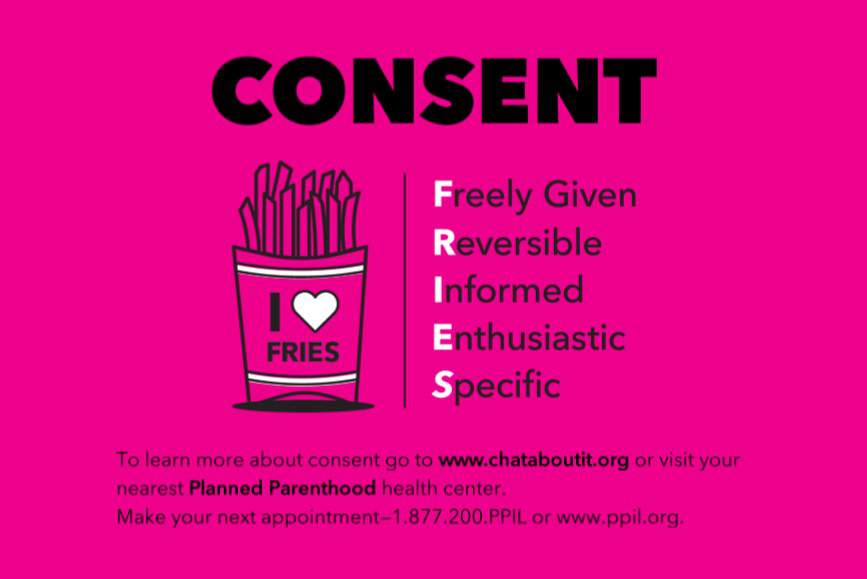
Freely given means the choice is not produced by threats, guilt, persistent requests, or fear of a reaction. Reversible means either person can withdraw agreement, including after an activity has begun. Informed means a person understands what they are agreeing to and any condition important to that choice. Specific means agreement to one activity is not blanket permission for another. Enthusiastic points to an affirmative choice rather than mere silence or failure to resist.
“Enthusiastic” does not require someone to act excited or perform desire in a particular way. A calm, clear yes may be genuine. The distinction is between a choice the person wants and one inferred from passivity, extracted through pressure, or made when they cannot meaningfully decide. Consent must also be ongoing: an earlier yes is relevant to what happened earlier, not a guarantee about what the person wants now.
Capacity comes first. Someone who is asleep, unconscious, or too impaired to understand or communicate a choice cannot give meaningful consent. Legal rules about consent vary by jurisdiction; the framework here is for making respectful decisions, not determining a legal verdict.
CrashCourse’s video shows why judging consent requires more than finding a spoken “yes.” It discusses sexual violence and involuntary responses, so you can skip it if that material is difficult to view.
Watch “What is consent?: Sex Ed #11” from CrashCourse for its distinction between affirmative agreement and the absence of refusal, then its treatment of pressure and intoxication.
Watch affirmative consent for why silence, prior intimacy, and agreement to one activity cannot stand in for a current yes. Continue with bodily responses, focusing on why freezing or arousal cannot establish consent. In context and capacity, notice how social pressure, power, and alcohol complicate an apparent agreement. Finish with ongoing choice for the reminder that agreement can change at any point.
The central lesson is that an observable response must be interpreted alongside the conditions in which it was given. A spoken yes matters, but it does not repair coercion or incapacity. Conversely, attraction, arousal, and affectionate behaviour can be real without being permission.
When “yes” is not freely given
Imagine two friends who have been physically intimate before. One says they do not want to have sex tonight. The other replies that they have already come over, that refusing now is unfair, and that the evening will be ruined. Eventually the first person says, “Fine.”
The last word in that scene is not enough to establish consent. The repeated appeal to obligation and the implied cost of refusal are evidence of pressure. What matters is not whether the pressuring person sees themself as persuasive rather than coercive; it is whether the other person has room to decline without being worn down or punished.
The following reading gives concrete examples of that distinction and reviews the limits of any prior agreement.
What is sexual coercion? - love is respect
Read “What is sexual coercion?” from love is respect to see how obligation, guilt, and persistent requests can undermine an apparent yes.
Read the opening explanation, beginning with the paragraph about control over physical activity and continuing through the definition. Under “You can also be made to feel forced through more subtle actions,” read the examples, paying particular attention to claims that someone “owes” sex and to reactions after a refusal. Then read “Let's review what consent is,” from the first entry about prior consent through the final entry about circumstances in which a person cannot consent.
A request is not, by itself, coercion. People can express interest, hear a no, and accept it. The warning signs appear when refusal becomes difficult: repeated asking after a no, bargaining over someone’s boundary, making them responsible for another person’s disappointment, or suggesting that the friendship depends on compliance. An established friends-with-benefits arrangement creates no debt of sex. Neither does spending time together, accepting a gift, or having agreed before.
There is an important assessment distinction here:
- Clear agreement under freely chosen conditions: There is evidence of consent to the activity discussed, subject to continued willingness.
- Uncertainty or hesitation: Do not treat ambiguity as permission. Pause rather than trying to interpret silence in your favour.
- Pressure or inability to choose: An apparent yes does not establish valid consent.
These are judgments about the situation, not guesses about whether someone is “really” attracted to the other person.
Informed, specific, ongoing, and reversible
Suppose someone agrees to sexual activity on the understanding that a barrier method will be used. Changing or disregarding that condition without their agreement changes what they are being asked to participate in. Their earlier yes does not cover the changed circumstances. The same principle applies whenever information material to a person’s choice is withheld or the proposed activity changes: agreement must be informed and specific to what actually happens.
Specificity need not turn intimacy into a rigid checklist. It does mean paying attention to boundaries and obtaining clear agreement when moving to a different kind of activity. “We kissed last time” establishes neither that kissing is wanted tonight nor that other touching is welcome. An agreement about the overall arrangement also cannot function as permanent consent to each encounter.
Consent remains live during an activity. If someone says “stop,” pulls away, freezes, or becomes quiet and unresponsive, the appropriate response is to stop and give them space. Silence may mean many things; it is not an affirmative answer. A person does not owe an explanation for changing their mind, and stopping is not an invitation to negotiate until the answer changes.
Consider three brief assessments:
Uncertainty: Two friends are kissing. One becomes still and no longer responds. There is not enough evidence of continued willingness. The safe assessment is to pause, not to rely on the fact that they were participating moments earlier.
Withdrawal: Both clearly agreed to an activity, but one says they want to stop halfway through. Consent has been withdrawn. Earlier agreement does not make continuing acceptable.
A limited yes: One person clearly agrees to kissing and clearly declines sex. Consent supports kissing only while both still want it. Treating the first yes as a reason to push for sex would disregard its limit.
In each case, the decision depends on what is agreed now, not on how affectionate, casual, or committed the relationship is.
Intoxication and the limits of certainty
Alcohol and other drugs can interfere with understanding, judgment, and communication. There is no reliable number of drinks that lets you determine capacity in every person and situation. A person who is slurring, cannot follow what is being proposed, is drifting in and out of awareness, or cannot communicate a stable choice should not be treated as able to consent. A verbal yes does not override those signs.
The more difficult case is when drinking has occurred but impairment is unclear. Do not use a person’s apparent eagerness—or your own desire to proceed—as proof of capacity. If there is doubt about whether either person can understand and freely choose, wait until the doubt is gone. Choosing not to proceed while someone is impaired or their capacity is uncertain is more dependable than trying to settle the question in the moment. Alcohol also makes it harder to judge one’s own comfort and decisions, so the same caution applies to both people.
This approach does not require you to diagnose someone or determine a legal threshold. It asks whether there is sufficient reason to rely on a freely made, informed agreement. When there is not, pause.
Bringing the assessment together
In a friends-with-benefits arrangement, familiarity can make assumptions feel natural: “We have done this before,” “We are comfortable together,” or “This is what our arrangement involves.” None answers the consent question on its own. The strongest assessment considers capacity, freedom from pressure, clarity about the activity and its conditions, affirmative agreement, and whether that agreement still holds.
The practical rule is modest but consequential: do not fill gaps in consent with assumptions. An unclear signal calls for a pause; a boundary calls for respect; a withdrawn yes means stop. Consent is not a one-time authorization attached to a relationship label. It is a choice each person remains free to make, limit, or change.
The next lesson focuses on a consent check-in that makes those choices easier to express without turning uncertainty or refusal into a confrontation.