Hello! In our last lesson, we navigated the complex world of error handling, comparing C++ exceptions to C-style error codes. We saw how modern alternatives like std::expected can lead to very descriptive, but also very long, type names. This perfectly sets the stage for today's topic.
This lesson addresses the learning outcome: Use the 'auto' keyword for automatic type deduction to improve code readability.
We'll explore auto, a C++11 feature that simplifies your code by asking the compiler to figure out a variable's type for you. We will cover:
- The basic mechanics of
auto. - The primary use case: simplifying complex type declarations.
- The important nuances of using
autowithconstand references. - Guidelines on when to use
autoand when it's better to be explicit.
1. What is auto?
At its core, auto is a placeholder that tells the compiler to deduce the type of a variable from its initializer. Instead of you explicitly writing the type, the compiler infers it from the value you assign at declaration.
int    i = 42;      // Explicit type
auto   j = 42;      // j is deduced to be 'int'

double d = 3.14;    // Explicit type
auto   e = 3.14;    // e is deduced to be 'double'

std::string s = "hello"; // Explicit type
auto        t = s;       // t is deduced to be 'std::string'
Because the compiler needs an initializer to deduce the type, auto variables must be initialized at the point of declaration.
auto x; // ERROR: Cannot deduce type without an initializer.
Let's start with a foundational reading that covers these basics.
10.8 — Type deduction for objects using the auto keyword - Learn C++
The website Learn C++ offers a clear and concise introduction to the auto keyword. This section will walk you through the fundamental concept.
Please read the first few sections of the article, starting from the top down to (but not including) 'Type deduction drops const from the deduced type'. Focus on understanding how auto deduces types from literals, expressions, and function calls, and note the requirement for an initializer.
2. The Main Benefit: Improving Readability
While auto can be used for simple types like int, its real power shines when dealing with the long and complex type names common in C++, especially when using the Standard Template Library (STL).
Consider iterating through a std::vector before C++11. The type for the iterator can be quite verbose:
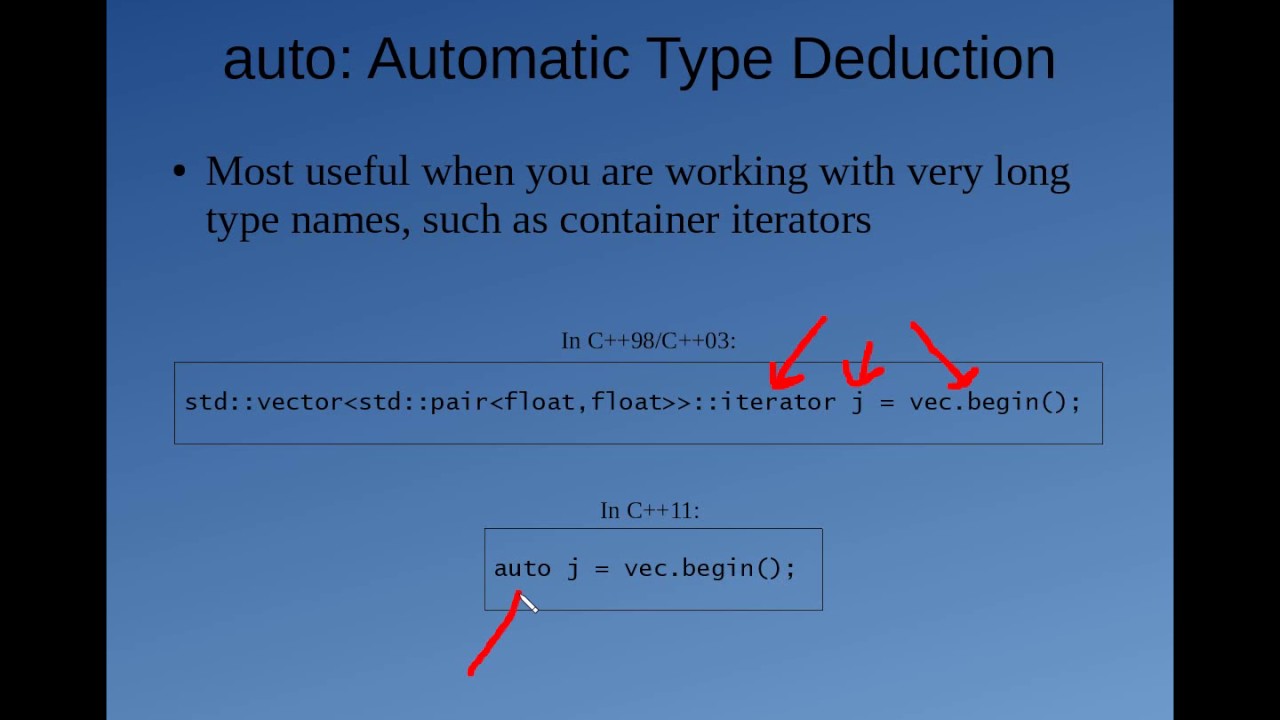
This is not just about saving keystrokes; it's about making the code's intent clearer. By removing type boilerplate, the logic of the loop becomes the primary focus.
The following video demonstrates this classic use case and another scenario involving a function that returns a complex type.
The Cherno provides excellent, practical C++ tutorials. In this clip, he demonstrates exactly why auto is so valuable for readability.
Watch the video from 08:53 to 14:18. First, pay attention to the iterator example (std::vector<std::string>::iterator). This is the canonical example for auto. Next, focus on the DeviceManager example with the std::unordered_map. This illustrates how auto simplifies capturing complex return types from functions.
The video also touched upon a critical point: auto doesn't automatically deduce references. This leads us to the essential rules of using auto correctly.
3. The Rules of Deduction: const, Pointers, and References
This is the most important "under the hood" detail to master. Your experience with other languages will tell you that the distinction between a value, a reference, and a constant reference is crucial for performance and correctness. With auto, you have to be explicit about these qualifiers.
Here are the rules:
- By default,
autodeduces a value type. This means it creates a copy, and it dropsconstand&from the initializer's type. autowill deduce a pointer type. If the initializer is a pointer,autowill correctly deduce a pointer.- You must add
&or*yourself if you want a reference or a pointer to a non-pointer type.
#include <string>
#include <vector>

std::vector<std::string> get_names() {
    return {"Ana", "João", "Maria"};
}

const std::string& get_first_name(const std::vector<std::string>& names) {
    return names[0];
}

int main() {
    auto names = get_names(); // OK: 'names' is a std::vector<std::string>. A copy is fine here.

    // --- The important part ---
    const auto& first = get_first_name(names); // 'first' is const std::string&. No copy is made. Efficient.

    auto second = get_first_name(names); // 'second' is std::string. A copy of names[0] is made.
                                         // The const and reference were dropped by auto.

    auto& third = get_first_name(names); // ERROR: third would be std::string&, but initializer is const.
                                         // Cannot bind non-const reference to const object.
}
The key takeaway is to use const auto& when you want to inspect an object without copying it, especially in range-based for loops.
// Bad: makes a copy of every string in the vector
for (auto name : names) {
    // ...
}

// Good: gets a read-only reference to each string. No copies.
for (const auto& name : names) {
    // ...
}
The following video provides a very precise and technical explanation of these deduction rules, comparing them to how template types are deduced.
C++ Weekly - Ep 287 - Understanding `auto`
Jason Turner's 'C++ Weekly' is known for its deep dives. This video clarifies the rules of auto deduction with exceptional precision.
Watch from 02:20 to 05:47 and then from 06:40 to 10:03. First part (02:20 - 05:47): The most important rule is stated here: "auto is never ever going to deduce a reference type for you." He demonstrates how you must add the & yourself and how const is deduced (or dropped for value types). Second part (06:40 - 10:03): This part clarifies the behavior with pointers, contrasting pointer-to-const with const-pointers, and reinforces how value types are always copies.
4. When to Be Cautious: The Downsides of auto
Like any tool, auto can be misused. Overusing it can make code less readable by obscuring types, which can lead to subtle bugs.
Modern C++ • Type Inference - Alberto Gramaglia
To round out our understanding, let's look at a balanced perspective on the pros and cons, with some clear guidelines on when to avoid auto.
Please read the section titled 'Abusing type inference' in this article by Alberto Gramaglia. It gives excellent advice on using auto judiciously and highlights a subtle bug that can arise from its thoughtless use (the integer overflow example).
Here's a summary of when to think twice before using auto:
- For simple, numeric types: Writing
int x = 0;is often clearer thanauto x = 0;. Explicitly stating the type can prevent mistakes, like intending adoublebut accidentally providing anintliteral (auto x = 5;instead ofauto x = 5.0;). - When you need a specific type conversion: If you want to intentionally convert a
doubleto anint, you must be explicit:int i = 3.14;. Usingauto i = 3.14;would makeiadouble. - For public APIs: In function signatures within header files, it's almost always better to use explicit types. It makes the interface clear to the users of your code without them having to look at the implementation.
A good rule of thumb is: Use auto when it makes the code more readable, not just shorter. It's ideal for types that are verbose (iterators), unutterable (lambda types), or obvious from the context (the right-hand side of the assignment makes the type clear).
Conclusion
You've now learned how to use auto to write cleaner, more modern C++ code. While it may seem like a simple syntactic sugar, understanding its deduction rules is key to using it effectively and avoiding performance pitfalls or subtle bugs.
Key Takeaways:
autodeduces a variable's type from its initializer, which is mandatory.- Its primary benefit is improving readability by replacing long, complex type names (e.g., STL iterators).
- By default,
autodeduces a value type (a copy) and dropsconstand reference qualifiers. To avoid copies and get references, you must useauto&orconst auto&. - Use
autojudiciously. Avoid it for simple types or in public APIs where clarity demands an explicit type.
Next Up
So far, we have been compiling single files with g++. As projects grow, with code spanning multiple .h and .cpp files, this manual approach becomes unmanageable. In the next lesson, we will learn how to write a basic CMakeLists.txt file to build a C++ executable. This is the first step towards managing real-world C++ projects using CMake, the industry-standard build system generator.