Welcome back! In our last lesson, we examined the CAP theorem and concluded that to build a resilient, offline-capable collaborative application, we must prioritize Availability and Partition Tolerance. This choice means your visual workflow builder will remain functional even when a user's network connection is lost. Users can continue to create and modify nodes, and the application won't freeze or show an error.
Today, we'll explore the architectural pattern that makes this possible. This lesson focuses on optimistic replication, the "how" that follows the "why" established by the CAP theorem. You'll learn how this pattern enables the fast, responsive, and offline-capable user experience that is the hallmark of modern collaborative tools, often referred to as "local-first" applications.
The Shift from Pessimistic to Optimistic
In your years as a frontend engineer, you've likely spent a lot of time managing the traditional request/response cycle. A user performs an action, the UI shows a loading spinner, an API call is made, and the UI updates only after receiving a successful response from the server. This is a pessimistic approach: the system assumes the operation might fail and waits for confirmation before reflecting the change.
Optimistic replication flips this model. The application optimistically assumes the operation will succeed. When a user acts, the change is applied to the local data state immediately, and the UI updates instantly. The process of synchronizing this change with the server happens asynchronously in the background.
This fundamental difference is illustrated below.
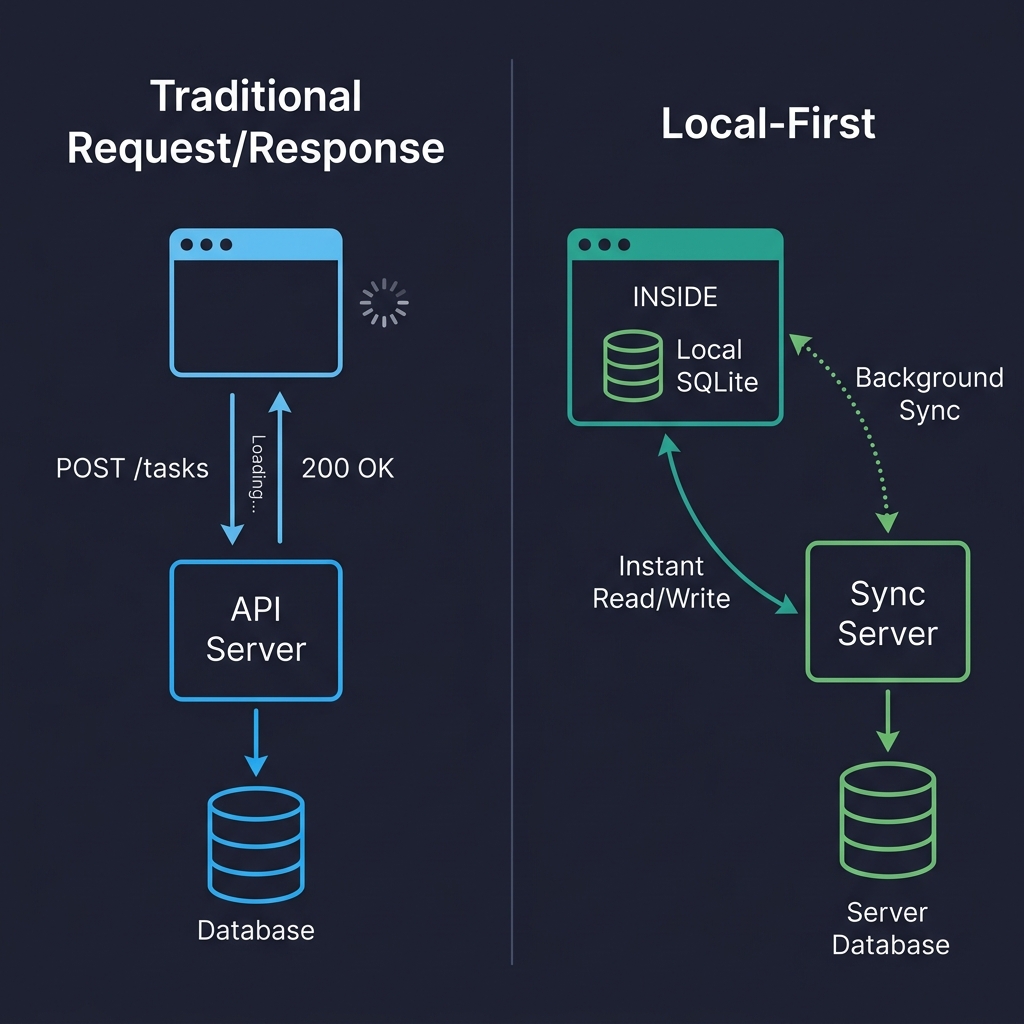
As you can see on the right, the user experience becomes instantaneous. There are no loading states for local writes. This is the core principle that enables "offline-first" functionality. If the UI can update without waiting for a server, it doesn't matter if the server is reachable or not.
Local-First: The Architecture of Optimism
The architectural pattern that formalizes this optimistic approach is called local-first. It's more than just caching data; it's a fundamental shift in where the "source of truth" resides.
The Architecture Of Local-First Web Development — Smashing Magazine
The article "The Architecture Of Local-First Web Development" from Smashing Magazine provides an excellent, developer-centric overview of this concept. It clarifies common misconceptions and introduces the core mental model.
Please read the first two sections: What “Local-First” Actually Means and Replicas, Not Requests. Pay close attention to the distinction between local-first and offline-first, and how the Git analogy provides a powerful mental model for this architecture.
The key takeaway from the reading is that in a local-first architecture, each client is treated as a first-class citizen with its own replica of the data. Your application code doesn't make API calls to fetch or update data; it interacts directly with a local database.
This approach has profound implications for how you build applications, many of which simplify the frontend logic you're used to writing:
- No Optimistic UI Logic: In a traditional app, you might implement an "optimistic update" by temporarily changing the UI state and then rolling it back if the API call fails. In a local-first app, the local write is the state. There is no temporary state to manage.
- Simplified State Management: Much of the complexity in tools like Redux or React Query comes from managing server cache, loading states, and refetching logic. When the database is local, it becomes your state manager. Queries are subscriptions to local data, which update reactively.
How it Works: Caching, Queuing, and Lazy Writes
Let's break down the mechanics. How does an application read data when offline and handle writes that need to be sent later? The concepts of caching and queuing are central.
Offline-first Architecture - How to survive without the internet? - Zixuan Liu & Ahlam Aatif
The talk "Offline-first Architecture - How to survive without the internet?" from NDC Conferences provides a clear, conceptual breakdown of the mechanisms involved.
Please watch the following segments: The introduction to offline-first mechanisms. Here, the speakers use a great thought experiment to explain caching for offline reads and queuing for offline writes. The discussion on "lazy writes". This strategy is a perfect description of optimistic replication: write to the local data source first, then queue the operation to be sent to external services later.
As the video explains, the process works as follows:
- Reading (Caching): The application proactively downloads data it might need and stores it in a local database (e.g., IndexedDB or SQLite compiled to WebAssembly). When the UI needs to display data, it queries this local database, which is always available and extremely fast.
- Writing (Queuing & Lazy Writes): When the user performs an action (like moving a node on your canvas), the application executes a
writeoperation directly against the local database. The UI updates instantly. This operation is also added to a background queue. A synchronization process monitors this queue and sends the changes to the server whenever a network connection is available.
The result is that from the user's perspective, both reads and writes are instantaneous.
The Architecture Of Local-First Web Development — Smashing Magazine
Let's return to the Smashing Magazine article to see how this translates into code and performance.
Read the sections Building A Real App and Performance. The useLiveQuery hook example in the first section is a powerful demonstration of how simple component logic becomes. The second section quantifies the performance benefits of this architecture.
The Inevitable Consequence: The Merge Problem
Optimistic replication provides a superior user experience, but it introduces a new challenge. By choosing Availability in the CAP theorem trade-off, we allow different replicas of the data to diverge.
Consider your visual workflow builder:
- User A is offline on a laptop and moves a "Data Processing" node to the right.
- Simultaneously, User B is online and moves the same node to the left.
- When User A comes back online, their client will try to sync its change. The server now has two conflicting updates for the same node's position. Which one is correct?
This is the merge problem. A simple "last write wins" strategy might discard one of the user's changes, leading to data loss. A consensus protocol, as discussed in the context of blockchains, would choose one change and discard the other—also not what we want for collaboration. We want to merge all contributions intelligently.
CRDTs and the Quest for Distributed Consistency
This challenge is expertly framed in the talk "CRDTs and the Quest for Distributed Consistency" by Martin Kleppmann. He uses the familiar example of Google Docs to illustrate how optimistic replication naturally leads to this concurrency issue.
Please watch from this clip. He explains that Google Docs applies your changes locally and immediately for performance, then syncs in the background. He explicitly links this to offline editing and network partitions, showing how concurrent changes are a natural outcome. The automerge example from later in the talk shows how two concurrent, independent changes can be merged cleanly, guaranteeing convergence.
Handling these concurrent operations and ensuring that all users eventually see the same, correct state—a property called convergence—is the central problem that CRDTs are designed to solve. They are data structures that have a mathematically provable merge function, ensuring that no matter what order changes are received in, all replicas will eventually converge to the same state without conflicts.
Conclusion
In this lesson, we have moved from the theoretical trade-off of the CAP theorem to the practical architecture that enables offline-first collaborative applications.
Here are the key takeaways:
- Optimistic Replication: This is a UI/application pattern where changes are applied locally first, providing an instantaneous user experience. Synchronization with a server happens asynchronously.
- Local-First Architecture: This is the architectural style that enables optimistic replication by making a local database on the client the primary source of truth for the application.
- Benefits: This approach leads to highly performant, resilient applications that work seamlessly online and offline.
- The Trade-off: The power of optimistic replication comes at the cost of complexity. We must now solve the "merge problem" by devising a strategy to resolve conflicts between concurrently edited, divergent data replicas.
You now understand why we must accept eventual consistency (CAP theorem) and how we can build a responsive, offline-capable application using optimistic replication and a local-first architecture. The next crucial step is to understand the mechanics of resolving the conflicts this architecture creates.
In our next lesson, we will begin to tackle this by defining the "happens-before" relation, a fundamental concept for understanding and ordering events in a distributed system. This will lay the groundwork for implementing logical clocks, which are the first tools we'll need to build our own CRDTs.