Hello. In the previous lesson, you reviewed a household agreement by looking at completion, independence, and sustained effort. If shopping repeatedly gets done only after you remind the task owner and make the decisions, the arrangement may not be working—even if you cannot tell why. This lesson focuses on what you can do in response: formulate a boundary that protects your time without trying to control or punish the other person, and without putting anyone’s essential care at risk.
A boundary does not require a verdict about intent
Suppose a partner agreed to own the weekly grocery shop. At several review points, you find yourself noticing that food is running low, sending reminders, and choosing substitutes. You might suspect deliberate avoidance, a genuine difficulty, or an agreement that still needs adjustment. You do not have to settle that question before deciding what responsibility you can continue to carry.
A request describes what you want the other person to do: “Please make the ordinary shopping decisions yourself.” An agreement assigns responsibility: “You will plan and complete the weekly shop by Sunday.” A boundary describes what you will do when a pattern affects you: “I will no longer provide routine reminders or make ordinary substitution decisions.” Requests and agreements still matter; a boundary does not replace them. It identifies the limit of your own participation when an agreement repeatedly fails.
Watch the opening and the later explanation of conditional boundaries in How to Set Boundaries That Actually Work Part 2, from Therapy in a Nutshell. The useful distinction is between directing another adult’s behavior and stating an action you can take yourself. The later segment includes a food-related example; take its structure, not that particular response, into a household situation where meals and care may be essential.
How to Set Boundaries That Actually Work Part 2: Relationship Skills #6
In “How to Set Boundaries That Actually Work Part 2: Relationship Skills #6,” Therapy in a Nutshell distinguishes a personal limit from an instruction to someone else.
Watch the distinction at the opening, then skip to conditional boundaries. Notice that the person setting the boundary names their own planned action while leaving the other person free to make their own choice.
The comparison chart below makes that distinction visible. Its “rules” column depicts controlling demands, not every rule two people might freely agree to. A shared grocery budget or food-safety standard, for instance, can be a reasonable part of a household agreement. Nor does stating a boundary automatically create trust; how it is carried out matters.
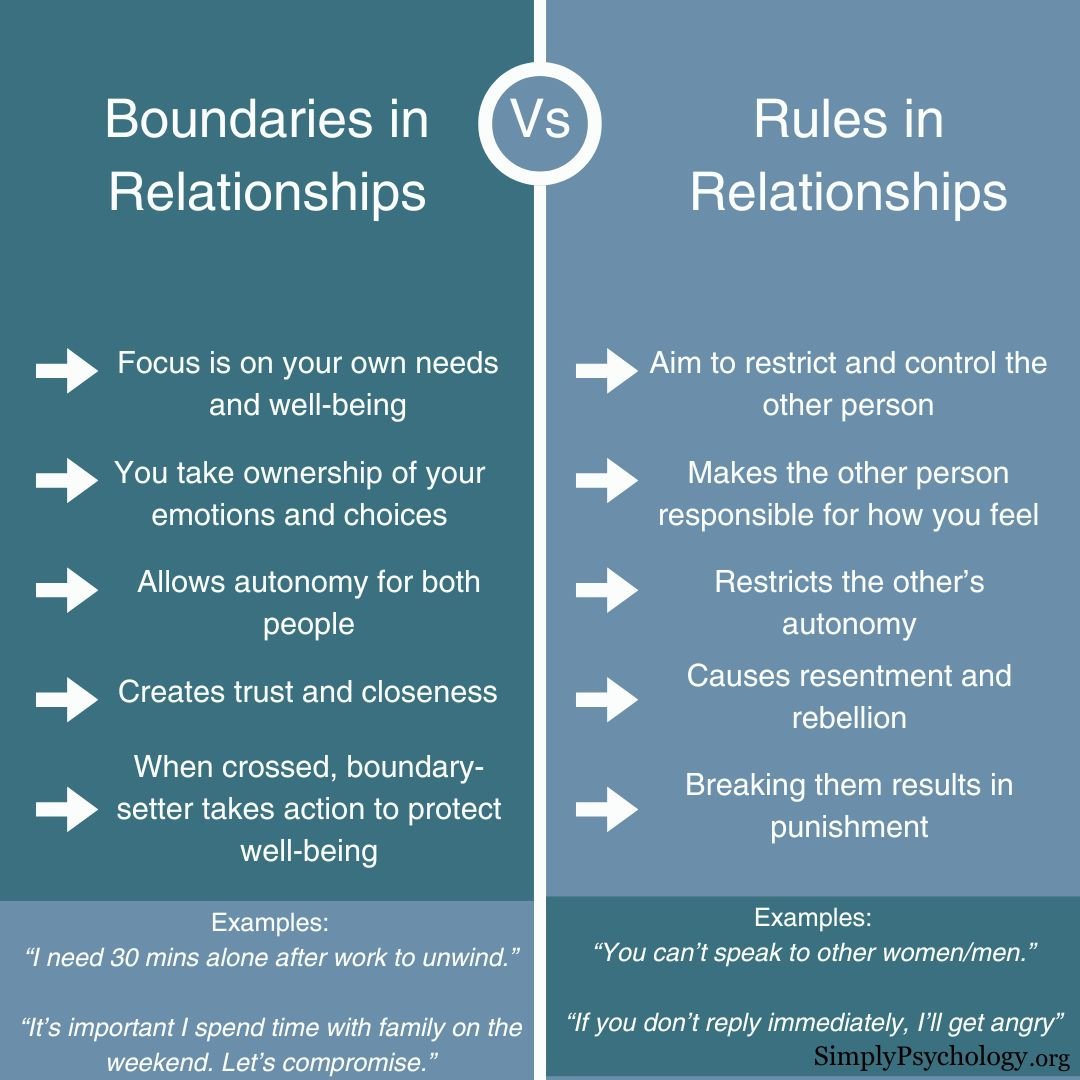
There is a further test beyond wording. “If you miss the shop, I will cancel your plans” starts with I, but it is still a punishment unrelated to protecting your capacity. A boundary should be a feasible, proportionate response to the burden you are carrying—not a threat designed to make the other person comply.
State the pattern, the limit, and your own action
A useful boundary is specific enough that you can recognize when it applies. “If you keep being irresponsible, I’m done helping” leaves both the trigger and the action unclear. “After two more weekly shops that require me to send routine reminders or choose ordinary substitutes, I will stop doing those parts of the shopping task” identifies observable conduct and a change within your control. The number of opportunities is not a universal rule; it depends on what was agreed and what has already happened.
The Cleveland Clinic’s How To Set Boundaries in Healthy Ways offers a concise account of speaking from your own perspective, stating what you will do, and following through. Read its communication guidance with this distinction in mind: an “I” statement can describe an impact honestly, but the action following it must also be one you can take safely.
How To Set Boundaries in Healthy Ways
Read the Cleveland Clinic’s guidance for wording a limit and making your response clear. Focus on the difference between communicating an impact and assigning blame.
In “Step 3: Use ‘I’ statements,” read the explanation, beginning with “Talk about your needs” and ending just before the comparison table. Then, in “Step 4: Establish consequences” and “Step 5: Follow through,” read the action guidance, from the examples of limiting interactions through the first paragraph under “Step 5.” Here, interpret a consequence as your protective action, not a penalty imposed on a partner.
For repeated shopping non-follow-through, a boundary can be built from four connected parts:
- An observable pattern: “At the last two reviews, I was still sending reminders and deciding routine substitutions.”
- Its impact: “That keeps the planning and monitoring with me, alongside my other responsibilities.”
- A limit and action you control: “I will not send routine shopping reminders or make decisions already within your agreed authority.”
- A safe plan for what happens next: “We need a way to keep essential food available, and I will not treat an emergency workaround as an agreement to manage the whole task indefinitely.”
This is not a formula that guarantees cooperation. It makes your position understandable and gives you a way to act consistently even if the other person disagrees. You can still listen to new information—for example, a previously unrecognized capacity constraint—without automatically accepting permanent supervision as the solution.
Do not use essentials as leverage
Shopping has an important complication: sometimes not stepping in would leave someone without food. The same issue arises with medication, dependent care, and other safety-critical tasks. A boundary must not depend on letting an essential need go unmet to prove a point. “I won’t remind you, so the children simply won’t eat if you forget” is not an acceptable way to transfer responsibility.
Instead, separate the immediate safeguard from the long-term task division. A household might keep a small supply of suitable essentials, use a feasible backup way to obtain food, or make another plan that accounts for budget, dietary needs, and anyone who depends on them. The exact safeguard will vary. What matters is that it is realistic before a lapse occurs.
A safeguard can create a new problem if it quietly becomes the standing arrangement: one partner still monitors the deadline, orders replacement groceries, and plans every meal. If you must cover an immediate need, name that as a temporary response and revisit the division of work. You can decline to be the indefinite, unacknowledged fallback while still making sure essentials are covered. If the original agreement is not feasible because of time, health, disability-related capacity, or money, the response may be a different division or a bounded support—not an unsafe test of whether someone will finally follow through.
The same distinction applies to less urgent costs. Choosing not to plan an optional meal you did not agree to plan may protect your time. Withholding access to necessary food, shared funds for essentials, or care in order to provoke a reaction is different. A response is not made constructive merely by calling it a boundary.
Put the boundary into practice without policing the outcome
Here is a boundary stated after a clear agreement and repeated reviews:
“We agreed that you would plan and complete the weekly grocery shop, including ordinary substitutions. At the last two reviews, I was still sending reminders and making those choices, and I can’t keep managing the task that way. Starting next week, I won’t send routine reminders or decide ordinary substitutes. We need to keep essential food available, so if the shop is missed I will use our feasible essentials backup for the immediate need. I won’t treat that backup as a new arrangement for me to manage regular shopping. Before another week begins, I will raise a change to the task division.”
The speaker does not claim to know whether the lapses were intentional. They also do not promise to make the other person shop. They specify the work they will stop doing, protect essential needs, and commit to raising a change rather than silently absorbing the task. If the other person will not discuss a workable division, the speaker can still decide what responsibilities they are willing and able to accept; they cannot unilaterally make the other person accept a new agreement.
Follow-through should match the stated limit. If the task owner asks which ordinary substitute to buy, you can refer them to the decision-making authority already agreed and leave that choice with them. If a genuinely new dietary requirement or other shared constraint arises, discussing it is not a failure of your boundary. The aim is to stop routine hand-backs, not all communication.
Boundaries can also be revised. If circumstances change or the plan proves unsafe or impractical, adjust it openly. Consistency means not repeatedly making a limit that you cannot or should not carry out; it does not mean persisting with a harmful plan.
One final qualification matters. This lesson assumes it is reasonably safe to discuss responsibilities and limits. If raising a boundary could bring intimidation, retaliation, coercive control, or danger, do not use a declaration of non-follow-through as a test of the other person’s reaction. Prioritize safety and confidential support instead. The next lesson distinguishes that situation from persistent but non-abusive conflict and considers appropriate routes to outside help.
Key takeaways
Repeated non-follow-through can justify a boundary without proving motive. Ground it in the observed pattern, explain the burden it leaves with you, and state a proportionate action within your control. Do not disguise a punishment as an “I” statement or put essential care at risk. Where a backup is needed, make it safe and feasible without silently turning it into permanent task ownership.