Hello. Last lesson showed why both giving to a campaign and paying for your own election advocacy raise First Amendment concerns, even though they burden speech differently when restricted. This lesson turns that difference into a practical rule: which constitutional standard applies to a candidate-contribution limit, and which applies to a ban on independent expenditures? Allow about 35–40 minutes, including two focused readings.
Start with the transaction, not the dollar amount
Before selecting a standard of review, identify what the law restricts. A candidate contribution transfers value to a candidate’s campaign. An independent expenditure pays for the outside spender’s own advocacy without coordination with the candidate. The amount spent does not determine the category: a large check to a campaign is still a contribution, and a modest independently purchased advertisement is still an expenditure.
The two advertisements below make the distinction visible. The first identifies an outside payer and says the advertisement was not authorized by a candidate. The second identifies a party committee as the payer and says a candidate’s committee authorized it. Those statements are useful clues, though the legal classification of a real advertisement depends on the facts of its payment and coordination, not solely on its printed disclaimer.

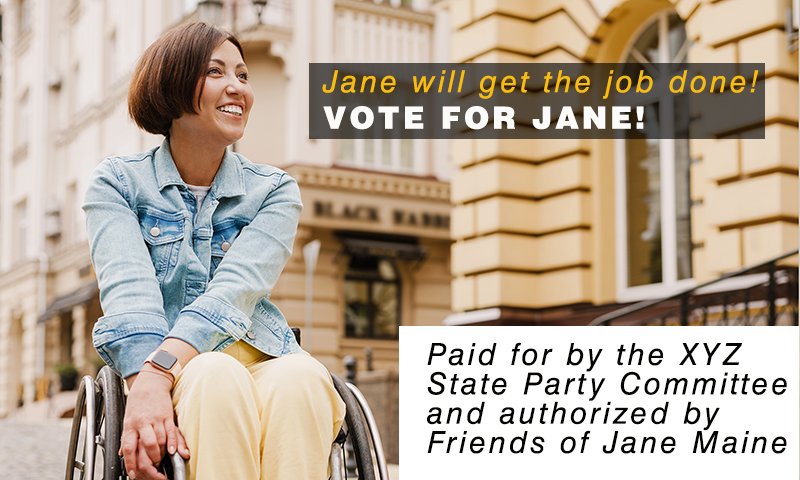
This first step matters because constitutional review follows the activity being restricted. A rule capping what a supporter gives to a candidate is not assessed the same way as a rule forbidding that supporter to pay for an independent message to voters.
The two standards in Buckley
The Congressional Research Service’s Constitutionality of Limits on Contributions and Expenditures states the distinction compactly. Read its explanation of the two standards before examining how the contribution standard works in practice.
Constitutionality of Limits on Contributions and Expenditures
Read the Congressional Research Service’s introduction for the governing comparison between contribution limits and expenditure limits.
In “Introduction,” find the paragraph beginning “The Court in Buckley, however, afforded different degrees of First Amendment protection to contributions and expenditures.” Read the standards through the end of that paragraph. Focus on the different descriptions of the government’s interest and the required fit between the rule and that interest.
A candidate-contribution limit receives what courts call closely drawn review. The government must show that the limit is a closely drawn means of serving a sufficiently important governmental interest. This is meaningful First Amendment review, not permission to set any cap the government wishes. But it is less demanding than the standard for restricting a speaker’s independent advocacy.
An independent-expenditure ban or limit receives strict scrutiny. The government must show that the restriction is narrowly tailored to serve a compelling governmental interest. Restricting what someone may spend to communicate their own election message directly limits the amount of that person’s paid expression. That is why Buckley applies the more demanding standard.
| Restricted activity | Standard | What the government must establish |
|---|---|---|
| Giving to a candidate | Closely drawn review | A closely drawn means of serving a sufficiently important interest |
| Paying for independent election advocacy | Strict scrutiny | A narrowly tailored means of serving a compelling interest |
The standards tell a court how to evaluate a rule; they do not, by their labels alone, decide every case. Under either standard, a court examines the government’s justification and how the restriction actually works. Still, Buckley upheld the candidate-contribution limits before it and struck down its restrictions on independent expenditures. The distinction between the standards helps explain those different results.
What “closely drawn” requires of a contribution limit
A contribution limit burdens the donor’s ability to support and associate with a candidate. It does not, however, directly prevent that donor from explaining a position to voters in an independently produced message. Buckley treated the contribution limit’s restraint on the donor’s own speech as less direct and accepted preventing corruption or its appearance as a sufficiently important interest.
That does not make every candidate-contribution cap constitutional. The fit matters. If a limit is so low that candidates cannot gather the resources needed for effective advocacy, it may restrict political activity more severely than the label “contribution limit” suggests.
Read the contribution section for both sides of that point: a limit upheld in Buckley and an example of limits found too low.
Constitutionality of Limits on Contributions and Expenditures
Continue with the Congressional Research Service’s account of how courts apply closely drawn review to candidate-contribution limits.
Under “Contributions,” go to “Base Limits.” Read the base-limit discussion, starting with its definition of base limits and stopping at the end of the paragraph about the Vermont limits and volunteer expenses. Pay particular attention to the discussion of whether a limit leaves candidates able to raise enough for effective advocacy. The intervening paragraph on Nixon notes that a permissible limit need not be precisely “fine tuned.”
The examples prevent two opposite mistakes. “Closely drawn” does not mean “automatically valid”: a contribution limit can fail if its effects are too restrictive. Equally, “protects political participation” does not mean “no contribution limits”: a reasonable cap can leave donors ways to express support while addressing the risks posed by large contributions to candidates.
Notice also that closely drawn and narrowly tailored are not interchangeable names for the same test. Both demand a relationship between the rule and a valid governmental objective, but strict scrutiny sets the higher threshold for the justification and the tailoring.
Why independence changes the review
Suppose a law says that no person may spend more than a specified amount on an advertisement expressly urging voters to elect a candidate, even when the person acts without the candidate’s involvement. This is an independent-expenditure limit. It caps what the outside speaker can pay to say and distribute. Apply strict scrutiny, not closely drawn review.
In Buckley’s analysis, independence also weakens the corruption justification that supports limits on money given to a candidate. An outside speaker who acts without coordination is not placing funds at the campaign’s disposal. The Court did not accept restricting that speaker’s advocacy simply to reduce the volume of election spending or balance the resources of competing speakers. Thus, selecting strict scrutiny is not just terminology: for the independent-expenditure limits at issue, the government could not supply a justification sufficient to sustain them.
Now change one fact. The candidate’s campaign arranges for the supporter to pay a vendor for an advertisement as part of the campaign’s effort. If the relevant coordination requirements are met, the payment can be treated as an in-kind contribution rather than an independent expenditure. Calling it “outside spending” because the check went to a vendor would miss the legal point. For a contribution restriction, the starting standard is closely drawn review.
That produces a reliable sequence for reading a proposed law or a news report:
- Identify the restricted transaction. Is value going to a candidate or campaign, directly or through coordinated activity? Or is a speaker paying for advocacy independently?
- Select the standard. Apply closely drawn review to a candidate-contribution limit; apply strict scrutiny to a ban or limit on independent expenditures.
- Assess the justification and fit. A corruption-related purpose does not dispense with the applicable test, and naming a valid interest does not establish that a particular rule is properly drawn.
This is a framework for these two types of restrictions, not a claim that every campaign-finance rule falls into one of these boxes. Disclosure requirements, for example, raise a different set of questions later in the course.
Conclusion
The governing distinction is contribution versus independent advocacy, not “small money versus large money.” A candidate-contribution limit receives closely drawn review: it must serve a sufficiently important interest through a closely drawn means. An independent-expenditure ban receives strict scrutiny: it must be narrowly tailored to a compelling interest. Neither label replaces analysis of the facts, particularly when an outside-paid advertisement may have been coordinated with a campaign.
The next lesson examines the governmental interest behind these tests more closely: why the Court distinguishes quid pro quo corruption or its appearance from aims such as equalizing political influence.