In our last lesson, we explored the brain's large-scale networks—the Default Mode, Salience, and Executive Control networks—and saw how their interplay shapes your inner world of thought, focus, and self-awareness. We saw how states like hypnosis are a clear example of intentionally modulating this neural architecture. Now, we will connect these high-level brain states to your body's fundamental operating system.
This lesson focuses on the autonomic nervous system (ANS), the intricate network that runs your body's essential functions below the level of conscious thought. Our goal is to distinguish between its two primary branches—the sympathetic and parasympathetic systems—and, most importantly, to learn how to recognize their distinct effects on your own body. Understanding this internal see-saw is a foundational skill for managing stress, regulating emotions, and improving your overall wellbeing.
1. Your Body's Accelerator and Brake
Your brain and body are in constant communication. When the Salience Network in your brain detects a threat, it doesn't just switch your attention; it sends an immediate signal that puts your entire body on high alert. Conversely, when you feel safe and relaxed, a different set of signals tells your body to conserve energy and recover. This is the work of the autonomic nervous system.
The ANS is best understood as having two main branches that act in opposition to each other, like an accelerator and a brake pedal for your physiology.
- The Sympathetic Nervous System (SNS) is the accelerator. It triggers the famous "fight or flight" response, mobilizing your body's resources for immediate, intense action.
- The Parasympathetic Nervous System (PNS) is the brake. It activates the "rest and digest" response, promoting calm, recovery, and energy conservation.
To get a more formal definition of these systems, let's turn to an article from the BBC.
These breathing techniques could reduce your stress in minutes
This article provides a clear, concise introduction to the autonomic nervous system and its primary divisions.
Please read the section titled "Training the nervous system". Focus on the descriptions of the sympathetic and parasympathetic systems to solidify their core functions.
As you just read, these two systems orchestrate a cascade of physical changes throughout your body. While you don't consciously control them, you can absolutely feel their effects. Here’s a breakdown of what to look for:
| Bodily Function | Sympathetic ("Fight or Flight") | Parasympathetic ("Rest and Digest") |
|---|---|---|
| Heart Rate | Increases | Decreases |
| Breathing | Fast and shallow | Slow and deep |
| Pupils | Dilate (widen) | Constrict |
| Digestion | Slows or stops | Increases |
| Saliva | Mouth becomes dry | Saliva production increases |
| Muscles | Tense for action | Relax |
| Blood Flow | Directed to major muscles | Directed to digestive organs |
The key is that these are not abstract concepts; they are tangible, physical experiences. Learning to recognize them is the first step in learning to influence them.
2. Recognizing the Systems in Your Body
Think about the last time you were startled—perhaps by a loud, unexpected noise or by narrowly avoiding an accident. You likely felt a near-instantaneous surge of energy: your heart pounded, your breathing quickened, and your muscles tensed. That was your sympathetic nervous system in action.
Now, recall the feeling of sitting down to a relaxing meal with friends, or the deep sense of calm after a satisfying day's work. Your heart rate is slow, your breathing is gentle, and your body feels settled. That is the feeling of your parasympathetic nervous system taking the lead.
This constant dance between alertness and calm is happening all day long. The video below offers a great practical guide to identifying the signs of each state.
Parasympathetic Response: Train Your Nervous System to Turn off Stress: Anxiety Skills #11
The host of the "Therapy in a Nutshell" channel gives a clear, practical explanation of how to feel the difference between the two systems.
Watch the first minute of the video, from the beginning to the end of the explanation on meditative breathing and saliva. Notice the simple but powerful distinction she makes between a dry mouth (sympathetic) and increased saliva (parasympathetic).
As the video points out, the simple act of noticing saliva in your mouth is a direct, physical confirmation that your "rest and digest" system is active. Conversely, a dry mouth before giving a presentation is a classic sign of the "fight or flight" response. Take a moment now to check in with your own body. Is your breathing shallow or deep? Are your shoulders tense or relaxed? You are directly observing your autonomic nervous system.
3. The Breath as Your Remote Control
Here is the most powerful insight of this lesson: while the autonomic nervous system is largely unconscious, you have a direct, physical lever to influence it—your breath.
The relationship is bidirectional. When you feel stressed, your breathing automatically becomes faster and shallower. However, you can deliberately make your breathing slower and deeper, which sends a signal back to your brain that everything is safe, thereby activating your parasympathetic "brake."
This communication happens largely via the vagus nerve, a massive nerve that wanders from the brainstem down to the abdomen, connecting to the heart, lungs, and digestive tract. It is the primary superhighway of the parasympathetic nervous system. Slow, controlled breathing, particularly with a long exhale, stimulates the vagus nerve, which tells your heart to slow down and your body to relax.
The image below provides a fantastic visual summary of this entire process.
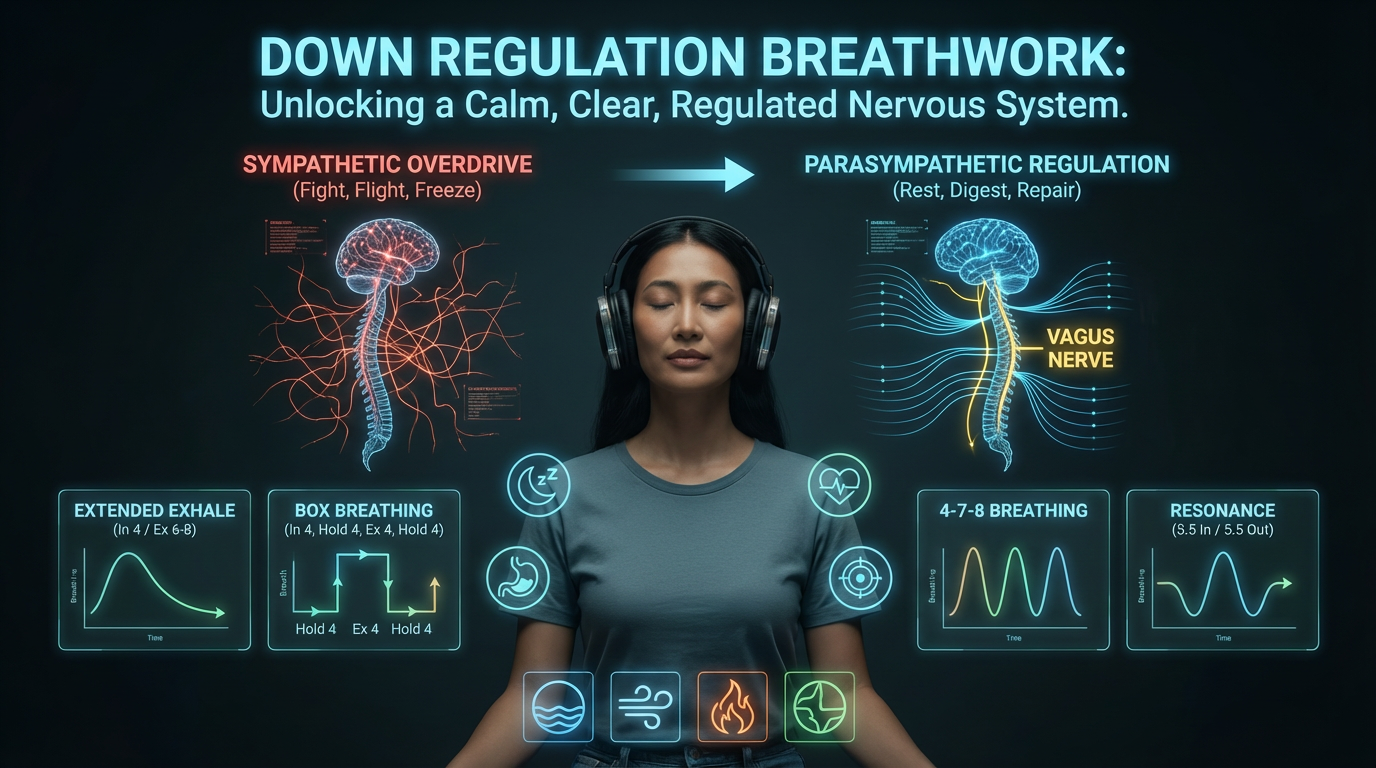
On the left, you see "Sympathetic Overdrive," represented by chaotic, high-energy nerve firings. On the right, after applying breathwork, you see "Parasympathetic Regulation," characterized by calm, orderly signals and explicit activation of the vagus nerve. The small graphs at the bottom (Extended Exhale, Box Breathing, etc.) show different patterns of breathing that can achieve this shift. This is the core principle of using breathwork for stress regulation.
Let's return to the BBC article to see the science behind why a long exhale is so effective.
These breathing techniques could reduce your stress in minutes
This article explains the direct, mechanical link between your breathing patterns and your nervous system state.
First, read the paragraph just before "Training the nervous system" that begins "If we breathe through our mouths...". Then, read the section on "1. Cyclic sighing", paying close attention to the explanation of why a prolonged exhalation is key to calming the body.
As the article explains, inhaling is an active process that slightly speeds up the heart, while exhaling is a passive process that slows it down. By intentionally extending the duration of your exhale, you are consciously engaging your body's built-in relaxation mechanism. This is not a placebo effect; it is a direct physiological intervention. Techniques like the physiological sigh, extended exhales, and 4-7-8 breathing, which we will explore in later lessons, are all built on this fundamental principle.
Conclusion
Today we've mapped the two opposing forces that govern your body's physical state. You are now equipped not just to understand them intellectually, but to recognize them in your own lived experience.
Key Takeaways:
- The autonomic nervous system controls your body's unconscious functions and has two main branches.
- The Sympathetic Nervous System (SNS) is your "fight or flight" accelerator, preparing you for action with a faster heart rate, shallow breathing, and muscle tension.
- The Parasympathetic Nervous System (PNS) is your "rest and digest" brake, promoting recovery with a slower heart rate, deep breathing, and relaxation.
- You can recognize which system is dominant by observing physical signs like your heart rate, breathing pattern, and muscle tension.
- Your breath is a powerful, direct tool for influencing your nervous system. Intentionally slowing down your breathing, especially with long exhales, stimulates the vagus nerve and activates the calming parasympathetic response.
In this lesson, we explored your body's "electrical wiring." In our next session, we will investigate its "chemical messengers." We will examine the roles of key neurotransmitters like dopamine, serotonin, and GABA, and discover how these molecules shape your mood, motivation, and focus from one moment to the next.