Introduction
Welcome back! In our previous lesson, we established a visual vocabulary for "maximum impact" bikinis, identifying the hallmarks of embellished and luxury styles: crystals, chains, and metallic finishes. We defined these as garments designed for spectacle rather than swimming.
Today, we apply that vocabulary to a specific and highly influential cultural context. Our objective is to analyze the use of statement bikinis in hip-hop music videos as symbols of status, wealth, and brand identity. We will move beyond simply identifying what these bikinis look like and delve into what they mean within this genre. For female rappers, the bikini is not just an article of clothing; it's a powerful tool for communication, a key part of a uniform that projects power, success, and a carefully constructed persona.
1. From Swimwear to Uniform: The 'Hard Core' Aesthetic
While bikinis appeared in music videos before the mid-1990s, they were often worn by background models. A pivotal shift occurred when female rappers began to adopt the bikini as a central part of their own artistic image. This transformed the garment from a passive prop into an active "uniform" of power and defiance.
The artist most central to this shift was Lil' Kim. Her debut album, Hard Core, arrived with a visual language that was as confrontational and revolutionary as its lyrics.
How Lil Kim and Foxy Brown Revolutionized Fashion
Let's begin by reading a description of the iconic imagery that launched Lil' Kim's career. This excerpt from an ELLE article captures the immediate impact of her styling.
Please read the opening paragraph of the article, which describes Lil' Kim's famous promo shot for her album 'Hard Core'. Focus on the author's choice of words: 'sensational, raunchy, and powerful.'
The leopard print thong bikini, paired with heels and fur, was a deliberate statement. It wasn't about a day at the beach; it was a visual manifesto. It established a new aesthetic paradigm where femininity, sexuality, and power were not mutually exclusive but deeply intertwined.
This approach was quickly adopted by her contemporaries, solidifying the statement bikini as a core component of the female rapper's wardrobe.
This next reading, from an essay by Zandria F. Robinson, situates this trend within a broader cultural context, explicitly identifying the bikini as a 'uniform' for a new generation of artists.
Please read the first half of the section that begins 'Long before Sports Illustrated discovered Black women...'. Focus on the passage starting 'Whether on the page or on set or in concert, rappers like Lil’ Kim...'. Note how the author argues that these artists were not seeking 'a tolerable and derivative sense of elegance' but were instead using the bikini to usher in a 'new epoch of rap'.
This idea of the bikini as a "uniform" is critical. As with any uniform, it signifies membership in a group and communicates a specific set of values. In this case, the values were opulence, sexual autonomy, and a rejection of mainstream respectability politics.
2. Decoding the Symbols: Status, Wealth, and Brand Alignment
Once the bikini was established as a uniform, it also became a canvas for displaying social and economic capital. There are two primary ways statement bikinis achieve this in hip-hop videos:
A. Logomania and Luxury Association
The most direct method is through the explicit use of high-fashion branding. By wearing bikinis from houses like Dior, Fendi, and Gucci, artists align themselves with established symbols of wealth and exclusivity. This was not about subtlety; it was about making luxury brands visible and claiming a space within that world.
As the two articles you've just read mention, both Lil' Kim and Foxy Brown were pioneers in this. Foxy Brown called herself the "dark-skinned Christian Dior poster girl," while Lil' Kim's association with Versace and her famous (though ultimately unreleased) Louis Vuitton body paint ad cemented this link between hip-hop and high fashion. This act forced luxury houses, which had historically ignored Black women, to pay attention.
B. Material Opulence and Symbolic Currency
This is where our previous lesson on embellishments becomes crucial. The crystals, chains, and metallic fabrics are not just decorative; they function as a form of symbolic currency.
- Crystals & Rhinestones: A bikini covered in crystals visually communicates expense and craftsmanship. It’s an overt display of being able to afford non-functional, purely aesthetic luxury.
- Chains & Hardware: Chains replace fabric straps, not for comfort, but to evoke the imagery of expensive jewelry. The bikini becomes a piece of body jewelry, signaling wealth through its materials.
- Metallic Finishes: The "liquid gold" or "molten silver" look immediately connotes precious metals and, by extension, wealth.
This symbolic language is so ingrained in the genre that it has become part of the lyrical lexicon.

3. Building a Brand: The Bikini as an Expression of Identity
Beyond just signaling wealth, the statement bikini is a powerful tool for constructing an artist's brand identity. This is particularly relevant given your interest in personal relationships and your background in social research. The choice of bikini—its cut, its embellishments, its styling—is a calculated performance of a specific persona.
Let's return to the essay "All of Us Had a Taste" to explore this idea further.
This final reading connects the legacy of pioneers like Lil' Kim to contemporary artists like Megan Thee Stallion, framing the bikini as a symbol of economic and sexual freedom.
Please read the section that begins 'Some twenty-five years after Lil’ Kim’s debut...'. Pay close attention to the analysis of Megan Thee Stallion's 'Sports Illustrated' cover and her own swimwear line. Note the connection the author makes between 'female freedom,' 'sexual freedom,' and 'economic freedom.'
As the text argues, when Megan Thee Stallion wears a bikini from her own collection, it's a multi-layered statement. It reinforces her brand identity, which is built on unapologetic confidence ("I like to drink and I like to have sex"). It's also a display of entrepreneurship and "economic freedom." The bikini is no longer just a borrowed luxury item; it's a product of her own empire.
This is the evolution of the trend: from using bikinis to signal wealth to using them to generate it, completing the circle of brand identity.
4. Case Study: The Maximalist Statements of 'WAP'
Let's synthesize these ideas by analyzing a definitive example from recent years: the styling in Cardi B and Megan Thee Stallion's "WAP" music video.
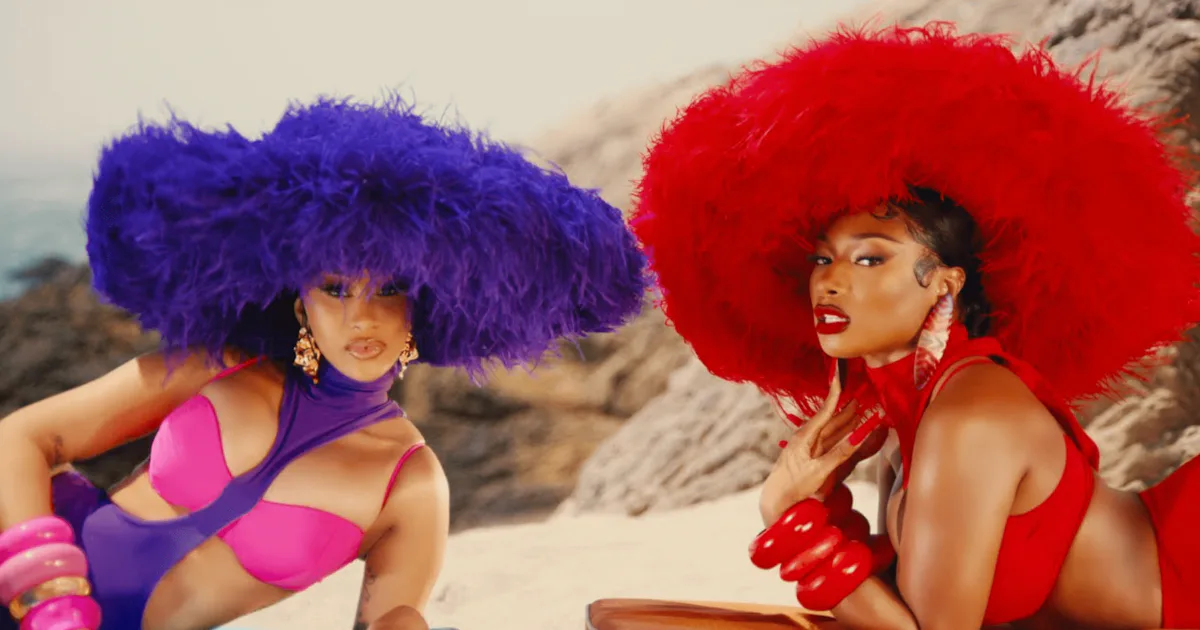
Take a moment to analyze this image using the framework of our lesson:
- Status & Wealth: How is status being communicated here? Consider that these are custom-designed, not store-bought. The sheer level of coordination, detail (note the cut-outs and hardware), and accessorizing signifies an enormous budget and access to top-tier designers. This is a display of A-list industry power.
- Brand Identity: What kind of persona does this styling project for Cardi B and Megan? The vibrant colors, exaggerated silhouettes, and revealing cuts project extreme confidence, a celebration of their bodies, and a total command of their image. It reinforces their shared brand of being bold, dominant, and in control of their sexuality and success.
The bikinis in "WAP" are the culmination of the legacy we've discussed. They are uniforms of power, laden with the symbolic currency of luxury, and are the primary vehicle for expressing a meticulously crafted brand identity.
Conclusion
In this lesson, we've analyzed how the statement bikini functions within the specific cultural arena of hip-hop music videos. We've seen that it is far more than simple swimwear; it's a complex and powerful signifier.
Key Takeaways:
- Pioneering artists like Lil' Kim transformed the bikini from a background prop into a "uniform" for female rappers, symbolizing a new era of female power and sexual agency in hip-hop.
- Statement bikinis communicate status and wealth through two main channels: direct association with luxury brands (logomania) and the use of opulent materials like crystals and chains that act as symbolic currency.
- The bikini is a central tool in building an artist's brand identity, used to project a persona of confidence, economic independence, and unapologetic femininity.
- Contemporary artists like Cardi B and Megan Thee Stallion continue this legacy, using custom, high-fashion bikini looks to create iconic visual statements that reinforce their status and brand.
In our next lesson, we will continue our exploration of embellished bikinis but shift the context. We'll evaluate how these styles are used in mainstream pop performance contexts by artists like Jennifer Lopez and Shakira, comparing their aesthetic function to what we've analyzed today in hip-hop.