Welcome to our next lesson on linked lists. In our previous session, we explored the fast and slow pointer technique, a powerful pattern for solving problems like cycle detection and finding a list's middle element. Those exercises were excellent practice in manipulating next pointers to analyze a list's structure.
Today, we'll continue to hone those pointer manipulation skills by tackling another classic and fundamental interview problem: merging two sorted linked lists. The goal is to combine two lists, which are already in ascending order, into a single, larger sorted list. This problem is not only a frequent test of your linked list proficiency but also serves as a core component of more complex algorithms, such as the Merge Sort algorithm, which we'll encounter later in the course.
By the end of this lesson, you will be able to implement both iterative and recursive solutions to merge two sorted linked lists and articulate the trade-offs between them.
Defining the Problem
First, let's clearly define the task. You are given the heads of two singly linked lists, list1 and list2. Each list is guaranteed to be sorted in non-decreasing order. Your job is to merge them into a single sorted list by "splicing" together the nodes from the original two lists. This means you should rearrange the existing nodes' next pointers, not create a brand-new list with new nodes.
For example, if list1 is 5 -> 10 -> 15 and list2 is 2 -> 3 -> 20, the result should be 2 -> 3 -> 5 -> 10 -> 15 -> 20.
This GeeksforGeeks article starts by clearly defining the problem with helpful diagrams.
Review the introductory section, from the problem statement and examples, to solidify your understanding of the inputs and expected output.
An Initial Thought: The Naive Approach
When faced with a new problem in an interview, it's often a good strategy to start by discussing a simple, even if suboptimal, solution. For this problem, one straightforward idea is to traverse both linked lists, collect all node values into an array, sort that array, and then build a new linked list from the sorted values.
The same GeeksforGeeks article describes this brute-force method.
Read the section "[Naive Approach] By Using Array" to see how this would be implemented. Focus on the core idea and skim the Python code block to see it in action.
This approach works, but it has significant drawbacks. Let's analyze its complexity. If the lists have lengths m and n, creating the array takes time. Sorting this array takes time. Finally, creating a new list from the array takes another time. The dominant factor is sorting, so the total time complexity is . Furthermore, it requires extra space for the array.
We can do much better. Since the lists are already sorted, we can leverage that property to build the merged list in a single pass, avoiding the need for a separate sorting step and extra storage.
The Optimal Iterative Solution
The most efficient approach is an iterative one that builds the merged list in place. The core idea is to maintain pointers to the current nodes in both list1 and list2 and, at each step, append the smaller of the two nodes to our result list.
A key technique here is the use of a dummy node. This is a placeholder node that acts as a temporary head for our new list. It elegantly solves the "empty list" edge case, as we always have a node to which we can append the first element. We'll also use a tail pointer, which always points to the last node in our merged list, making it easy to append the next node.
The NeetCode video below provides an excellent visual walkthrough of this exact process.
Merge Two Sorted Lists - Leetcode 21 - Python
This video from NeetCode explains the iterative merge process, focusing on the dummy node technique.
First, watch the introduction and initial walkthrough from the beginning. Then, pay close attention to the explanation of the dummy node and how pointers are managed from this section.
The algorithm can be summarized as follows:
- Create a
dummynode to serve as the start of the result list. Initialize atailpointer to thisdummynode. - While both
list1andlist2have nodes:- Compare the values of the current nodes of
list1andlist2. - Set
tail.nextto point to the node with the smaller value. - Advance the pointer of the list from which you just took the node.
- Advance the
tailpointer to the new last node (tail = tail.next).
- Compare the values of the current nodes of
- Once the loop finishes, one of the lists will be empty, but the other might still contain nodes. Since that remaining list is already sorted, we can simply append it to the end of our result by setting
tail.nextto the head of the remaining list. - Finally, return
dummy.next, which is the true head of the merged, sorted list.
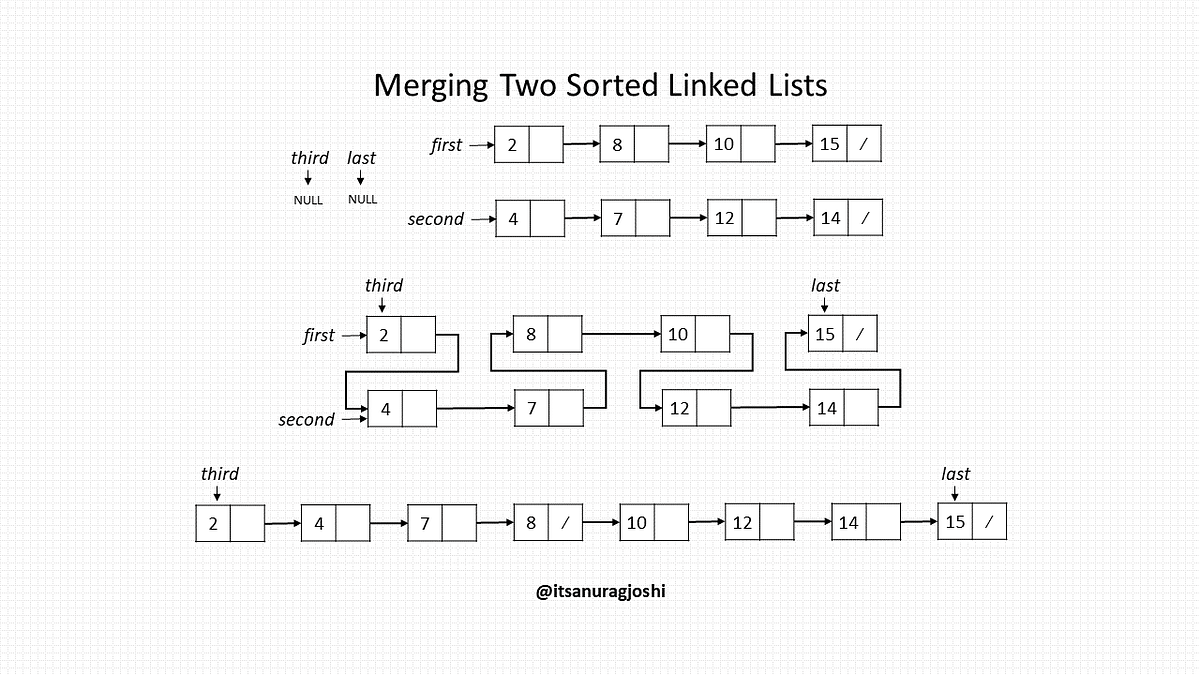
Let's see how this translates into clean, efficient Python code.
Merge Two Sorted Lists - Leetcode 21 - Python
The rest of the NeetCode video details how to handle remaining list portions and implements the full algorithm in Python.
First, see how to handle the case where one list is exhausted before the other from this part. Then, watch the full Python implementation from the coding walkthrough. Finally, see how the function returns the final result, dummy.next, at the end.
This iterative approach has a time complexity of because we visit each node in both lists exactly once. Crucially, its space complexity is because we are only using a few pointers (dummy, tail) and not allocating any new data structures proportional to the input size. This is the optimal solution and the one you should aim for in an interview.
The Recursive Solution
Another elegant way to think about this problem is through recursion. The problem exhibits a self-similar structure: merging two lists is equivalent to picking the smaller of the two head nodes and then merging the rest of the lists. This naturally lends itself to a recursive definition.
The logic is as follows:
- Base Case: If either
list1orlist2is empty, there's nothing to merge. Simply return the non-empty list. - Recursive Step: Compare the values at the heads of
list1andlist2.- If
list1.valis smaller, then we knowlist1's head is the head of our merged list. Itsnextelement will be the result of merging the rest oflist1(list1.next) with all oflist2. - Otherwise,
list2's head is the head of our merged list. Itsnextelement will be the result of merging all oflist1with the rest oflist2(list2.next).
- If
21. Merge Two Sorted Lists - In-Depth Explanation
This AlgoMonster article provides excellent intuition for the recursive approach, comparing it to merging sorted piles of cards.
Start by reading the "Intuition" section to understand the recursive structure. Next, read the "Solution Approach" section, which breaks down the base case and the recursive logic. Follow the detailed walkthrough to trace how the recursion unfolds and then winds back up to build the final list. Finally, examine the Python code which implements this logic.
To get an even deeper understanding of how the program executes these recursive calls, the following video provides a step-by-step visualization of the call stack.
LeetCode 21: Merge Two Sorted Lists RECURSIVELY - Interview Prep Ep 62
This video from Fisher Coder gives a fantastic visual trace of the recursive calls and how the pointers are re-linked as the stack unwinds.
Start with the explanation of the base cases and initial logic. Follow the main recursive logic from this section. The most valuable part is the detailed visualization of the call stack. Watch from this complete walkthrough to see exactly how the computer builds and unwinds the stack to produce the result.
Complexity and Trade-offs
The recursive solution is concise and can be very intuitive once you grasp the pattern. However, it comes with a trade-off.
- Time Complexity: . Similar to the iterative solution, we process each node once.
- Space Complexity: . This is the key difference. Each recursive call adds a frame to the call stack. In the worst case, the depth of the recursion can be the sum of the lengths of the two lists, leading to space usage proportional to the input size. For very long lists, this could even lead to a stack overflow error.
Given your background as a full-stack developer, this is a classic trade-off: the iterative solution is generally preferred for production systems due to its space complexity and robustness against stack limits, while the recursive solution is a beautiful demonstration of algorithmic thinking that is also important to know for interviews.
Conclusion
In this lesson, we explored two effective methods for merging sorted linked lists, a foundational problem in data structures. You've seen how to leverage the sorted property of the lists to achieve a linear time solution.
Key Takeaways:
- Problem: Merge two sorted linked lists into one by splicing existing nodes.
- Iterative Solution:
- Uses a dummy node and a
tailpointer to build the list. - Time Complexity:
- Space Complexity: - This is the optimal solution in terms of memory.
- Uses a dummy node and a
- Recursive Solution:
- Defines the problem in terms of itself: pick the smaller head and recursively merge the rest.
- Time Complexity:
- Space Complexity: due to the call stack.
- Trade-off: The iterative approach is more space-efficient and robust for large inputs, while the recursive approach can offer more concise code.
Having mastered fundamental linked list operations and patterns like fast/slow pointers and merging, we are now ready to move on. In the next lesson, we will shift our focus to another essential linear data structure: the stack. We will learn about its Last-In, First-Out (LIFO) principle and apply it to solve problems like validating parentheses.