Introduction
Welcome back! In the last lesson, we developed a brute-force recursive solution for the "Climbing Stairs" problem. We concluded by observing its major drawback: it's incredibly inefficient. The function ends up recalculating the number of ways for the same step over and over again. This is a classic case of overlapping subproblems.
Today, we'll fix that. You'll learn your first and most intuitive dynamic programming technique: memoization. We will take our existing recursive solution and apply memoization to it, transforming it from an exponential-time algorithm into a highly efficient linear-time one. This technique of using recursion with memoization is also known as the top-down dynamic programming approach.
The Problem with Brute-Force Recursion
Let's quickly recall the recursion tree for finding the number of ways to climb 5 stairs.

Every time our function climbStairs(3) is called, it re-computes the entire branch below it. This redundant work is the source of the inefficiency. The solution seems simple: what if our function could remember the answers it has already found?
Memoization: Remembering Your Results
This is precisely what memoization does. It's an optimization technique where you cache, or store, the results of expensive function calls and return the cached result when the same inputs occur again.
To understand the concept more formally, please read the first few paragraphs of the following article.
Chapter 7 - Memoization and Dynamic Programming
This text from 'Invent with Python' provides a clear and concise definition of memoization and explains how it fits into the broader picture of dynamic programming.
Read the sections 'Memoization' and 'Top-Down Dynamic Programming'. Focus on the definition of memoization and the idea of 'overlapping subproblems'.
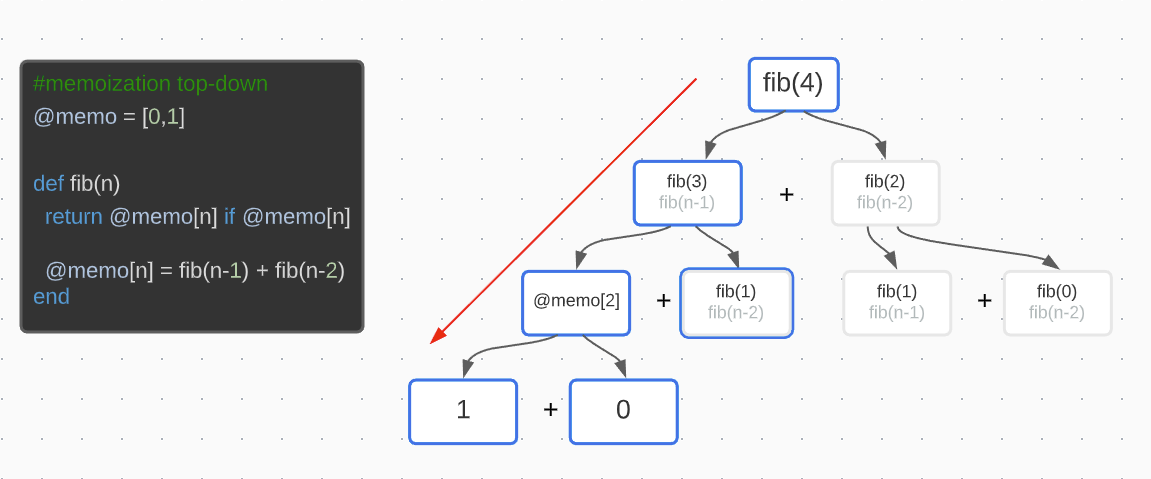
The core idea is to trade a bit of memory (to store the results) for a significant gain in speed. When our function needs a result, it first checks its memory (the cache). If the answer is there, it uses it. If not, it does the calculation, stores the answer in the cache, and then returns it.
Implementing Memoization in Python
Let's translate this idea into code. We'll modify the recursive function we developed in the previous lesson. The logic follows a simple, repeatable pattern.
The following video provides an excellent walkthrough of this process using the Fibonacci problem, which has the exact same recursive structure as our Climbing Stairs problem.
What Is Dynamic Programming and How To Use It
This video from CS Dojo clearly explains how to modify a naive recursive function to include memoization.
Watch from 02:19 to 06:34. Pay close attention to the three key changes made to the function: (1) adding a 'memo' data structure, (2) checking the memo at the beginning, and (3) storing the result in the memo before returning.
As the video demonstrates, the process can be broken down into these steps:
- Create a cache: A Python dictionary is a perfect choice. It will store our computed results, mapping the input
nto the resultways(n). - Check the cache: At the very beginning of the recursive function, check if the result for the current input
nis already in the dictionary. If it is, return it immediately. - Compute and store: If the result is not in the cache, perform the recursive calculation as before. Then, just before returning, store the newly computed result in the cache.
Let's apply this to our climbStairs function.
Original Brute-Force Code (from last lesson):
def climbStairs_recursive(n):


    # Base cases from our previous lesson:
    # ways(0) = 1 (do nothing)
    # ways(1) = 1 (take one step)
    if n == 0:
        return 1
    if n == 1:
        return 1


    # Recurrence relation
    return climbStairs_recursive(n - 1) + climbStairs_recursive(n - 2)
Memoized (Top-Down DP) Version:
# We use a helper function to handle the recursion with the memo cache
def climbStairs_helper(n, memo):


    # Step 2: Check if the result is already in the cache
    if n in memo:
        return memo[n]


    # Base cases
    if n == 0:
        return 1
    if n == 1:
        return 1


    # Step 3: If not in cache, compute it recursively
    result = climbStairs_helper(n - 1, memo) + climbStairs_helper(n - 2, memo)


    # Store the result in the cache before returning
    memo[n] = result
    return result

def climbStairs(n):


    # Step 1: Create the cache (a dictionary)
    memo = {}
    return climbStairs_helper(n, memo)


# Let's test it!
print(f"Ways to climb 5 stairs: {climbStairs(5)}") # Output: 8
print(f"Ways to climb 40 stairs: {climbStairs(40)}") # This now computes almost instantly!
Notice that the core recursive logic climbStairs_helper(n - 1, memo) + climbStairs_helper(n - 2, memo) remains unchanged. We've simply wrapped it with logic to manage our cache.
For another perspective, watch this short segment that directly implements memoization for the Climbing Stairs problem.
Climbing Stairs - Leetcode 70 - Dynamic Programming (Python)
This video from Greg Hogg provides a concise implementation of the top-down memoized solution for our exact problem.
Watch from 05:54 to 07:20. The base cases are slightly different (n=1 and n=2), but the memoization principle is identical. Observe how a dictionary is used as the cache.
Analyzing the Improvement
What have we gained? Let's analyze the time complexity.
With our memoized solution, the recursive function climbStairs_helper is now called for each number from n down to 0 exactly once. The first time it's called for a number k, it does the computation and stores the result. Every subsequent call for k is an O(1) dictionary lookup.
What Is Dynamic Programming and How To Use It
Let's return to the CS Dojo video for a clear analysis of the time complexity.
Watch from 06:34 to 09:26. The video explains why the number of function calls becomes linear, leading to a time complexity of O(n).
- Time Complexity: We went from exponential
O(2^n)to linearO(n). This is a monumental improvement. CalculatingclimbStairs(40)went from taking minutes (or more) to milliseconds. - Space Complexity: We are now using extra memory. The recursion can go
nlevels deep on the call stack, and ourmemodictionary will store up tonkey-value pairs. Therefore, the space complexity isO(n). This is the trade-off: we use more space to save a lot of time.
A Pythonic Shortcut: @lru_cache
This pattern of creating and managing a cache for a recursive function is so common that Python has a built-in tool to do it for you, called a decorator.
Chapter 7 - Memoization and Dynamic Programming
The 'Invent with Python' article also introduces a much simpler way to memoize a function in Python using the @lru_cache decorator.
Read the section 'Python’s functools Module'. See how just two lines of code can fully memoize our original recursive function.
Using this decorator, our entire solution becomes incredibly clean:
from functools import lru_cache

@lru_cache(maxsize=None) # The decorator automatically handles the caching
def climbStairs_pythonic(n):


    # Just the original recursive logic!
    if n == 0:
        return 1
    if n == 1:
        return 1
    return climbStairs_pythonic(n - 1) + climbStairs_pythonic(n - 2)


# Test it
print(f"Ways to climb 40 stairs (pythonic): {climbStairs_pythonic(40)}")
In a technical interview, being able to quickly write this version demonstrates strong Python knowledge. However, it is crucial that you can also explain and implement the manual cache method to show you understand the underlying mechanism.
Conclusion
In this lesson, you applied your first major dynamic programming optimization. By adding a cache to our brute-force recursive solution, we eliminated redundant computations and drastically improved its performance.
Key Takeaways:
- Memoization is a technique to speed up functions by storing the results of previous calls.
- It is the core of the top-down dynamic programming approach.
- The implementation involves three steps: create a cache, check the cache at the start of the function, and store the result in the cache before returning.
- Memoization reduces the time complexity of Fibonacci-style recursive problems from
O(2^n)toO(n)at the cost ofO(n)space complexity. - In Python, the
@lru_cachedecorator provides a convenient way to apply memoization automatically.
Preview of the Next Lesson:
We have now mastered the top-down, recursive approach to dynamic programming. But what if we could solve the problem without recursion at all? In the next lesson, we will explore the bottom-up approach, also known as tabulation. We will see how to solve the same problem by starting with the base cases and iteratively building up our solution, which can sometimes be even more efficient.