Introduction
Hello! Welcome back to our module on Technical Interview Skills. In our previous lesson, we tackled the classic problem of reversing a linked list in-place using a three-pointer iterative method. You learned how to manipulate next pointers efficiently, achieving an optimal solution with time and space complexity.
Today, we're going to explore another fundamental linked list problem that's a favorite in interviews: how to detect a cycle in a linked list. This lesson will introduce you to a new and powerful algorithmic pattern called the Fast and Slow Pointer technique, also known as Floyd's Tortoise and Hare algorithm.
A cycle occurs when a node in the list points back to a previously visited node, creating an infinite loop. If you were to traverse such a list, you'd never reach the end. Our goal today is to write a function that can determine if such a cycle exists.
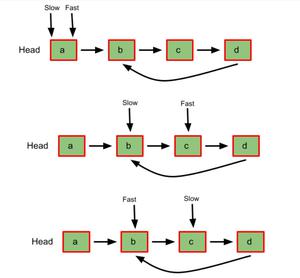
The Problem: Cycle Detection
The formal problem statement is: "Given head, the head of a linked list, determine if the linked list has a cycle in it." You must return true if there is a cycle and false otherwise.
Before diving into the optimal solution, let's consider a more straightforward approach. How could we detect a node we've already seen? This thought process often leads to using a hash table (or a set in Python).
A Naive but Intuitive Solution: Using a Hash Set
The most direct way to check if you've visited a node before is to keep a record of every node you've seen. A hash set is perfect for this.
The algorithm would be:
- Create an empty hash set, let's call it
visited_nodes. - Start traversing the list from the
head. - For each
nodeyou visit:- Check if the
nodeis already invisited_nodes. If it is, you've found a cycle! Returntrue. - If it's not, add the
nodetovisited_nodesand move to the next node.
- Check if the
- If you reach the end of the list (
None) without finding a duplicate, it means there is no cycle. Returnfalse.
The following video explains this approach clearly.
L14. Detect a loop or cycle in LinkedList | With proof and Intuition
Let's watch the first part of this video from the 'take U forward' channel. It explains the hash set method and analyzes its performance, which is a great starting point for understanding the problem.
Please watch from the beginning up to 07:36. Focus on the logic of using a hash map (or set) to keep track of visited nodes and why this correctly identifies a loop.
As the video explains, this solution has:
- Time Complexity: , because we visit each node once.
- Space Complexity: , because in the worst case (a list with no cycle), we store every node in the hash set.
While this works, an interviewer will almost always follow up by asking: "Can you do it with space?" This is where the Fast and Slow Pointer technique comes in.
The Optimal Solution: Floyd's Tortoise and Hare Algorithm
This elegant algorithm uses two pointers that move through the list at different speeds.
- A slow pointer (the "tortoise") moves one node at a time.
- A fast pointer (the "hare") moves two nodes at a time.
The logic is as follows:
- Initialize both
slowandfastpointers to theheadof the list. - Move
slowby one step andfastby two steps in each iteration. - If the list has no cycle, the
fastpointer will reach the end (None) first. In this case, we can stop and returnfalse. - If the list has a cycle, the
fastpointer will enter the cycle and start lapping theslowpointer. Eventually, they are guaranteed to meet at the same node. Whenslow == fast, we've detected a cycle and can returntrue.
This article provides a great analogy to help you visualize this.
Fast & Slow Pointers: Master Floyd’s Cycle Detection
This article from Medium uses the analogy of two runners on a track to explain the core concept. It's a very intuitive way to think about why this algorithm works.
Read the introductory sections 'What Are Fast & Slow Pointers?' and 'How It Actually Works'. Don't worry about the code yet, just focus on the analogy and the high-level logic.
Why Are They Guaranteed to Meet?
This is the most important question to understand. It might seem possible for the fast pointer to "jump over" the slow pointer indefinitely. However, this is not the case.
Once both pointers are inside the cycle, the distance between them (in the direction of traversal) decreases by exactly one node with each step. Since the distance is a finite integer that decreases by one at a time, it is guaranteed to eventually become zero, meaning the pointers will meet.
Let's return to the video from 'take U forward', which provides an excellent mathematical intuition for this guarantee.
L14. Detect a loop or cycle in LinkedList | With proof and Intuition
This segment of the video breaks down why collision is inevitable. Understanding this proof is key to explaining the algorithm's correctness in an interview.
Please watch from 07:36 to 10:28 to see the algorithm in action, and then from 13:36 to 18:27 for the proof and intuition. Focus on how the relative distance between the pointers changes at each step.
Python Implementation
Now, let's translate this logic into Python code. The implementation is surprisingly concise.
# Assume the ListNode class is defined as in the previous lesson
class ListNode:
    def __init__(self, val=0, next=None):
        self.val = val
        self.next = next

def has_cycle(head: ListNode) -> bool:
    """
    Detects if a linked list has a cycle using Floyd's algorithm.
    Time: O(n), Space: O(1)
    """
    if not head or not head.next:
        return False

    slow = head
    fast = head


    # The loop condition is crucial: we must check `fast` and `fast.next`
    # to ensure we don't try to access `next` on a None object.
    while fast and fast.next:
        slow = slow.next          # Move 1 step
        fast = fast.next.next   # Move 2 steps


        # If they meet, a cycle exists
        if slow == fast:
            return True


    # If the loop finishes, fast reached the end, so no cycle
    return False


# --- Example Usage ---
# Create a list with a cycle: 1 -> 2 -> 3 -> 4 -> 2 (back to node 2)
node1 = ListNode(1)
node2 = ListNode(2)
node3 = ListNode(3)
node4 = ListNode(4)
node1.next = node2
node2.next = node3
node3.next = node4
node4.next = node2  # Creates the cycle

print(f"Does the list have a cycle? {has_cycle(node1)}")  # Output: True


# Create a list without a cycle: 1 -> 2 -> 3 -> 4 -> None
nodeA = ListNode(1)
nodeB = ListNode(2)
nodeC = ListNode(3)
nodeD = ListNode(4)
nodeA.next = nodeB
nodeB.next = nodeC
nodeC.next = nodeD

print(f"Does the list have a cycle? {has_cycle(nodeA)}") # Output: False
Analysis and Interview Context
To be fully prepared for an interview, you need to understand the algorithm's performance and how to discuss it.
Fast & Slow Pointers: Master Floyd’s Cycle Detection
Let's revisit the Medium article to look at a clean implementation and, more importantly, the performance analysis and interview tips.
Please read the sections 'Python Solution', 'Performance Analysis', and 'Interview Tips & Tricks'. Pay close attention to the time and space complexity and the points about what interviewers look for.
As the article confirms, the performance is:
- Time Complexity: . Although it might seem more complex, the slow pointer travels at most nodes before a collision or the end of the list is found.
- Space Complexity: . We only use two pointers, regardless of the list's size. This is the optimal space complexity and the main advantage of this algorithm.
Being able to explain these points and handle edge cases (like an empty list or a list with one node) will show your thorough understanding.
Conclusion
Excellent work today! You've added another essential algorithm to your interview preparation toolkit. You now know how to detect a cycle in a linked list using the highly efficient fast and slow pointer technique.
Key Takeaways:
- A cycle in a linked list is an infinite loop where a node points back to a previous node.
- A hash set provides an intuitive space solution, but the optimal approach uses constant space.
- Floyd's Tortoise and Hare algorithm uses a slow pointer (1 step) and a fast pointer (2 steps). If there is a cycle, they are guaranteed to meet.
- The optimal solution has a time complexity of and a space complexity of .
Preview of the Next Lesson:
In the next lesson, we will continue practicing for interviews by tackling a problem that requires you to solve a problem requiring a combination of data structures, such as a hash table and a list. This will test your ability to choose and integrate the right tools to solve a problem efficiently, a skill that is highly valued in technical interviews.