Hello! Welcome to your second lesson.
In our first session, we learned that cryptocurrency is digital money built on a technology called a blockchain. We also saw that when you trade on Binance, most of your trades happen on Binance's internal records, but the whole system is anchored by the security of the underlying blockchain for deposits and withdrawals.
Today, we're going to pull back the curtain on that foundational technology. This lesson will explain the role of blockchain in ensuring secure and permanent transactions. Understanding this is key to building confidence in crypto, as it answers the crucial question: "Why is this system considered trustworthy without a bank or central authority in charge?"
The Core Idea: A Distributed, Digital Ledger
In the previous lesson, we described a blockchain as a public ledger. Let's expand on that. Imagine a special notebook where new entries can be added, but old entries can never be erased or changed. Now, instead of that notebook being in one person's hands, an identical copy is shared with thousands of people around the world.
This is the essence of a blockchain: it's a decentralized and distributed digital ledger.
To get a quick overview, let's watch this short video from Binance.
What Is Blockchain? Explained in 3 Minutes, 6 Seconds
This video, 'What Is Blockchain?', provides a concise, 3-minute explanation of the fundamental concepts, including the digital ledger, blocks, and immutability.
Watch from the beginning until timestamp 01:36. Focus on how it describes the blockchain as a ledger spread across many computers and how data, once recorded, is 'in for good'.
The video introduces two critical concepts that make blockchains so powerful:
- Immutability: Once data is recorded, it's nearly impossible to alter. This makes transactions permanent.
- Decentralization: There is no single owner or middleman; the network is maintained by its users. This is a core part of what makes it secure.
Now, let's explore how the technology achieves this.
How the "Chain of Blocks" Creates Permanence
The name "blockchain" is quite literal. Transactions are grouped into "blocks," and these blocks are linked together to form a "chain." The magic that links them and makes them tamper-resistant is a cryptographic tool called hashing.
A hash is like a unique digital fingerprint for a piece of data. If you change even one tiny detail of the data, the hash (the fingerprint) changes completely.
Each block in the chain contains three key things:
- The transaction data.
- Its own unique hash (its fingerprint).
- The hash of the previous block.
This third point is the crucial link in the chain. By including the previous block's hash, it creates a dependency. If someone tried to alter an old transaction in Block 100, the hash of Block 100 would change. This would break the link to Block 101, which was expecting the original hash. To make the chain valid again, they'd have to recalculate the hashes for Block 101, 102, 103, and every single block that came after.
This video provides an excellent visual explanation of this process.
How does a blockchain work - Simply Explained
The video 'How does a blockchain work - Simply Explained' does a fantastic job of visually demonstrating how blocks, hashes, and the chain structure work together to secure the data.
Watch from timestamp 00:58 to 02:59. Pay close attention to the visual example of how changing data in one block invalidates all the following blocks in the chain.
As you saw, changing a past block creates a cascade effect that instantly invalidates the rest of the chain. This structure is the primary reason why blockchain records are considered immutable or permanent.
Securing the Network: Decentralization and Consensus
Hashing alone isn't enough. A powerful enough computer could theoretically alter a block and quickly recalculate all the hashes for the subsequent blocks to create a new, fraudulent chain.
This is where the other two pillars of blockchain security come into play: Proof-of-Work and Decentralization.
-
Proof-of-Work (PoW): This is a mechanism that deliberately makes it difficult and time-consuming to create a new block. In systems like Bitcoin, "miners" use powerful computers to compete to solve a complex mathematical puzzle. The winner gets to add the next block to the chain. This process takes, on average, 10 minutes. So, to alter a past block, a bad actor would not only have to recalculate the hash for that block but also re-do the difficult "proof-of-work" for that block and every single block after it, all while the rest of the network is continuing to add new, valid blocks. This makes it computationally infeasible.
-
Decentralization: The blockchain ledger isn't stored in one place; it's distributed across a global network of thousands of computers (called "nodes"). When a new block is created, it's broadcast to all nodes. Each node independently verifies it and adds it to its copy of the ledger. For a fraudulent chain to be accepted, an attacker would have to control more than 50% of the network's computing power to convince the network that their fake chain is the real one. This is known as a "51% attack" and is practically impossible on large, established blockchains.
The following clip from the same video explains these two concepts very well.
How does a blockchain work - Simply Explained
Let's continue with the 'Simply Explained' video to see how Proof-of-Work and the distributed network add the final layers of security.
Watch from timestamp 02:59 to 04:48. This part explains how Proof-of-Work slows down block creation and how the distributed network reaches an agreement, or 'consensus'.
This agreement that the nodes come to is called consensus. Proof-of-Work is one type of consensus mechanism. Another popular one you'll hear about is Proof-of-Stake (PoS), where users lock up their own crypto (their "stake") to get a chance to be chosen to validate transactions. Both methods achieve the same goal: they make it incredibly difficult and expensive for anyone to cheat the system, ensuring all participants can agree on a single source of truth.
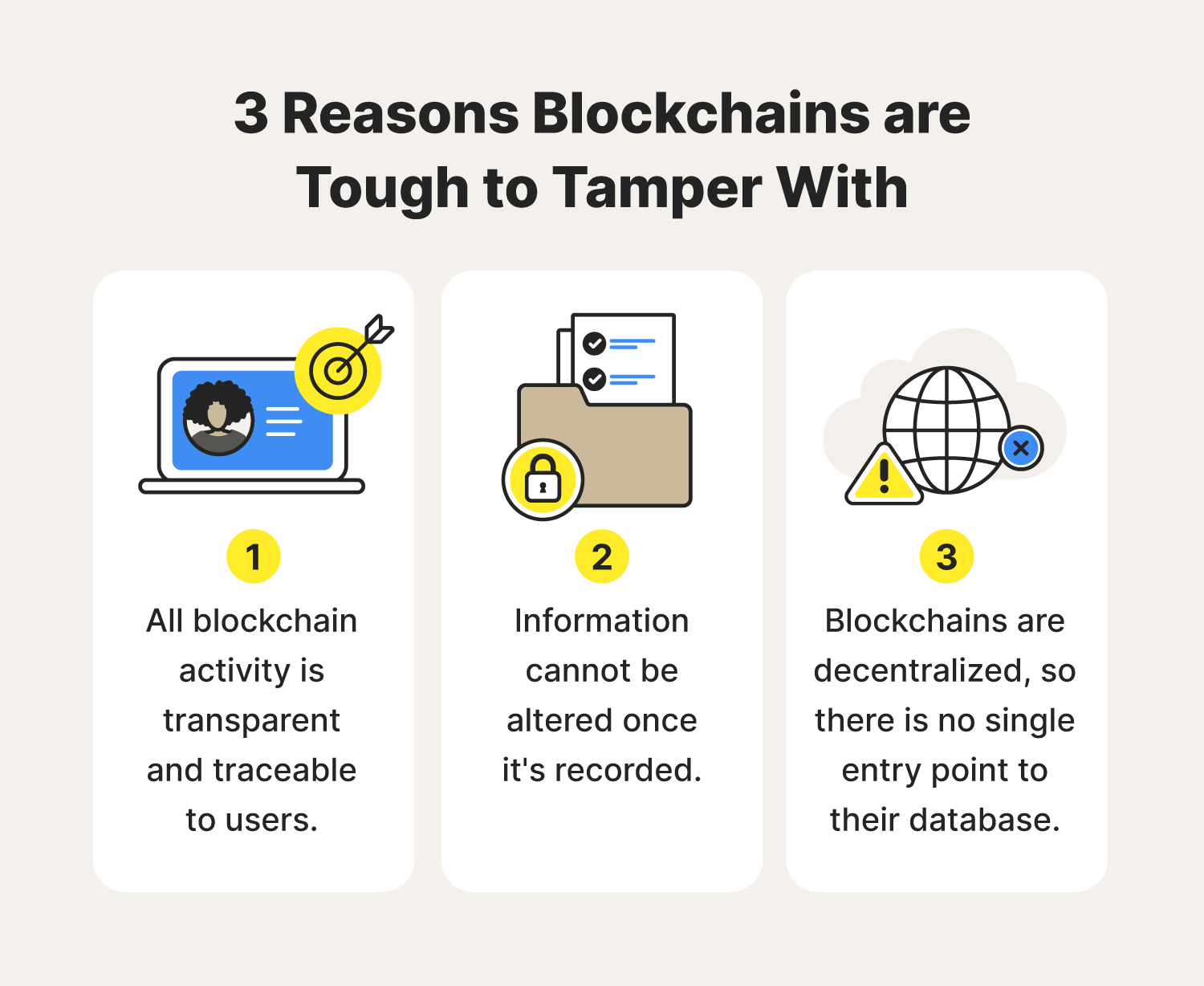
The image below summarizes these core security principles nicely.
Tying It All Together: The Life of a Transaction
So, we have all the pieces: transactions, blocks, chains, hashing, decentralization, and consensus. Let's walk through how they work together when you make a real transaction.
How Does a Blockchain Transaction Work? - Ledger
This article from Ledger, 'How Does a Blockchain Transaction Work?', provides a clear, step-by-step walkthrough of a transaction's journey from creation to final confirmation.
Please read the section titled 'How Does a Blockchain Transaction Work?'. Start from the subheading 'Creating a transaction' and read down to the end of the 'Consensus' subheading. This will give you a detailed view of the entire process.
To make this complex process easier to remember, the same article provides a great analogy.
How Does a Blockchain Transaction Work? - Ledger
Let's look at a simple analogy to help solidify your understanding of how transactions are processed.
Now, read the section titled 'How Blockchain Transactions Work: The Bus Station Analogy'. This comparison is a very helpful way to visualize how transactions are chosen and processed into blocks.
The bus station analogy is a perfect summary:
- Passengers are transactions waiting to be confirmed.
- The Bus is the block, which has limited space.
- The Ticket Price is the transaction fee; passengers willing to pay more get on the bus first.
- The Bus Driver is the miner/validator who collects the passengers (transactions), puts them on the bus (the block), and drives to the destination (adds the block to the chain).
Conclusion
In this lesson, we dissected the technology that makes cryptocurrency possible and trustworthy. You now understand how blockchain ensures that transactions are both secure and permanent.
Here are the key takeaways:
- Blocks and Chains: Transactions are bundled into blocks, which are cryptographically linked together in a chain. Changing any past data would require re-doing the entire chain that follows.
- Immutability (Permanence): The use of hashing to link blocks makes the historical record virtually unchangeable once it's been confirmed.
- Decentralization & Consensus (Security): The ledger is copied across thousands of computers. The network uses a consensus mechanism (like Proof-of-Work or Proof-of-Stake) to agree on the state of the ledger, making it extremely difficult for any single party to corrupt it.
What's Next?
Now that you have a solid understanding of both what cryptocurrency is and the blockchain technology that powers it, we can start looking at the different types of assets you'll encounter. In the next lesson, we will "Distinguish between Bitcoin, altcoins, and stablecoins". You'll learn why not all cryptocurrencies are the same and what their different purposes are.