Hello! Welcome to the first lesson of your course on kinematics. Given your goal of achieving a deep, fundamental understanding of the subject, we will begin by establishing the conceptual and mathematical bedrock upon which all of kinematics is built.
This lesson addresses the first learning outcome: Distinguishing between position, displacement, distance, and path length using rigorous definitions derived from first principles. We will move methodically from the abstract idea of a point in space to a precise, vector-based description of its motion. This foundational language is essential before we can start exploring the "why" behind the physical laws of motion.
1. The Language of Motion: Frames of Reference and Point Particles
Before we can describe motion, we must agree on two simplifying abstractions.
First, in kinematics, we often model real-world objects (cars, planets, electrons) as point particles. This is an idealization where we consider an object's size and shape to be negligible for the problem at hand, allowing us to describe its location as a single point in space. This is a powerful simplification that lets us focus purely on the object's translational motion.
Second, any description of motion is meaningless without a point of view. In physics, this "point of view" is formalized as a frame of reference. A frame of reference consists of:
- An origin: A fixed point
Ofrom which we make our measurements. - A coordinate system: A set of axes (e.g., Cartesian
x, y, zaxes) that define directions in space. - Clocks: To measure time.
All motion is relative. The numbers you use to describe a particle's location depend entirely on the frame of reference you choose.
2. Position: Where is the particle?
With a frame of reference established, we can now rigorously define position.
The position of a particle is its location in space relative to the origin of the coordinate system. We represent this mathematically using the position vector, denoted by .
The position vector is a vector drawn from the origin of the coordinate system to the current location of the particle.
To understand this formally, please read the following introductory sections.
The document 'Kinematics 1' from Duke University provides a clean, first-principles introduction to the concept of the position vector.
Please read the sections titled 'Locating a point particle: the position vector' and the following paragraphs up to the definition of the displacement vector. Focus on how a coordinate system is used to give a numerical specification to the position vector \vec{r} and how its magnitude is defined.
As you've read, in a 3D Cartesian system, the position vector can be written in terms of its components and the standard unit vectors :
Here, are the coordinates of the particle. The magnitude of the position vector, or simply , is the particle's straight-line distance from the origin:
Crucially, position is a vector. It has both magnitude (how far?) and direction (where?).
3. Displacement: The Change in Position
Motion is fundamentally about change in position. This change is captured by a new vector: the displacement vector.
The displacement of a particle is the vector representing the change in its position.
Let's say a particle is at an initial position at time and moves to a final position at time . The displacement vector, , is defined as the vector difference:
This vector points from the initial position to the final position. The diagram below provides an excellent visualization of this vector subtraction.
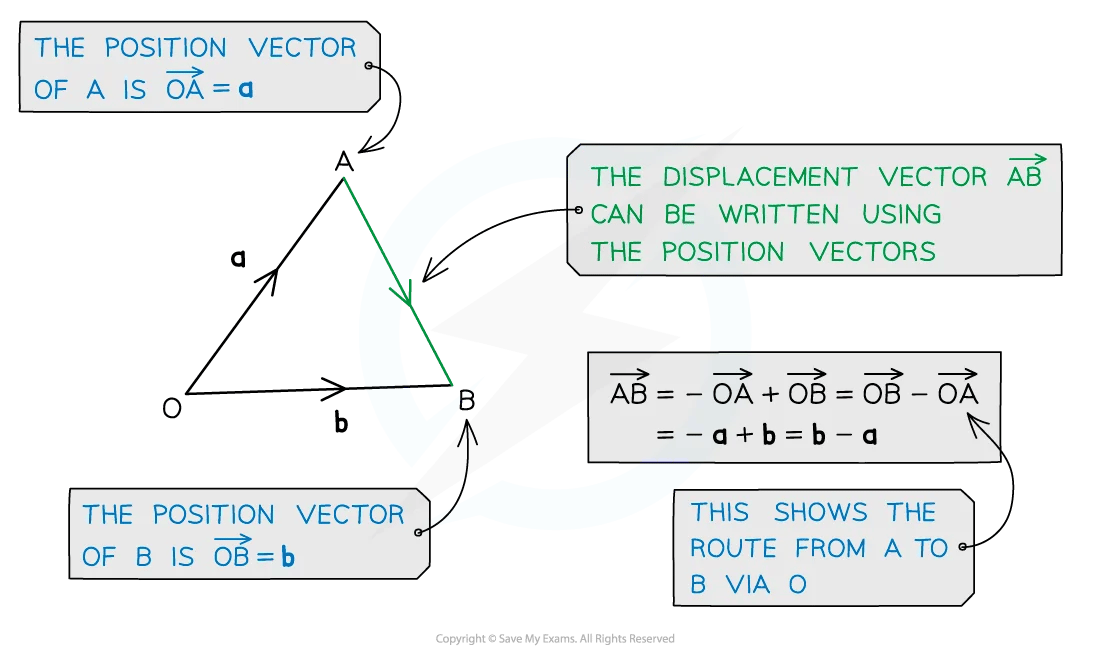
The components of the displacement vector are simply the differences in the corresponding components of the position vectors:
If and , then
Test your understanding!
A particle is initially at position meters. It moves to a final position meters. What is its displacement vector, ?
Show answer
The displacement is .
4. Distance vs. Path Length: The Heart of the Distinction
Now we arrive at two concepts that are often confused: distance and path length. Your preference for rigor will be particularly helpful here.
- Path Length (): The path length is the total length of the actual path, or trajectory, that the particle travels. Imagine an odometer in a car; it measures path length. It is a scalar quantity and is always non-negative.
- Distance (): The distance is defined as the magnitude of the displacement vector, . It represents the length of the straight line connecting the initial and final points. It is also a scalar.
The shortest path between two points is a straight line. Since distance is the length of this straight line, and path length is the length of the actual, possibly meandering, path, we can state a fundamental inequality:
Distance Path Length
Let's prove this with the mathematical rigor you appreciate.
The Proof using the Triangle Inequality
Consider a particle moving along a curved trajectory from point A to B. We can approximate this curve as a sequence of infinitesimally small, straight-line displacement vectors: .

-
The total displacement vector is the vector sum of these infinitesimal displacements:
-
The total path length is the scalar sum of the magnitudes of these infinitesimal displacements:
-
By applying the triangle inequality repeatedly (a process known as mathematical induction), we can extend it from two vectors to vectors:
-
Substituting our definitions from steps 1 and 2, we arrive at the proof:
Or, in other words, distance path length.
The equality holds if and only if the particle moves along a straight line and does not reverse its direction. In this specific case, all the infinitesimal vectors point in the same direction.
A Concrete Example
Imagine a particle moving from point A to point B along a semicircular path of radius , as shown below. Let's place the origin at the center of the circle.
A particle travels from A(-R, 0) to B(R, 0) along a semicircular path.
- Initial Position:
- Final Position:
- Displacement:
- Distance:
- Path Length: = length of the semicircle =
As you can see, the distance () is indeed less than the path length (), since .
Test your understanding!
An athlete runs exactly one lap around a circular track of radius 50 meters, returning to her starting point.
- What is her final displacement?
- What is the distance she has covered?
- What is the path length she has traveled?
Show answer
- Displacement: Since her final position is the same as her initial position (), her displacement is zero. .
- Distance: The distance is the magnitude of the displacement vector. meters.
- Path Length: She traveled the full circumference of the track. meters.
This example clearly highlights the difference: a zero displacement (and distance) despite a very large path length.
Conclusion
This lesson established the fundamental vocabulary of kinematics with the rigor you requested. We have built these concepts from the ground up, starting with the need for a frame of reference.
Here are the key takeaways:
| Concept | Type | Definition | Key Property |
|---|---|---|---|
| Position | Vector () | Vector from the origin to a particle's location. | Depends on the choice of origin. |
| Displacement | Vector () | The change in position: . | Independent of the choice of origin. |
| Path Length | Scalar () | Total length of the trajectory traversed. | Always non-negative; like an odometer. |
| Distance | Scalar () | Magnitude of the displacement vector: $ | \Delta\vec{r} |
Most importantly, we rigorously proved the relationship distance path length, with equality holding only for unidirectional, straight-line motion.
In our next lesson, we will continue building on this vector foundation. We'll explore how to apply vector algebra to decompose motion in arbitrary coordinate systems. This will involve resolving vectors into components, which is the critical step that bridges pure mathematical definitions with the practical analysis of motion in two and three dimensions.