Hello! Welcome to your next lesson on projectile motion.
In our last session, we used vector calculus to derive the parametric equations that describe a projectile's position as a function of time:
These equations tell us where the projectile is at any given time. However, they don't explicitly tell us the geometric shape of the path it traces through space.
Today, we will address that question directly. Your learning outcome is to derive the trajectory equation, y(x), for projectile motion and prove its parabolic nature. We will first eliminate the time parameter, , to get an equation relating directly to . Then, as you prefer a rigorous approach, we will prove mathematically that this equation describes a parabola, connecting the physics to the formal geometry of conic sections.
1. Deriving the Trajectory Equation
The process to find the trajectory equation, , involves a straightforward algebraic substitution. We will use the two parametric equations to eliminate the variable . For simplicity, let's consider a projectile launched from the origin, so and .
The parametric equations become:
From equation (1), we can express time as a function of the horizontal position :
This makes physical sense: since the horizontal velocity is constant, the time elapsed is directly proportional to the horizontal distance covered.
Now, we substitute this expression for into equation (2):
Let's simplify this expression. In the first term, the cancels out, and we can use the identity . In the second term, we square the contents of the parenthesis.
This gives us the celebrated equation of trajectory for a projectile:
This video provides a clear walkthrough of the derivation we just performed.
Equation of Trajectory - Kinematics
To see this derivation in action, please watch the following video from 'The Applied Maths Tutor'. It clearly explains how to resolve the initial velocity and then substitute the time variable to arrive at the trajectory equation.
Watch the segment from 00:39 to 04:17. This covers resolving the initial velocity, finding the expression for time 't' from the horizontal motion, and substituting it into the vertical motion equation to get the final form of y(x).
This equation gives the vertical height of the projectile for any given horizontal position . You can also find this derivation presented clearly on page 3 of the following document under the heading "EQUATION OF PATH".
For a concise written reference of this derivation, please review the following document from Unacademy.
Read the section titled 'EQUATION OF PATH' on page 3. It mirrors the derivation we just did, resulting in the equation y = Ax - Bx^2.
2. Proving the Parabolic Nature of the Trajectory
The trajectory equation is of the form , where and are constants for a given launch. A function of this form is, by definition, a parabola. However, a deeper, more rigorous proof is necessary to truly understand why this shape emerges and how it relates to the formal geometric definition of a parabola.
We will explore two proofs: an algebraic one that transforms the equation into a standard form, and a more fundamental geometric one based on the focus-directrix property.
Proof 1: Algebraic Transformation to Standard Vertex Form
The standard equation for a parabola with a vertical axis of symmetry is or , where is the vertex and is the focal length. Let's show that our trajectory equation can be rearranged into this form.
Starting with :
- Rearrange the terms:
- Divide by :
- Complete the square for the terms. To do this, we add and subtract :
- The terms in the parenthesis form a perfect square:
- Factor out on the right-hand side to isolate :
This equation is now in the standard vertex form , with:
- Vertex
- A negative sign on the right, indicating the parabola opens downwards.
This algebraically proves that the trajectory is a parabola with a vertical axis of symmetry. The vertex corresponds physically to the point of maximum height of the projectile.
Proof 2: The Focus-Directrix Geometric Proof
This proof connects the trajectory to the fundamental geometric definition of a parabola, which aligns with your preference for first-principles reasoning.
Definition of a Parabola
A parabola is the locus of points in a plane that are equidistant from a fixed point (the focus) and a fixed line (the directrix).
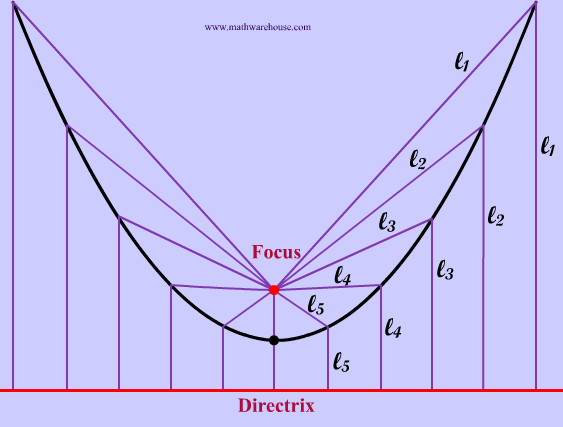
Let's derive the standard equation from this definition. Let the vertex of the parabola be at the origin . We place the focus at and the directrix as the line . Let be any point on the parabola.
By definition, the distance must equal the perpendicular distance from to the directrix line.
Setting them equal:
Squaring both sides:
This is the standard equation for a parabola with its vertex at the origin, opening upwards. For a parabola opening downwards, the equation is .
Connecting to the Trajectory Equation
We have already shown that the trajectory equation can be rewritten in a coordinate system (where the origin is at the vertex) as:
This is precisely the standard form of a parabola opening downwards, with .
Thus, we have rigorously demonstrated that the trajectory equation derived from physical principles perfectly matches the geometric definition of a parabola. The parabolic shape of a projectile's path is a direct mathematical consequence of constant downward acceleration.
The document "Parabolic Projectiles" explores some advanced consequences of this property, though its notation and derivations can be unconventional. You might find its exploration of the focus interesting as supplementary reading.
Test your understanding!
The trajectory of a projectile is given by the equation , where and are in meters. Assume . Determine:
- The angle of projection, .
- The initial speed, .
Show answer
We compare the given equation with our standard trajectory equation:
-
Angle of Projection:
By comparing the coefficients of the term:
This implies . -
Initial Speed:
By comparing the coefficients of the term:
Substitute and :
Since , we have:
Conclusion
In this lesson, we bridged the gap between the time-dependent parametric equations and the geometric path of a projectile.
Key Takeaways:
- By eliminating the time parameter from the and equations, we derived the trajectory equation: .
- This equation is of the general quadratic form , which describes a parabola.
- We rigorously proved the parabolic nature of the trajectory by:
- Algebraically transforming the equation into the standard vertex form .
- Demonstrating that the equation is equivalent to the fundamental focus-directrix definition of a parabola, , in a coordinate system centered at the trajectory's vertex.
Preview of the Next Lesson:
Now that we have established that the trajectory is a parabola, we can analyze its key features. In the next lesson, we will use the equations we've derived to find expressions for the three most important quantities in projectile motion: the maximum height, the time of flight, and the horizontal range. We will derive these formulas with rigorous proofs from our kinematic equations.