Welcome back! In our last lesson, we defined the moral core of your Mahabharata game, outlining win and loss conditions that reinforce the story's message. You now have a solid conceptual blueprint. It's time to bring that blueprint into the physical world.
Today's lesson is all about turning ideas into something tangible. Our learning outcome is to create a paper prototype of your mythology-themed card or board game. This is a foundational practice in both digital and physical game design and a perfect way to explore the connection between the two for your project. Think of it as the UX design principle of creating low-fidelity wireframes, but for gameplay. It’s a fast, inexpensive, and powerful way to see if your game is actually fun before you invest time in polished art or code.
From Blueprint to Playable Object
What is a prototype, and why is it so crucial for a story-driven game? A prototype isn't a finished product; it's a question. It asks, "Does this idea work when a player interacts with it?" For narrative games, the risk isn't just about whether the mechanics are balanced, but whether the player's journey is compelling.
A paper prototype is the fastest way to test this journey. The video below from the Game Developers Conference (GDC) explains this beautifully.
Building a Paper Prototype For Your Narrative Design
In "Building a Paper Prototype For Your Narrative Design," the speaker explains why paper is the perfect medium for testing the complex systems of a narrative game. It allows you to put the player—the hero of the story—into the experience as early and cheaply as possible.
Please watch the following segments to get a solid grasp of the philosophy behind our task today: What is a Prototype? This section defines a prototype as a disposable practice run. The Player is the Hero: Watch the explanation of a game narrative and the critical role of the player at this timestamp. This reinforces our work from the last lesson. Why Paper? This segment makes the case for paper as a quick, flexible, and imaginative tool for narrative prototyping. Laying Out the Elements: The speaker lists the core narrative elements to define in this part. You've already done most of this work in previous lessons! Building the Prototype: Finally, get a quick overview of the physical construction process for pieces and the board.
The key idea is that your paper prototype is a playable outline. Its purpose is to test the flow of your game: the choices, the events, the resources, and how they all come together to tell the story of the Pandavas' exile.
The Anatomy of a Paper Prototype
So, what does a paper prototype consist of? It's simply the minimum set of physical components needed to play the game. For your concept, this will likely include:
- A Game Board: The "play space" that represents the journey.
- Player Pieces: Simple tokens or meeples to show each player's position.
- Cards: For events, choices, resources, or challenges.
- Tokens: To track things like your 'Virtue' points or the 'Kaurava Tracker'.
- A Rule Sheet: A simple, one-page guide explaining how to play.
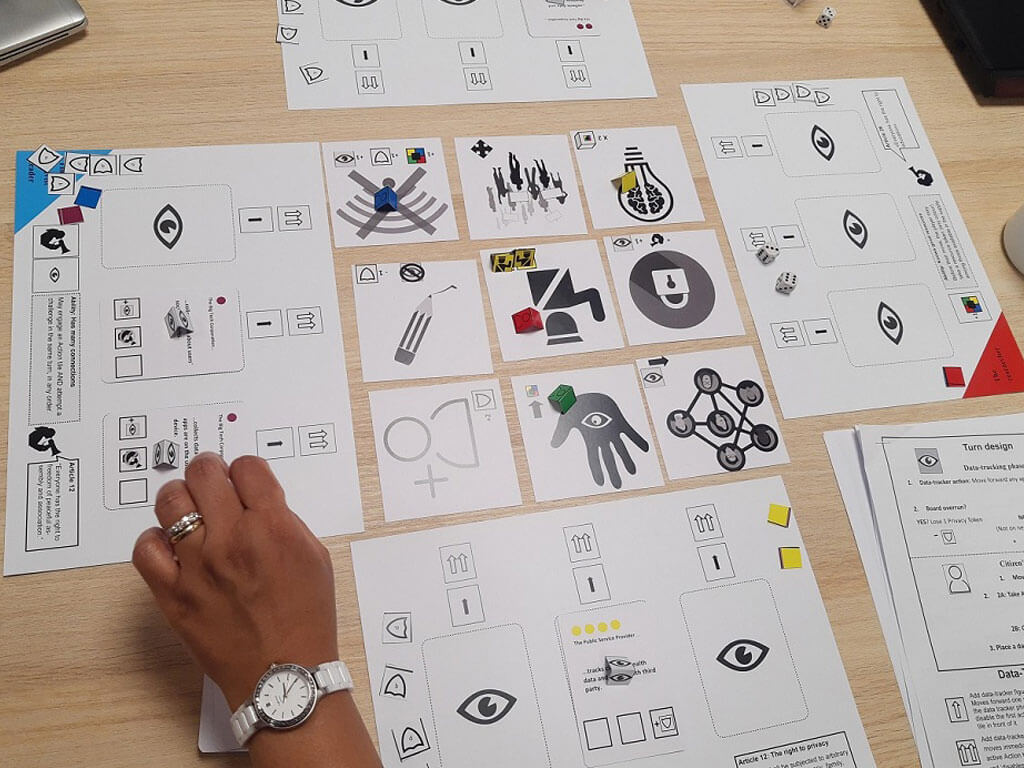
Your goal is not to create a beautiful, finished product like the one pictured below. Instead, you're creating a tool for testing.

Assembling Your Prototype: A Practical Guide
Let's get practical. Creating your prototype is a craft activity. You’ll need simple materials: paper, cardstock (if you have it), pens or markers, scissors, and perhaps some dice or tokens borrowed from another board game. Your proficiency with tools like Figma and Canva is an asset here—you can quickly design simple cards or icons to print out—but hand-drawn elements are perfectly fine, too.
The following article gives some excellent, practical tips for making your prototype feel a bit more robust and easier to handle during play.
Tips and Tricks for Board Game Prototyping
This article from Launch Tabletop provides hands-on advice for creating higher-quality prototypes at home.
Please read these sections for some useful techniques: Add Bleed: If you're printing components, this is a simple graphic design trick to avoid ugly white edges when you cut. Bond Your Paper: This section gives a great tip for making flimsy paper feel more like sturdy card stock by gluing two sheets together. Build with Playtesting in Mind: This is the most important advice. Prioritize clarity and usability. Use legible text and placeholder art so you can make changes quickly.
The point about designing for iteration is crucial. Your prototype will change. The rules will be tweaked, cards will be re-written, and entire mechanics might be thrown out. That's not a failure; it's the process working!
Your Task: Create the Mahabharata Prototype
It's time to build. Using your game concept document from the previous lessons, create a physical, playable paper prototype of your Mahabharata game.
1. Create the Physical Components:
Gather your materials and create a physical version of each component your game needs. Based on your concept, this should include at least:
- The Game Board: Draw a path representing the 13 years of exile. Mark key locations or event spaces.
- Player Pawns: One for each Pandava brother, or a single pawn for the group. Simple colored cubes or even coins will do.
- 'Virtue' Tokens: Create physical tokens for players to collect. These could be small paper squares, glass beads, or borrowed pieces.
- 'Kaurava Tracker': Create a simple track and a marker to represent the antagonists' progress in finding the Pandavas.
- Event/Quest Cards: Create a small deck of cards that players draw from. Each card should present a scenario based on the Mahabharata (e.g., "Help a Sage," "Encounter a Demon," "Practice Archery"). The outcome should link to your mechanics (e.g., "Gain 1 Virtue Token," "Advance the Kaurava Tracker").
2. Draft the Rule Sheet:
On a single sheet of paper, write a simple set of rules. Your experience in content creation will be helpful here—aim for clarity and conciseness. A great structure for this is provided in the academic paper "An Approach for Designing Board Games."
An Approach for Designing Board Games
This paper includes a detailed breakdown of a sample prototype. We will use its structure as a template for your rule sheet.
Refer to the section titled The Board Game Prototype (Chapter 4.2). Don't worry about the specific game being described. Instead, use its subheadings as a template for your own rule sheet: Thematic Background: A one or two-sentence summary of the story. Components List: A simple list of the pieces you made. Game Objective: Your win condition. Game Setup: How to arrange the board and pieces to start. How-To-Play: A simple, turn-by-turn explanation of what a player does. Ending Condition: Your loss condition(s).
Keep your rules simple. Remember the design suggestions for your target audience (ages 5-8) from earlier in this course and from the Han paper. Focus on simple rules, repetition, and clear goals. The video "How to design a board game for CHILDREN" by Adam in Wales is a great resource if you want to refresh your memory on mechanics that work well for this age group, such as cooperative play and a healthy dose of randomness.
Once you have your physical components and your one-page rule sheet, you will have officially created your first paper prototype!
Conclusion
In this lesson, you've taken your game from a purely conceptual design to a tangible, interactive object. This is a massive step. A paper prototype is more than just arts and crafts; it's an essential tool for asking questions and finding answers about your game's core experience.
Key Takeaways:
- A paper prototype is a fast, cheap, and effective way to test a game's narrative and mechanical flow.
- Prototypes are tools for iteration. They should be simple, clear, and easy to change. Don't aim for perfection; aim for "playable."
- Every game prototype needs a clear set of components (board, pieces, cards, tokens) and a simple rule sheet outlining the objective, setup, and turn structure.
You now have a playable game in your hands. What's next? A prototype's true value is only realized when you put it in front of players. In our next lesson, we will begin the "Playtesting with Young Players" module by discussing the crucial ethical considerations and safeguards when conducting research with children, preparing you to test your creation with your target audience.