Welcome to this new module on physical game prototyping. While our main focus has been on designing a digital interactive story, you've also expressed interest in how your Mahabharata project could be adapted into a physical board or card game. This module will give you the foundational tools to do just that, and you'll find that many of the design principles are universal, whether the medium is a screen or a tabletop.
In this first lesson, we will get back to basics. Our goal is to identify the core components of any board or card game. Just as we previously deconstructed digital games into mechanics, dynamics, and aesthetics (MDA), we will now break down physical games into their four essential building blocks: rules, pieces, goals, and the play space. Understanding these elements individually is the first step toward designing a cohesive and engaging physical game experience for your niece.
The Four Pillars of a Board Game
At its heart, every board game, from a simple children's game to a complex strategy epic, is built on four interdependent components. Think of them as answering the fundamental questions of play:
- Goals: What are the players trying to achieve?
- Play Space: Where does the game take place?
- Pieces: With what do the players interact?
- Rules: How do players use the pieces in the play space to achieve the goals?
A great article that frames these ideas within a broader design context is "Breaking Down Board Game Design." It separates the design process into different aspects, two of which directly map to our core components.
Breaking Down Board Game Design
Please read the sections on Physical and Strategy design in this article.
Read the section titled Physical Design, which discusses the tangible elements players interact with. This directly relates to the pieces and play space. Then, read the following section, Strategy Design, which covers the game's objective and constraints. This corresponds to our concepts of goals and rules.
As you read, notice how the author links the physical components to the game's experience and the strategic elements to its playability and fun. These are not isolated concepts; they work together to create the final game. Let's look at each one more closely.
1. Goals and Rules: The What and the How
The goal, or win condition, is the destination. It gives players purpose and direction. The rules are the roadmap and the traffic laws—they define what players can and cannot do on their journey toward that goal. These two components are intrinsically linked; the rules structure the pursuit of the goal.
A clear goal is paramount. For your target audience of a 5-year-old, this might be as simple as "be the first to reach the last space" or "collect three special items." The rules must then support this goal in a way that is easy to understand and follow.
The rulebook is the ultimate authority on a game's goals and rules. Learning how a good rulebook is structured can teach us a lot about how to design the rules themselves. The following video offers excellent insights into writing rules, emphasizing the importance of clarity for a new player—a principle that is central to your own UX design experience and absolutely critical when designing for children.
How to Write a RULEBOOK - Designing a New Board Game
Watch this video on writing a rulebook, paying close attention to the structure and the principle of clarity.
First, watch the segment that outlines the main sections of a rulebook. Notice how "main objective" and "game's end/winning conditions" directly define the goal, while "how to play the game" defines the rules. Next, jump to the segment on clarity in language. The speaker's point about using precise, consistent, and even redundant language is vital for avoiding confusion, especially with young players.
The key takeaway here is that well-defined goals and clear, simple rules are the bedrock of a playable game. If the "what" and "how" are confusing, the game will fall apart before it even begins.
2. Play Space and Pieces: The Where and the With What
These are the tangible, sensory elements of a board game. The play space is the physical area where the game unfolds. This could be a static board with a path, a modular board built from tiles, or even just the surface of the table where cards are played. The pieces are all the components players touch and manipulate: tokens, meeples, cards, dice, and more.
Let's look at a very straightforward example.
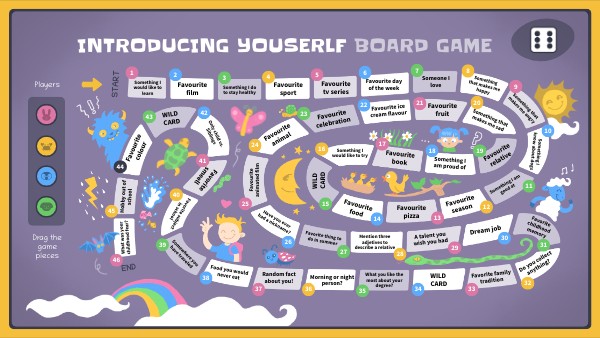
This game, designed for children, uses a classic linear path for its play space and simple tokens for its pieces. The design is intuitive and immediately understandable.
As games become more complex, so do their components. This next image shows a paper prototype, which gives you a sense of how you might start sketching out your own ideas using simple materials.
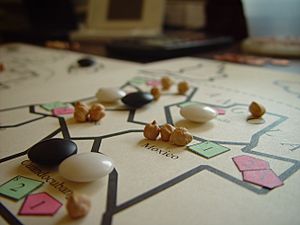
To give you a comprehensive overview of the sheer variety of physical components you can use in a prototype, the next video is a wonderful visual catalog.
Board Game Components & Supplies for Game Design | Calli’s Corner
This video showcases a wide range of common board game components. You don't need to memorize every item; the goal is to get a feel for the "palette" of physical materials available to a game designer.
Watch the video from the beginning to get a tour of different components. Pay attention to how different items can serve different purposes: Play Space: See examples of boards and tiles. Pieces: The rest of the video covers a huge variety of pieces, including cards, dice, wooden cubes and circles (often for resources or tracking), and the iconic meeples and custom tokens.
Seeing these components should spark ideas for how you could represent elements of the Mahabharata physically. Could a "meeple" represent a character? Could "gem" tokens represent divine weapons? Could cards represent choices or challenges?
Applying the Concepts
Let's ground this theory in your project. Take a small, self-contained story from the Mahabharata, like the famous episode where the Pandava princes are tested on their archery skill by Dronacharya, who asks them to shoot the eye of a wooden bird.
Imagine you were turning this single scene into a very simple board game for a 5-year-old. How would you define the four core components?
- Goal: What would be the objective? Perhaps it's landing on a specific "target" space, or maybe collecting a certain number of "focus" tokens before you can "take the shot."
- Play Space: What might the board look like? Would it be a simple path leading towards the target? Or maybe a circular board representing the field of practice?
- Pieces: What would players use? A token representing their archer? A special die? A deck of "distraction" cards they have to overcome?
- Rules: What does a player do on their turn? Do they roll and move? Draw a card? Decide whether to use a special ability?
Thinking through these questions, even at a high level, is the first step in translating a narrative into a playable game system.
Conclusion
In this lesson, we have deconstructed board games into their four essential building blocks. By identifying and defining these components, you gain a powerful framework for analyzing existing games and, more importantly, for structuring your own designs.
Key Takeaways:
- Every board game is composed of Goals (what you're trying to do), a Play Space (where it happens), Pieces (what you use), and Rules (how you do it).
- These components are interconnected. The rules must enable players to use the pieces within the play space to achieve the game's goals.
- For young audiences, clarity and simplicity are paramount. Goals must be obvious, and rules must be easy to grasp and remember.
- The physical components (pieces and play space) are not just functional; they are crucial for creating theme, immersion, and a satisfying tactile experience.
In our next lesson, we will build upon this foundation. We will focus specifically on game mechanics—the engines that drive the rules—and brainstorm how different mechanics like drawing cards or moving pieces can be used to represent the progression of a story.