Welcome back! In our last lesson, we explored how to brainstorm game mechanics that can bring a story to life. You learned to think like a designer, connecting narrative actions from the Mahabharata—like "going into exile"—to game actions like moving a piece or drawing a card. We now have the conceptual "verbs" for our game.
Today, we will take the next crucial step: formalizing those ideas into a set of rules. This lesson is focused on learning how to design game rules that are simple, clear, and engaging for young children, specifically your target audience of five and older. Writing rules for a child is very different from writing for an adult. It's less about creating a rigid legal document and more about building a gentle framework for shared play and discovery. Your background in user experience will be a great asset here; think of a game's rules as its most fundamental user interface.
The Guiding Principle: Design for Feeling First
Before we even write the first rule, we must ask the most important question: what do we want the player to feel? For a young child, a game isn't about strategic mastery. It's about connection, laughter, accomplishment, and the joy of a shared journey. By defining the emotional goal first, the rules will naturally align with that intention.
This article, "How to Design Your Own Board Game for Kids," provides a wonderful perspective on this philosophy.
How to Design Your Own Board Game for Kids (Ages 3+)
This article, written by a parent who designed a game with her three-year-old, is a perfect starting point. It shifts the focus from mechanics to emotion.
Please read the first section, Start with the most important question. Pay close attention to the list of what board games are really about for little kids, such as bonding, language development, and emotional safety.
For your Mahabharata game, this is a vital consideration. Do you want your niece to feel the excitement of adventure? The satisfaction of making a wise choice? The fun of embodying a heroic character? Let this emotional target guide every rule you create.
The Foundation: A Simple Rule Structure
Most successful children's games are built on a very simple, repetitive loop that is easy to learn and remember. The most common structure is:
- Roll a die (the randomizer).
- Move a piece (the progress).
- Do what the space says (the action/event).
This "Roll, Move, Do" sequence is the backbone of countless classic board games because it's intuitive and provides a clear rhythm to the play session. A simple paper prototype often starts with just this structure.
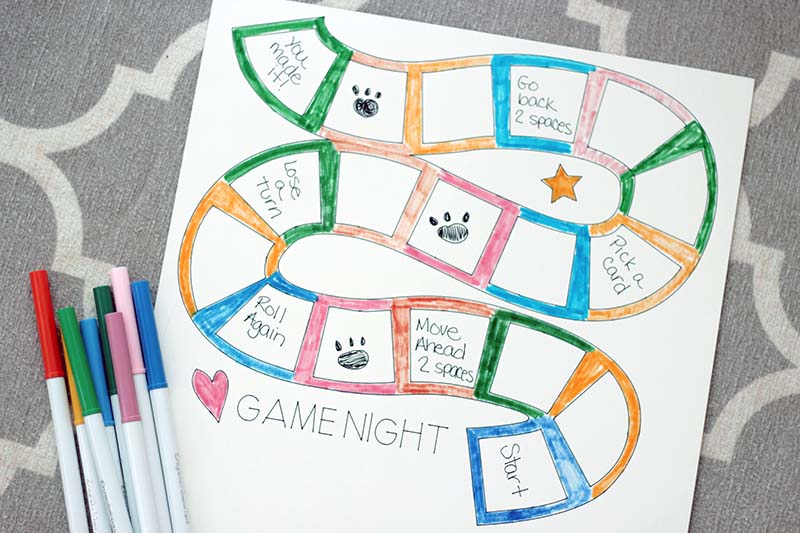
The article you just looked at provides an excellent, concise summary of this basic rule set.
How to Design Your Own Board Game for Kids (Ages 3+)
Now let's look at the practical application of this philosophy.
Please read the sections Keep the rules extremely simple and Play at their pace. Notice the emphasis on flexibility. The goal is joyful interaction, not perfect rule adherence.
The key insight here is that for a five-year-old, "the journey is the game." The rules are a guide for that journey, not a strict set of laws. If your niece decides to move her piece backwards to visit a fun space again, that's not breaking the rules—that's engaging with the world you've built.
Writing Rules: The Art of Simplification
Given that your source material, the Mahabharata, is vast and complex, the skill of simplification is paramount. A great way to learn this is to see how others have adapted complex adult games for younger audiences.
The following article offers practical strategies for modifying well-known games to make them accessible and fun for children with a wide range of abilities.
Making Games Work for Kids of All Ages and Needs
This article demonstrates how to create "Family Rules" by adapting existing games. It's a masterclass in simplification.
Read the introduction, which explains the concept of Family Rules. Then, study the example of how the author simplifies Monopoly. Note the specific changes made: using one die, simplifying the economy, and shortening the win condition.
Let's break down the key simplification techniques from the Monopoly example:
- Reduce Components: Using one die instead of two makes counting easier. Using only two denominations of money simplifies transactions.
- Simplify Actions: Instead of complex auctions and property management, a player lands on a property and can buy it for a single, flat price.
- Simplify Consequences: Landing on another player's property costs a simple, flat fee.
- Shorten the Goal: The win condition is changed from bankrupting all opponents to being the first to collect one complete set of properties. This makes the game much shorter and keeps a child's attention.
When designing your Mahabharata game, you can apply these same principles. For example, instead of a complex system for tracking a character's "dharma," you could have a simple rule: "If you land on a 'Good Deed' space, take one 'Dharma Token.' Be the first to collect three tokens to win."

Choosing Rule Types that Empower Young Players
Beyond the basic "Roll, Move, Do" structure, some game mechanics are particularly well-suited for children because they create a fun and fair experience, even when playing with adults. The video below provides an excellent overview of mechanisms that work well in children's games.
How to design a board game for CHILDREN *Top 10 Mechanisms*
The presenter, Adam in Wales, discusses several categories of mechanics common in children's games. Let's focus on two that are highly relevant to creating a positive family gaming experience.
Please watch the following segments: Randomness: The presenter explains how randomness (like dice rolls) "evens the playing field" between children and adults, giving the child a legitimate chance to win. Cooperative Games: This section explains how "we all win or lose together" mechanics teach teamwork and temper competitive instincts, which is perfect for family play.
Cooperative rules are especially powerful for narrative games based on epic tales. Instead of players competing against each other, they could all play as the Pandava brothers, working together to overcome challenges thrown at them by the game itself.
The video "My Favorite Board Games for Kids ages 5-8" provides two excellent, detailed examples of how cooperative rules work in practice.
My Favorite Board Games for Kids ages 5-8 // board games for the classroom!
The presenter, a teacher and parent, gives clear, step-by-step demonstrations of how to play two cooperative games. Pay attention to how the rules are structured to make players work together toward a common goal.
Watch these two walkthroughs: Outfoxed: A cooperative deduction game. Notice how players share information and work together to eliminate suspects before the fox escapes. The rules create a shared puzzle. Cauldron Quest: A cooperative collection game. Players must get three specific ingredients into the cauldron before the wizard blocks all the paths. The rules create a shared race against time.
These examples show how you can design rules where the "opponent" is the game itself. In your Mahabharata game, the players might cooperatively try to gather the celestial weapons needed to defeat a powerful foe before a "doom track" runs out.
Your Turn: Writing a Simple Rule
Let's put these principles into practice. In our last lesson, we brainstormed that the narrative action "Go into exile" could be represented by the game mechanic "The player must move their main piece off the main board onto a separate 'exile' track for 13 turns."
This is a great starting idea, but "13 turns" is too long and abstract for a five-year-old.
Your task: Rewrite this rule for a "Go to Exile" space on your game board. Your new rule should be simple enough for a five-year-old to understand and execute. Apply the principles of simplification we've discussed. Think about how you could make it shorter, more visual, or more concrete. There's no single right answer; aim for clarity and age-appropriateness.
Conclusion
Today we've translated abstract mechanics into the concrete language of rules. You've learned that designing rules for young children is an exercise in empathy and simplification, closely related to the principles of user-centered design you're already familiar with.
Key Takeaways:
- Design for Emotion: Start by deciding what you want the player to feel. The rules should serve this emotional goal.
- Use a Simple Foundation: The "Roll, Move, Do" structure is a reliable and intuitive core for a children's game.
- Simplify Everything: Reduce components, shorten goals, and make actions and consequences clear and immediate.
- Embrace Cooperative Play: Rules that have players working together against the game can create a positive, collaborative experience, which is ideal for family settings and complex narratives.
- Be Flexible: Remember that rules are a guide to facilitate play, not a rigid contract. The ultimate goal is a joyful, shared experience.
In our next lesson, we will synthesize everything we've covered so far—components, mechanics, and rules—to outline a high-level game concept. You'll create the first complete blueprint for your Mahabharata board game, mapping your chosen mechanics and rules to the story's key events.