Hello! In our last lesson, we mastered calculating the volume and surface area of 3D shapes. We saw how to break down composite objects and apply the correct formulas, a skill that is the perfect foundation for today's topic.
Today, we'll explore what happens when two shapes are related through enlargement. The learning outcome for this lesson is to solve problems involving similar shapes using length, area, and volume scale factors. This is a common and high-value topic on the IGCSE papers, especially Paper 4. It tests your logical reasoning by combining geometry with ratios and algebra, so a methodical approach is key to securing all the marks.
Let's dive in.
1. The Core Principle: Length, Area, and Volume Scale Factors
When two shapes are mathematically similar, it means one is a perfect enlargement of the other. All corresponding lengths are increased by the same multiplier, which we call the Length Scale Factor (LSF).
But what happens to their areas and volumes? They don't increase by the same factor.
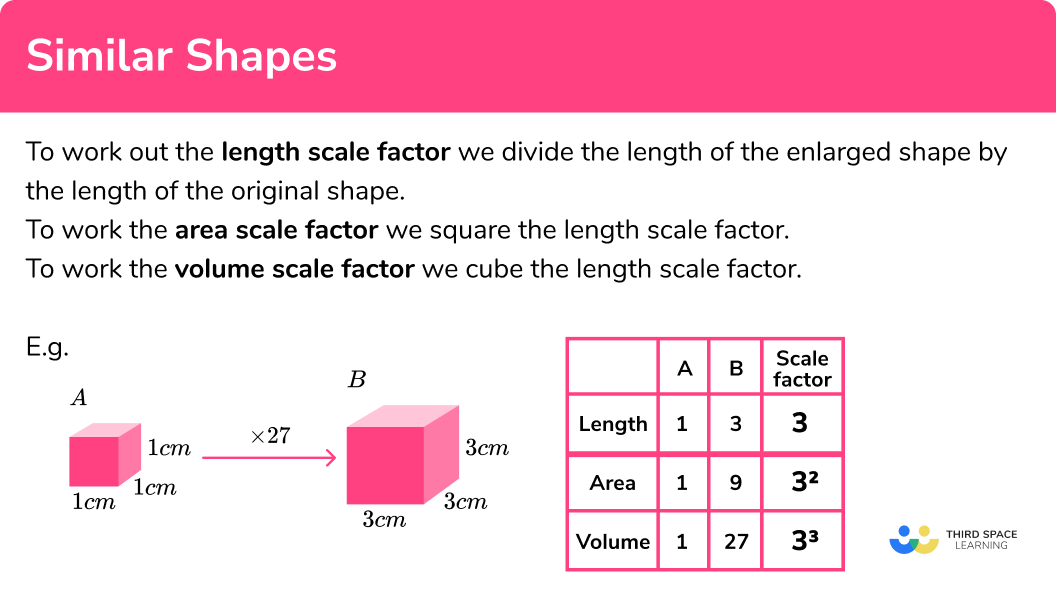
This image illustrates the fundamental rules that you must know:
- The Area Scale Factor (ASF) is the square of the Length Scale Factor.
- The Volume Scale Factor (VSF) is the cube of the Length Scale Factor.
This means if you know any one of the scale factors, you can find the other two. The Length Scale Factor acts as the crucial bridge between area and volume.
To see these rules explained and applied, let's watch a foundational video.
Similar Shapes - Area and Volume Scale Factors | GCSE Maths Tutor
This video from The GCSE Maths Tutor clearly explains how to find and use these three scale factors. It's the essential theory we'll build on for the rest of the lesson.
Please watch the following segments: Finding ASF and VSF from LSF (00:00 - 07:18): Pay attention to how the LSF is calculated (big ÷ small) and then squared for area or cubed for volume. This covers moving from a smaller shape to a larger one (multiplying) and vice-versa (dividing). Finding LSF from ASF/VSF (12:49 - 18:07): This shows the reverse process. Notice how you square root the ASF or cube root the VSF to get back to the LSF. The Bridge: From Area to Volume (20:20 - 24:00): This is a key exam skill. The instructor shows how to solve a problem where you are given areas and asked to find a volume. Note the mandatory intermediate step of finding the LSF.
The key process is always:
- Identify the known quantities (e.g., two corresponding lengths, two areas, or two volumes).
- Calculate the corresponding scale factor (LSF, ASF, or VSF) using: .
- Use the rules (, ) to find the scale factor you need.
- Apply the new scale factor to find the unknown length, area, or volume.
For a concise written summary of these rules, you can refer to the "Similar Areas & Volumes" section of the SaveMyExams revision notes.
CIE IGCSE Maths: Extended Revision Notes 2025
These notes from SaveMyExams provide a quick, text-based summary of the scale factor rules. It's a useful reference to have.
Skim through the 'Similar Areas & Volumes' section on pages 9-10. Focus on the formulas connecting the different scale factors. The worked example is also helpful.
Test your understanding!
Two similar statues, A and B, stand in a park. Statue A has a height of 2 metres and a surface area of 6 m². Statue B has a height of 3 metres.
- What is the Length Scale Factor (LSF) from statue A to statue B?
- What is the Area Scale Factor (ASF)?
- What is the surface area of statue B?
Show answer
- LSF: We have corresponding lengths (heights). LSF = New / Old = 3 / 2 = 1.5.
- ASF: ASF = (LSF)² = (1.5)² = 2.25.
- Surface Area of B: Area of A × ASF = 6 m² × 2.25 = 13.5 m².
2. Exam-Style Problems and Method Selection
Now let's focus on applying these rules to IGCSE-style questions. This is where you can choose different methods depending on whether it's a calculator or non-calculator paper, a skill you wanted to develop.
The following video tackles three distinct exam problems. We'll analyse the methods used.
#EP2 Similar Shapes with Ratios - Can You Solve These GCSE Questions? | Grade 6+ Problem Solving
This video from The GCSE Maths Tutor demonstrates how to solve exam questions involving ratios and scale factors. It's excellent for seeing how to structure your working and for comparing different approaches.
Watch the three worked examples: Question 1 (00:53 - 07:56): A 'show that' question where you're given an area ratio and need to find a volume. Notice the two methods presented: a ratio method (good for non-calculator questions with nice numbers) and a scale factor method (more direct for calculator questions). Question 2 (07:56 - 11:39): You are given volumes and asked for the ratio of the surface areas. This reinforces working backwards (VSF → LSF) and then forwards (LSF → ASF). Question 3 (11:39 - 17:58): A calculator-specific question where the numbers are not 'nice'. This is a very realistic Paper 4 problem. The key takeaway here is the importance of maintaining accuracy. Avoid rounding intermediate steps; use your calculator's memory or ANS function to carry the full decimal value through your calculations, as shown in the video Similar Shapes - Area and Volume Scale Factors.
Strategic Takeaways from the Video:
- "Show That" Questions: As seen in Question 1, you must lay out every logical step. Start with the given information (e.g., area ratio) and clearly show the conversion to the length ratio (by square rooting) and then to the volume ratio (by cubing).
- Method Selection:
- Ratio Method: Works well when the numbers are simple integers and you're on a non-calculator paper. It involves finding the multiplier within the ratio.
- Scale Factor Method: A more universal method that works for any numbers, especially on a calculator paper. It focuses on calculating the scale factor as a decimal or fraction (
New ÷ Old).
- Calculator Precision: For complex calculator questions (like Question 3), your final answer's accuracy depends on not rounding prematurely. An error of this type can cost you the final accuracy mark.
3. Your Turn: The Error-Loop Method in Action
It's time to put this into practice with some past paper questions. This is the core of the "Error-Loop Method" – you solve, check, and learn from any gaps in your logic.
Here is a worksheet with two typical IGCSE questions.

Your Task (15 minutes):
- Attempt Question 1 on the worksheet (the one about the two similar cones, A and B).
- Lay out your working clearly, as if it were an exam.
- Start by identifying the given information (ratio of radii, which are lengths).
- Determine the LSF.
- Use the LSF to find the VSF.
- Apply the VSF to find the volume of cone B.
- Once you have an answer, check your work against the official solutions.
To do this, I have provided links to a bank of past paper questions and their corresponding worked solutions.
IGCSE Past Paper Questions & Solutions on Similar Shapes
These links from Past Paper Penguin are your practice ground. The first link is a PDF of questions on this topic, and the second is the PDF with the full worked solutions.
First, download the 'Similar Shapes: Area and Volume Scale Factors' questions PDF. Then, download the 'Similar Shapes: Area and Volume Scale Factors' solutions PDF from the second list ('CIE IGCSE Worked Solutions by Topic'). Use the solutions to check your answer and, more importantly, to understand the marking method.
By comparing your method to the official one, you'll see exactly where marks are awarded and spot any logical errors in your own process. This is the fastest way to improve.
Conclusion
Today we've unpacked the relationship between length, area, and volume in similar shapes. This is a topic that beautifully connects different areas of maths and requires clear, logical thinking.
Key Takeaways:
- The Three Scale Factors: Remember the core rules: and .
- LSF is the Bridge: To move between area and volume, you must always go via the length scale factor. This means you may need to square root or cube root first.
- Be Methodical: Write down your steps clearly: 1. Find the known scale factor. 2. Convert it to the scale factor you need. 3. Apply it to find the unknown. This structure will help you secure method marks.
- Calculator Accuracy: In calculator-based papers, avoid rounding intermediate results. Use your calculator's
ANSfunction to maintain full precision until the final answer.
Preview of the Next Lesson:
We will now conclude our study of mensuration and move to another important part of the Geometry module: Circle Theorems. We will shift from calculations to a different kind of geometric reasoning, focusing on proving and applying angle properties within circles.