Hello! Welcome to your next lesson in the "Geometric Transformations and Vectors" module.
In our last lesson, we saw how to describe a translation using a column vector, like , which tells us how far to move a shape horizontally and vertically. This was our first introduction to vectors. Today, we'll build directly on that foundation.
Your learning outcome for this lesson is to perform vector arithmetic (addition, subtraction, scalar multiplication) and represent vectors with column notation. We will move from simply using vectors to describe movement to actively manipulating them with mathematical operations. This is a fundamental skill that unlocks the ability to solve a wide range of geometric problems in your IGCSE exam.
1. What is a Vector?
At its core, a vector is a quantity that has both magnitude (size or length) and direction. A scalar, by contrast, is just a number; it has magnitude but no direction (e.g., speed, mass, time).
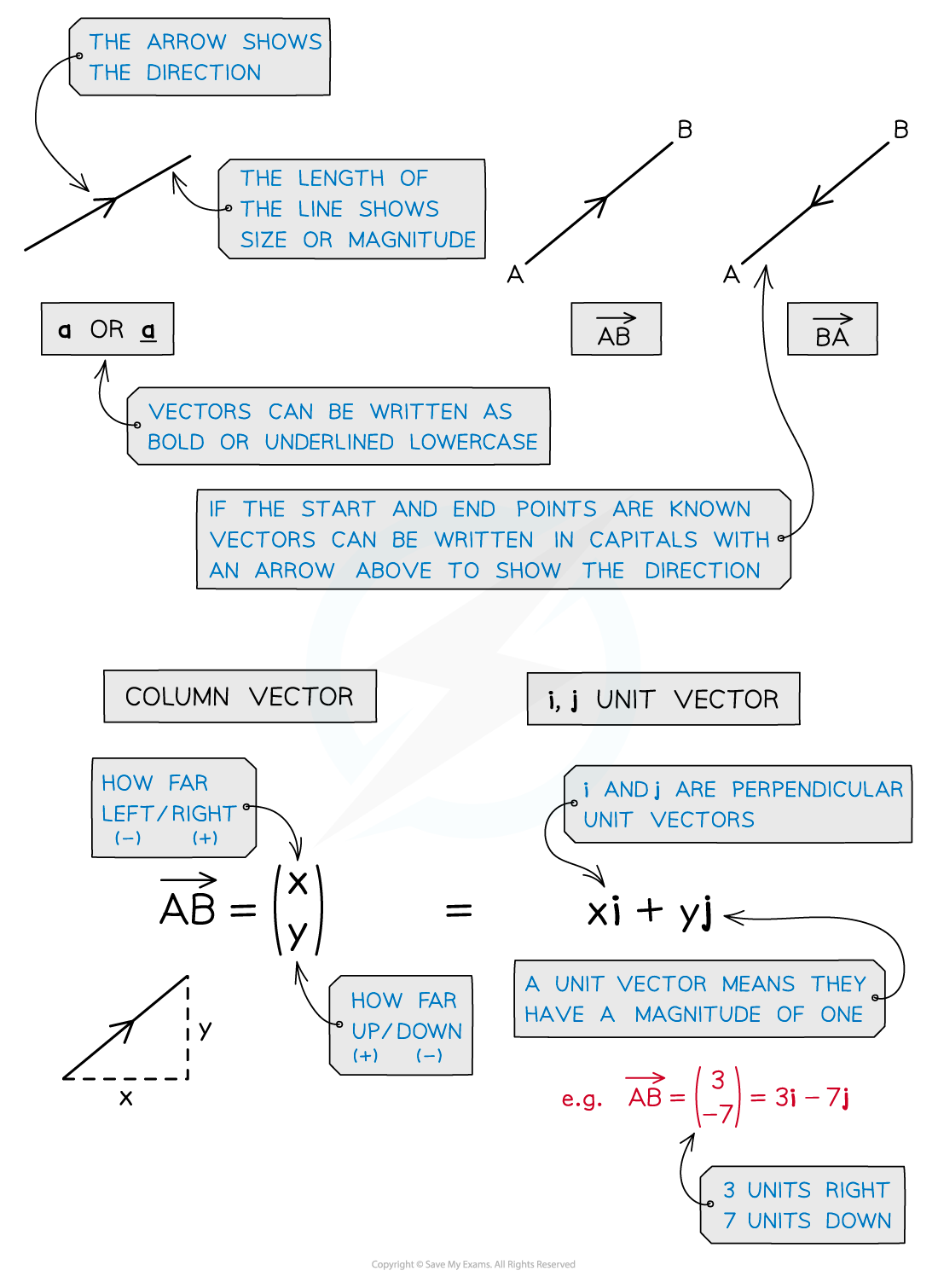
You've already seen vectors represented as column vectors. The numbers in the column tell you the components of the movement.
- The top number is the horizontal movement (positive for right, negative for left).
- The bottom number is the vertical movement (positive for up, negative for down).
Let's start with a quick visual refresher on how column vectors represent movement on a grid.
This short video from Maths Genie clearly explains how to interpret the numbers in a column vector as movements on a grid. It's a great visual foundation for everything that follows.
Watch the first 2 minutes and 18 seconds of the video. Focus on how positive and negative numbers correspond to directions (right/left and up/down).
Besides column vectors, you will also see vectors written as single bold lowercase letters (like a) or with an arrow if they connect two points (like ).
2. Vector Arithmetic: The Rules
Now, let's establish the rules for adding, subtracting, and multiplying vectors. The good news is that the arithmetic is very straightforward when using column notation. You simply perform the operations on the corresponding components.
Vectors | Cambridge (CIE) IGCSE Maths Revision Notes
This document from Save My Exams provides a clear and concise summary of the rules for vector arithmetic. It's an excellent reference to have.
Read the sections titled 'How do I add and subtract column vectors?', 'How do I multiply a vector by a scalar?', and 'How do I write an expression as a single column vector?'. Pay close attention to the worked example at the end, which combines these skills.
To summarize the rules:
- Addition: Add the top components and add the bottom components.
- Subtraction: Subtract the top components and subtract the bottom components.
- Scalar Multiplication: Multiply both components by the scalar (the number).
Let's watch these rules in action.
This next clip from the Maths Genie video provides worked examples for addition, scalar multiplication, and subtraction. Seeing it done step-by-step will help solidify your understanding.
Watch the section from 03:38 to 10:08. The presenter works through several examples, including those with negative numbers, which is great practice for avoiding the small arithmetic errors you've mentioned.
Test your understanding!
Given the vectors and , calculate the column vector for .
Show answer
First, calculate :
Now, subtract :
3. Applying Vector Arithmetic to Solve Problems
Performing the basic arithmetic is just the first step. The real power of vectors in your exam is in using them to solve geometric problems.
Finding the Vector Between Two Points
A common task is to find the vector that describes the journey from one point to another. If you have the position vectors of two points A and B (i.e., the vectors from the origin O to each point, and ), you can find the vector using a simple subtraction rule.
The Rule:
A simple way to remember this is "end point minus start point".
IGCSE/O LEVEL Maths - Vectors (Past Papers)
This video from 'Mathlete by Saad' directly addresses this rule by working through a past paper question. It shows how to write coordinates as column vectors and then apply the subtraction rule.
Watch the clip from 08:18 to 10:03. The presenter clearly explains the subtraction rule and provides a helpful trick for remembering it.
Finding Vector Paths in Geometric Shapes
Vector arithmetic allows you to find a path from one point to another by adding up a "route" of known vectors. Think of it like a journey: if you go from A to B, and then B to C, the total journey is from A to C. So, .
If you need to travel along a vector in the opposite direction, you subtract it. For example, .
Let's see this applied to a typical exam problem involving a parallelogram.
IGCSE/O LEVEL Maths - Vectors (Past Papers)
Let's return to the 'Mathlete by Saad' video. Here, he breaks down a problem in a parallelogram, showing how to find different vector paths by combining the base vectors a and b.
Watch from 03:40 to 07:47. Pay close attention to how he constructs the path for a vector like OC (by going OA then AC) and BP (by going BO then OP). This 'pathfinding' is a crucial exam technique.
These problems often involve ratios and midpoints. The principle is the same: break the journey down into known parts. For example, if M is the midpoint of AB, then .
Independent Practice
To solidify your skills, it's essential to work through some exam-style questions.
VECTORS GCSE (+ IGCSE) EXAM QUESTION PRACTICE
This PDF from Maths4Everyone contains a collection of IGCSE vector questions with full solutions. It's an excellent resource for practice.
Download the PDF. Focus on questions 1, 2, and 3, which are specifically about 'Column Vectors' and directly test today's learning outcome. Attempt the questions first, then check your working against the solutions. Also, take a moment to read the 'Disclaimer' section on the second page, which explains the B, M, and A marks. Understanding how method marks (M marks) are awarded is a core part of our course strategy.
Conclusion
Today you've built a solid foundation in vector arithmetic. This is a topic where precision is key, so always double-check your signs when adding and subtracting.
Key Takeaways:
- A vector has both magnitude and direction, and can be represented as a column vector .
- Vector Addition/Subtraction: Perform the operation on the corresponding components.
- Scalar Multiplication: Multiply both components by the scalar.
- The vector from point A to point B can be found using the position vectors: .
- You can find unknown vectors in geometric figures by creating a path using known vectors. Travelling against a vector's direction means you subtract it.
Preview of the Next Lesson:
We've defined a vector as having both direction and magnitude. In this lesson, we focused on direction and arithmetic. In the next lesson, we will focus on the other part: calculating the magnitude of a vector. You will learn how to find the length of a vector using a method that connects directly to Pythagoras' theorem.