Hello! Welcome to the final lesson in our Trigonometry module.
In the last lesson, we focused on memorizing and applying the exact trigonometric values for key angles, a crucial skill for your non-calculator paper. We saw how sin(30°) is exactly 1/2, not a long decimal.
Today, we'll answer the question: what if cos(x) = 1/2? You know from the last lesson that x = 60° is one answer. But are there others? This lesson is all about the systematic process of finding all possible solutions to a trigonometric equation within a given range, like 0° to 360°. This is a very common and important question type in your exam.
By the end of this 60-minute lesson, you will be able to solve trigonometric equations for a given range of angles.
1. The Core Problem: Why There's More Than One Answer
Trigonometric functions are periodic, meaning their graphs repeat in waves. If we draw a horizontal line on the graph, it will often intersect the wave multiple times. Each intersection point is a valid solution.
Your calculator will only ever give you one of these solutions, called the principal value. Our job is to use this principal value to find all the other solutions that fall within the specific range the exam question asks for (e.g., 0° ≤ x ≤ 360°).
There are two main methods to do this:
- Using Graph Symmetries: A visual method based on sketching the trig graphs.
- Using the Quadrant Rule (CAST diagram): A procedural method based on a diagram of the four quadrants.
Since you've mentioned finding graphs challenging but also wanting to know the most efficient methods, we will cover both. You can then choose the one you feel most confident with.
2. The Systematic Approach to Solving Trig Equations
Solving any linear trig equation follows a three-step process:
- Isolate: Rearrange the equation so the trig function (
sin(x),cos(x), ortan(x)) is the subject. - Principal Value: Use the inverse trig function (e.g.,
sin⁻¹) on your calculator to find the first angle. - All Solutions: Use either the graph method or the CAST method to find all other solutions in the required range.
Let's see this in action.
Method A: Using Graph Symmetry
The key is to understand the symmetry of the sin, cos, and tan graphs.
- Sine: The graph
y = sin(x)is symmetrical aboutx = 90°. Ifx₁is your principal value, the second solution isx₂ = 180° - x₁. - Cosine: The graph
y = cos(x)is symmetrical aboutx = 180°. Ifx₁is your principal value, the second solution isx₂ = 360° - x₁. - Tangent: The graph
y = tan(x)repeats every180°. Ifx₁is your principal value, the next solution isx₂ = 180° + x₁.
The following video works through several IGCSE-style problems using this graph-sketching method. It's an excellent way to see the process applied repeatedly.
Everything you need to know about IGCSE Trig Equations in 28 minutes
This video, 'Everything you need to know about IGCSE Trig Equations in 28 minutes' by the Ginger Mathematician, provides a fantastic set of worked examples. We will use it to guide our practice.
Watch from the beginning (00:32) to 14:04. The presenter solves equations for cos(x), tan(x), and sin(x). For each one, pay close attention to how he: Isolates the trig function. Gets the principal value from the calculator. Sketches the graph to find the second solution using symmetry.
Method B: The Quadrant Rule (CAST Diagram)
This method avoids sketching graphs. It uses a diagram to determine which quadrants the solutions will be in.

The CAST diagram shows which trigonometric functions are positive in each quadrant. All in the first, Sine in the second, Tangent in the third, and Cosine in the fourth.
The steps are:
- Find the principal value,
α, using your calculator. Important: If you are solving for a negative value (e.g.,sin(x) = -0.5), find the principal value for the positive equivalent first (i.e., usesin⁻¹(0.5)to getα=30°). - Use the CAST diagram to identify the two quadrants your solutions are in based on whether the original
kwas positive or negative. - Calculate the solutions in those quadrants using these rules:
- Quadrant 1:
x = α - Quadrant 2:
x = 180° - α - Quadrant 3:
x = 180° + α - Quadrant 4:
x = 360° - α
- Quadrant 1:
How to solve trigonometric equations using the Quadrant Rule
For a clear explanation of this method, watch this video from ExamSolutions. He demonstrates how to use the quadrant rule for positive and negative values.
Watch from the start (00:05) to 11:07. Notice how he first asks 'Where is the function positive/negative?' to decide on the quadrants, and then uses the principal value to find the angles.
Test your understanding!
Let's solve cos(x) = 0.5 for 0° ≤ x ≤ 360°. The principal value is cos⁻¹(0.5) = 60°.
How would you find the second solution using:
- The graph symmetry rule for cosine?
- The CAST diagram?
Show answer
- Graph Symmetry: For cosine, the second solution is
360° - x₁. So,360° - 60° = 300°. - CAST Diagram:
cos(x)is positive, so we look for the 'A' and 'C' quadrants (1st and 4th).- The 1st quadrant solution is
x = α = 60°. - The 4th quadrant solution is
x = 360° - α = 360° - 60° = 300°.
- The 1st quadrant solution is
Both methods give the same solutions: 60° and 300°.
3. Handling Negative Values and Complex Algebra
Things get slightly trickier when the equation involves more algebra or negative values. This is a common place to make mistakes.
Let's return to the Ginger Mathematician video, as he covers these cases well.
Everything you need to know about IGCSE Trig Equations in 28 minutes
Let's watch two more examples. The first involves more algebraic steps. The second is crucial, as it shows what to do when your calculator gives you a negative angle.
Watch from 14:04 to 24:02. For the first problem, 3(2 + cos(x)) = 5, focus on the algebraic manipulation before you even get to the trigonometry. For the second problem, 7sin(x) + 2 = 0, the calculator gives x ≈ -16.6°. This is outside the 0-360° range. Pay close attention to how he uses the graph sketch to find the two correct positive solutions.
Dealing with a negative principal value from the calculator (e.g., -16.6°):
- Graph Method: Sketch the graph and mark the negative angle. Use the symmetry to find the corresponding positive angles within the 0-360° range. For
sin(x) = -k, the solutions are180° + 16.6°and360° - 16.6°. - CAST Method: The principal angle is
α = 16.6°. Sincesin(x)is negative, we need the 'T' and 'C' quadrants (3rd and 4th).- 3rd Quadrant:
180° + α = 180° + 16.6° = 196.6° - 4th Quadrant:
360° - α = 360° - 16.6° = 343.4°
- 3rd Quadrant:
4. Quadratic and Transformed Equations
Your exam will also feature more complex equation types. Here's the strategy for two common variants.
A. Quadratic Trig Equations
These look like 2cos²(x) + 3cos(x) - 2 = 0.
The strategy is summarised in the flowchart below. The key is to turn it into a standard quadratic you can solve first.
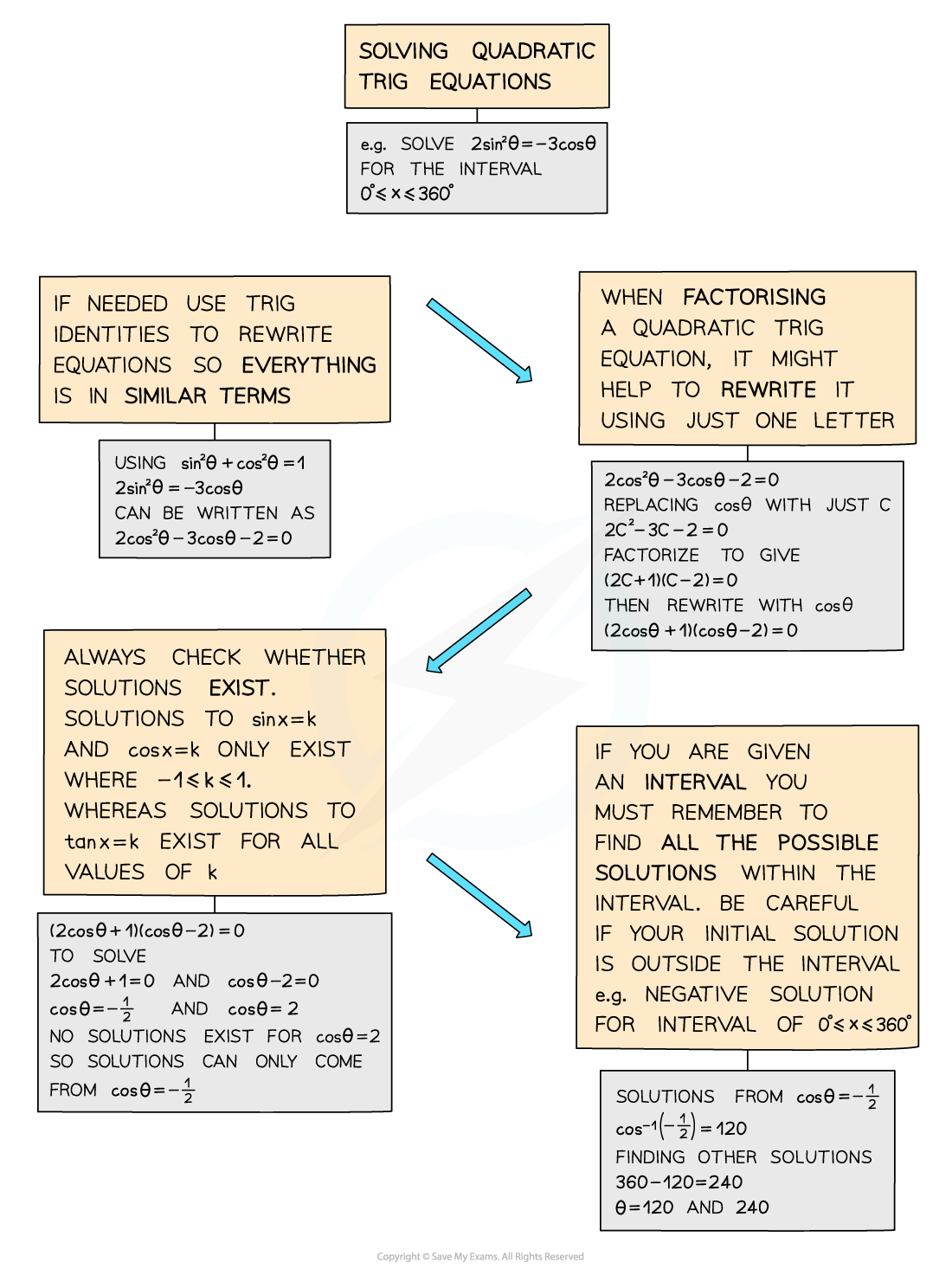
Crucial Identity: If your equation contains both sin²(x) and cos(x), you must use the identity sin²(x) + cos²(x) = 1 to get everything in terms of one function. For example, replace sin²(x) with 1 - cos²(x).
B. Equations with Transformed Angles
These look like sin(2x) = 0.5 or cos(x - 30°) = 0.8. The angle itself has been changed. This requires a specific technique to avoid missing solutions.
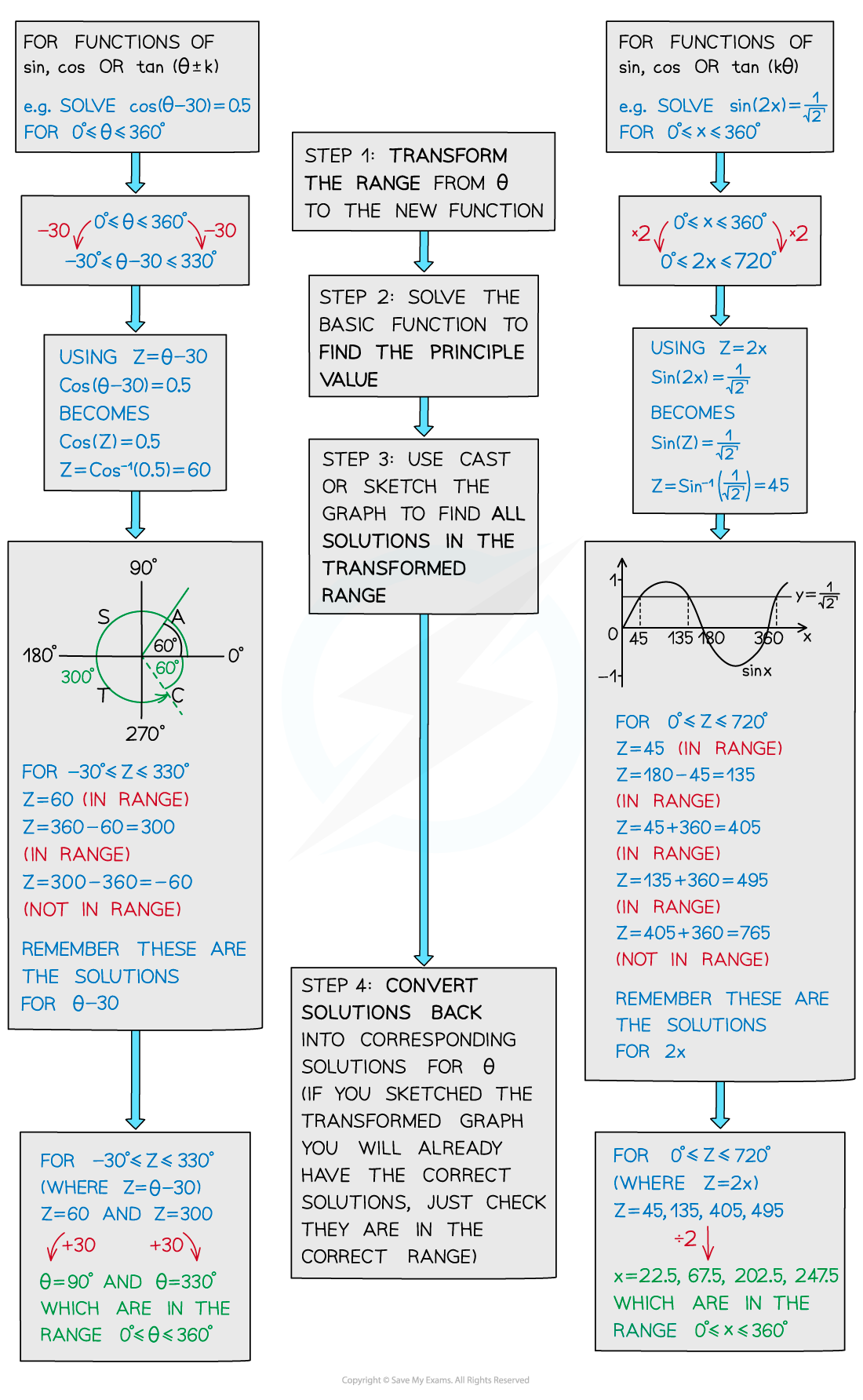
Let's break down step 1, as it's the most common source of error.
- If the equation is
sin(2x) = 0.5for0° ≤ x ≤ 360°:- Let
u = 2x. - The new range for
ubecomes2(0°) ≤ u ≤ 2(360°), which is0° ≤ u ≤ 720°.
- Let
- You must find all solutions for
uin this much wider range (720° means two full cycles of the sine wave). - Finally, divide all your
usolutions by 2 to find the values forx.
5. Avoiding Common Exam Errors
Your goal is to build a reliable method that earns you every possible mark. Let's look at two classic traps that students fall into.
Solving Trig Equations : Common Mistakes
The webpage 'Solving Trig Equations: Common Mistakes' from Next Level Maths clearly explains two major pitfalls. Internalizing these will help you avoid losing easy marks.
Read through both 'Common Mistake 1' and 'Common Mistake 2'. For Mistake 1, understand why dividing by sin(θ) is wrong and why factorising is the correct approach. For Mistake 2, see how forgetting the ± when taking a square root causes you to lose half of the solutions.
-
Error 1: Dividing by a variable. In an equation like
sin(x)cos(x) = sin(x), do NOT divide both sides bysin(x). You will lose the solutions wheresin(x) = 0. Instead, rearrange and factorize:sin(x)cos(x) - sin(x) = 0becomessin(x)(cos(x) - 1) = 0. This gives two equations to solve:sin(x) = 0andcos(x) = 1. -
Error 2: Forgetting the
±sign. When solving an equation liketan²(x) = 3, you must take both the positive and negative square roots. This means you have to solve two separate equations:tan(x) = +√3andtan(x) = -√3, which will give you four solutions in the 0-360° range.
Conclusion
Today, we've developed a robust, systematic method for solving trigonometric equations—a high-value skill for your exam. You now have a choice of two reliable techniques (graphs or CAST) to find multiple solutions and are aware of the common traps to avoid.
Key Takeaways:
- Always follow the three-step process: Isolate, find the Principal Value, and then find All Solutions.
- You can find the other solutions using either graph sketches (visual) or the CAST diagram (procedural). Choose the one you prefer and master it.
- When your calculator gives a negative angle, use your chosen method to find the equivalent positive angles in the correct range.
- For quadratic trig equations, convert them to a standard quadratic, solve, and then solve the resulting linear trig equations.
- For transformed angles like
sin(2x), always adjust the range first to ensure you don't miss solutions. - Never divide by a trig function involving the variable; always factorize instead. Remember the
±when you take a square root.
Preview of the Next Lesson:
We are now finished with the Trigonometry module. In our next lesson, we will begin Module 11: Introduction to Calculus. We'll start with the fundamental concept of differentiation and learn how to find the gradient function of polynomial functions. This is another major topic, and we'll approach it with the same focus on clear methods and exam application.