Hello, and welcome. This course starts with safety because a mini-split can appear quiet and harmless while still containing hazardous electrical energy and pressurized refrigerant. Before you inspect or maintain your own unit, you need to recognize what could injure you and where those hazards are located.
This first module establishes the boundaries for safe work. Today you will build a hazard map of a residential mini-split—not perform service. Your experience with electrical and mechanical equipment will help, but an air conditioner adds two important complications: energy can remain after power is disconnected, and the sealed refrigerant circuit remains pressurized when the machine is off.
Electrical power is not the same as stored energy
A typical mini-split has an indoor unit, an outdoor unit, and wiring between them. Electrical hazards may be present at the supply connection, disconnect, terminal blocks, interconnecting cable, control boards, motors, and—in an inverter model—the electronics that drive the compressor. Contact with an energized part can cause shock or electrocution; an electrical fault can also cause burns or fire.
The remote control’s Off button is an operating command, not electrical isolation. Even after the supply is disconnected, capacitors may retain a charge. Inverter equipment can have a hazardous DC bus: a set of capacitors that smooths the power supplied to its drive electronics. Stored charge is why “the fan stopped” and even “the disconnect is open” are not, by themselves, proof that internal parts are safe to touch.
Watch Electrical Safety Basics from HVAC School for the distinction between an electrical shock hazard and an apparently inactive machine, and for the purpose of personal isolation.
Watch shock fundamentals for how current can pass through the body and why the consequences depend on more than the voltage rating alone. Then watch personal isolation for why a technician must prevent someone else from restoring power. Treat this as hazard recognition; a later lesson covers the actual isolation and verification procedure.
A fuse or breaker is not a personal shock-protection guarantee: current capable of seriously injuring a person may not operate an overcurrent device. Nor should you assume there is only one point of supply without checking the model-specific wiring information. For now, the working boundary is straightforward: do not remove electrical covers or reach into the unit merely because it has been switched off.
Motion creates a separate hazard. The outdoor fan and indoor blower can injure fingers or catch loose clothing. A fan may coast after shutdown, and an automatic control may start it without warning while the system is powered. Guards and covers are part of what keeps an ordinary observation separate from contact with moving equipment.
The refrigerant circuit stays pressurized when the unit stops
Refrigerant circulates through the indoor coil, outdoor coil, compressor, and connecting pipes. Those components form a sealed, pressurized circuit. Shutting off electrical power does not remove its pressure. A damaged tube, loosened connection, or opened service point can release refrigerant and oil suddenly; a pressure-related component failure can also cause serious injury. A line that looks small or accessible is not necessarily safe to disconnect.
Escaping refrigerant presents three distinct exposure concerns:
- Cold injury: Liquid refrigerant flashing into gas can rapidly cool skin or eyes, causing frostbite.
- Breathing hazard: A substantial leak can displace breathable air, particularly in a small or poorly ventilated space. Dizziness or other symptoms are reasons to leave, not to continue investigating.
- Fire hazard: Some refrigerants can ignite under the right conditions. Many leaks cannot be reliably identified by smell.
Safety Basics for HVAC Technicians | Part 2
Watch Safety Basics for HVAC Technicians | Part 2 from Interplay Learning Interactive Training for the immediate human consequences of refrigerant exposure.
Watch refrigerant exposure. Focus on the different mechanisms behind frostbite and oxygen displacement. The presenter describes many familiar refrigerants as A1; do not assume your particular mini-split uses an A1 refrigerant. Its nameplate determines what it contains.
The refrigerant designation matters because toxicity classification and flammability classification are different properties. The following ASHRAE Standard 34 matrix places lower-toxicity group A and higher-toxicity group B across columns, with flammability classes down the rows. Within the flammable classes, 2L identifies a lower-burning-velocity subclass. An A1 designation does not mean a large leak is safe to breathe; A2L does not mean “cannot burn.”
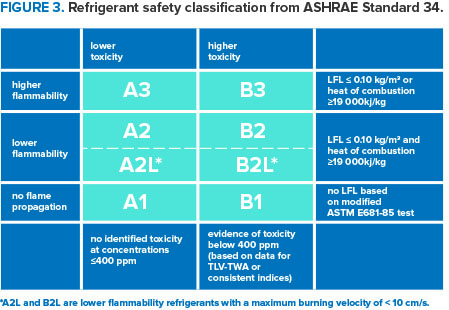
For orientation, R-410A is classified A1, R-32 is A2L, and R-290 is A3. These are examples, not a way to identify refrigerant by the unit’s appearance. Never substitute one refrigerant for another based on a similar-sounding name or a familiar pressure reading.
Multi Zone Ductless Mini-Split Heat Pump - Trane Technologies
Read the safety warnings in Trane Technologies’ Multi Zone Ductless Mini-Split Heat Pump manual to see how a manufacturer distinguishes hazardous voltage, pressure, flammable refrigerant, and sharp edges.
In the Introduction, p. 4, begin at the “Hazardous Voltage!” warning. Read the safety warnings through “Sharp Edges!” and its glove-and-arm-guard guidance. Notice that disconnecting power, relieving refrigerant pressure before opening a circuit, and avoiding ignition are different precautions for different hazards. This is an example manual; its procedures and refrigerant designation may not match your unit.
If you suspect a significant leak, leave the affected space and keep others out. Avoid flames, smoking, and operating electrical switches or equipment in a potentially flammable atmosphere. Arrange ventilation only if it can be done without entering the affected space or creating an ignition risk, and seek qualified help. Do not puncture a line, loosen a fitting, or attempt to “let the pressure out.”
A walk around the unit: where hazards overlap
Hazards rarely occupy neat, separate compartments. At the indoor unit, a cover may conceal wiring and a blower; the coil has delicate, sharp fins and contains pressurized refrigerant. At the outdoor unit, the fan sits behind a guard, sheet-metal panels and coil fins can cut, and the electrical compartment may contain energized or stored-energy components. The compressor, coil, valves, and service connections belong to the pressurized circuit. The line set between units also contains refrigerant, even when insulated or routed out of sight.
| If you notice… | Recognize the hazard before acting |
|---|---|
| A stopped fan | It may coast or restart automatically while powered. |
| An “off” display or remote | Internal electrical parts may still be energized. |
| A disconnected supply | Capacitors or an inverter DC bus may still hold energy. |
| An insulated copper line | Insulation does not remove refrigerant pressure. |
| An accessible coil or open panel | Fins and sheet-metal edges can cut. |
| Hissing, oily residue, or a suspected leak | Avoid contact and ignition; the refrigerant may also be odorless. |
The Trane service-manual excerpt below connects several of these hazards in a single pre-maintenance inspection. Its most useful point for today is not a procedure to copy, but the need to assess the environment, electrical energy, and possible refrigerant release separately.
Service Manual - Mini Split HW Inverter Up to 23 SEER. - Trane
Read the pre-maintenance portion of Trane’s Service Manual — Mini Split HW Inverter Up to 23 SEER to see why an inverter mini-split demands more than a quick power-off check.
Under “Maintenance,” find “1). Inspections before maintenance” on p. 22. In “(1) Inspection of maintenance environment,” read the environment checks, focusing on leaks, ventilation, and ignition sources rather than memorizing equipment requirements. Then, under “2) Inspection of air conditioner,” read the energy warning. Do not use this excerpt as an instruction to open or discharge your own unit; that requires the correct model procedure and suitable training.
For a safe first look at your own installation, keep every cover and guard in place and observe from an ordinary standing position. You may be able to identify the two units, insulated lines, and visible warning labels without touching any service component. If a label is illegible or the refrigerant is unknown, record that uncertainty rather than guessing.
Key takeaways
A mini-split presents electrical, stored-energy, rotating-equipment, sharp-edge, pressure, and refrigerant-release hazards. Several remain after the machine stops: capacitors can retain charge, fans can coast, and the sealed refrigerant circuit stays pressurized. Escaping refrigerant can cause frostbite and breathing danger; its particular flammability classification must be checked on the equipment, not assumed.
The next lesson turns this hazard map into task-specific protective equipment and work-area controls. Later, you will learn the model-appropriate isolation and verification process before doing any work that exposes internal components.