Introduction
In our last lesson, we rigorously proved that a standard floating rate note (FRN) is valued at par on its coupon reset dates. This principle is a cornerstone of floater valuation. Today, we will build directly on that foundation to answer the practical question: what is a floater worth on any given day between its reset dates?
This lesson will guide you through the derivation of the pricing formula for an FRN between coupon periods. We will start with an intuitive approach that leverages our "par value" principle, and then generalize it to a comprehensive discounted cash flow (DCF) model that incorporates market spreads—a method essential for real-world applications. This process will directly use the forward rate curve we've previously discussed to forecast the unknown future coupons.
The "Pull-to-Par" Valuation Method
Let's begin with the simplest case. Imagine we are at a valuation date, , which lies between two coupon dates, (the previous reset date) and (the upcoming coupon date).
For a "plain vanilla" floater where the contracted spread and the market's required spread are both zero, we know two things with certainty:
- The next coupon payment, , was already fixed at based on the reference rate at that time. This is a known cash flow.
- Based on our previous lesson's proof, the value of the floater at time will be its par value, .
Therefore, the value of the floater at time is simply the present value of all cash flows we expect to receive at . This includes the known coupon, , and the bond's principal, which it will be worth at that moment.
Mathematically, the full price () is:
where is the risk-free discount factor for the period from our valuation date to the next coupon date . This is derived from the spot rate curve.
This simple but powerful formula shows the price being "pulled" towards as approaches . However, this approach is a simplification. It implicitly assumes the bond reverts to par, which only happens if the market's required spread equals the bond's contracted spread. For the general case, we need a more robust model.
The General Discounted Cash Flow (DCF) Model
In practice, the market's required return on a floater can change, meaning the spread investors demand ( or "discount margin") may differ from the spread written into the bond's contract ( or "issue spread"). In this scenario, the bond will no longer trade at par on reset dates, and we must value it by explicitly projecting and discounting every future cash flow.
This method, often called the discount margin method, is the industry-standard rigorous approach. The following resources provide a detailed breakdown of this methodology.
Floating Rate Note Pricing Specifications
This document from the JSE outlines the standard "discount margin method" for pricing FRNs.
Read the Summary (Section 2) and Method of Valuation (Section 3). Focus on the key steps outlined: Predict future coupons using the forward curve plus the issue spread. Discount each coupon and the principal using the spot (zero) curve plus the current market spread. This distinction between the spreads used for forecasting coupons and for discounting is critical.
VALUING FLOATING RATE BONDS (FRBS)
This FIMMDA document provides a formal breakdown for valuing an FRN when the contracted spread differs from the desired (market) spread.
Read Section 8 through Section 11. This part, titled "We now look at the remaining situation where the contracted spread is x% over benchmark but the desired spread at the time of valuation is y%", details the exact same logic. Note its conclusion that this rigorous method is the correct one when the par-value assumption is invalid.
Let's synthesize the steps from these documents into a formal pricing formula. Let our valuation date be , and the future coupon payment dates be .
Step 1: Forecast the Future Cash Flows (CFs)
-
First Coupon (): The coupon for the current period (paid at ) is already known, as it was set at the last reset date. Let the known coupon rate for this period be . The cash flow is , where is the day-count fraction for the period.
-
Subsequent Coupons ( for ): These coupons are unknown. We must forecast them using the forward rate curve. The coupon rate for the period from to is the forward rate for that period plus the contracted spread.
The cash flow at is therefore:
-
Principal Repayment: At maturity (), the principal is also repaid. So, the final cash flow is .
Step 2: Discount the Cash Flows
Each cash flow at time must be discounted back to the valuation date . The discount rate must reflect the current market-required return, which is the risk-free rate plus the market spread. We use the spot rate curve for the risk-free rate.
The discount factor for each cash flow is based on the spot rate and the market spread .
(Note: The exact formulation depends on the compounding convention; here we use an annualized form where is the time in years from to .)
Step 3: The Full Pricing Formula
The full price of the floater is the sum of the present values of all its future cash flows.
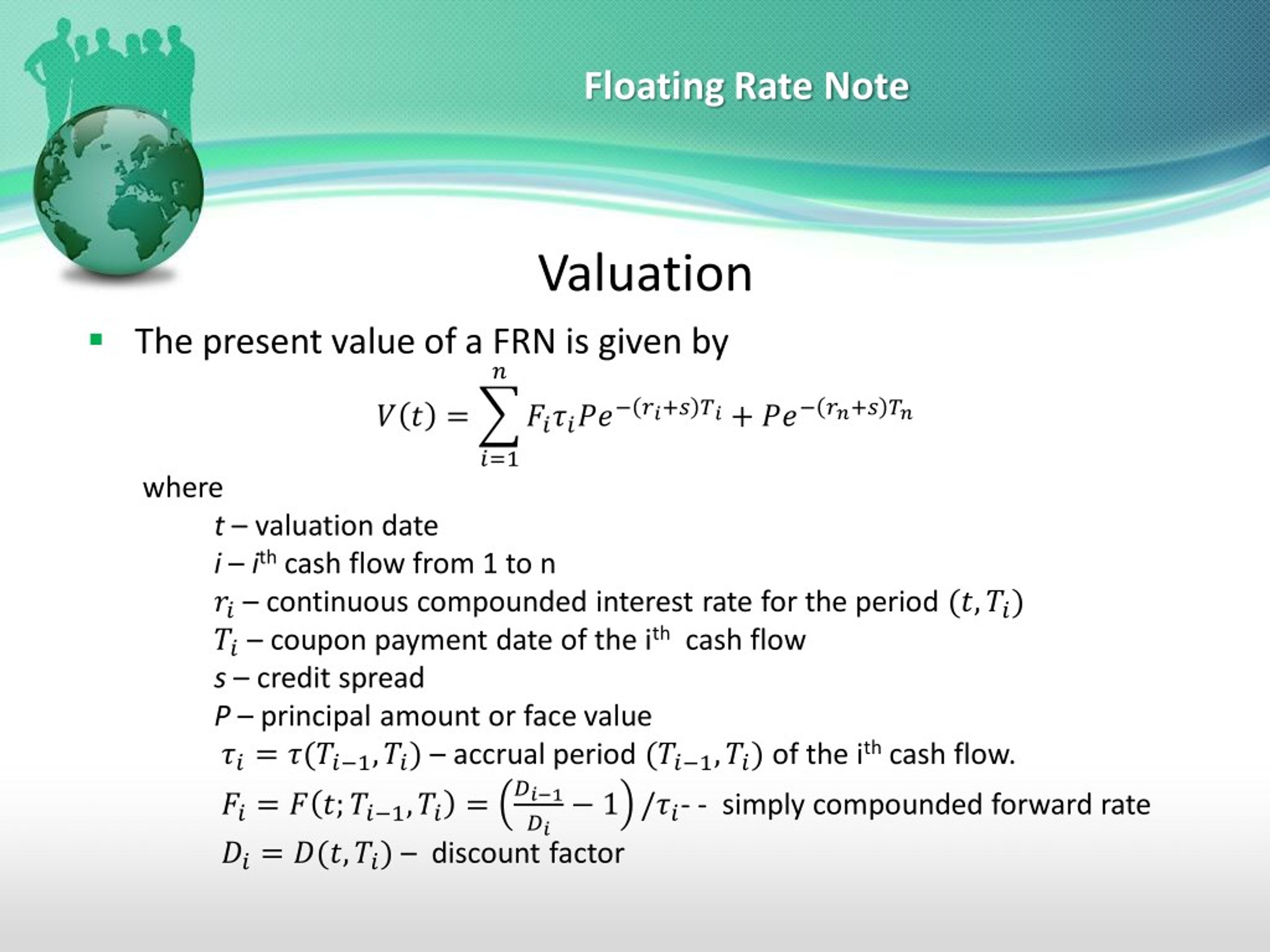
The complete formula is:
Where the cash flows are defined as in Step 1.
Clean Price vs. Full (Dirty) Price
The formula above gives us the Full Price (also known as the Dirty Price), which is the price an investor actually pays. However, bonds are typically quoted in terms of their Clean Price. The difference is the Accrued Interest (AI).
For a floater, the accrued interest is calculated using the known coupon rate for the current period.
And the clean price is simply:
The JSE document provides a concrete example of this, distinguishing between the "ALL IN PRICE" (full price) and the accrued interest.
Conclusion
Today we have derived the general pricing formula for a floating rate note valued between its reset dates. This is a critical piece of practical knowledge in fixed income.
Key Takeaways:
- For a standard floater, a simple "pull-to-par" method can be used, where the value is the PV of the next known coupon plus the PV of the par value at the next reset date.
- The more general and robust discount margin method must be used when the market-required spread differs from the bond's contracted spread.
- This method involves a two-step process:
- Forecast Cash Flows: Use the forward rate curve plus the contracted spread to estimate future, unknown coupons.
- Discount Cash Flows: Use the spot rate curve plus the market spread to calculate the present value of all cash flows (known and forecasted).
- The final price paid is the Full (or Dirty) Price, which can be separated into the quoted Clean Price and the Accrued Interest.
In our next session, you will put this theory into practice. We will implement a Python function to price a floating rate note using the general DCF model we've just derived, leveraging the curve construction techniques from earlier modules.