Welcome to the first lesson in your course on bond mathematics. Our goal today is to build the foundational formula for pricing a bond. We will start from the core financial principle of present value and derive the mathematical expression that connects a bond's price to its future cash flows and a single discount rate, known as the Yield to Maturity (YTM). This lesson establishes the theoretical groundwork that we will translate into Python code in our next session, following your preferred approach of building from first principles.
1. The Time Value of Money and Present Value
Before we can price a bond, we must first understand a fundamental concept in finance: the time value of money. The idea is simple: a dollar today is worth more than a dollar promised in the future. This is because a dollar today can be invested to earn interest. To compare money across different points in time, we use a process called discounting.
Discounting converts a future cash flow to its equivalent value today, its present value (PV). To do this, we need a discount rate, which represents the interest rate or rate of return we could earn over that period.
The following video provides an excellent introduction to interest, compounding, and the logic of discounting.
Lecture 1, Part III: Bond “Mathematics”
Watch this lecture from MIT OpenCourseWare to understand the principles of compounding and discounting.
Start with the section on compounding interest to see how a present sum grows into a future value. Then, focus on the section explaining discounting. Pay close attention to the no-arbitrage argument used to determine the present value of a future dollar. This is the core logic we will apply to bonds.
The general formula for the present value of a series of future cash flows is the sum of each individual cash flow discounted back to the present.
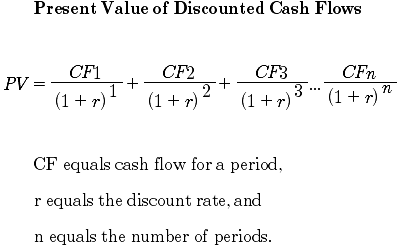
Mathematically, if you are to receive cash flows at times , and the per-period discount rate is , the total present value is:
This formula is the bedrock of valuation for almost all financial assets, including bonds.
2. Formulating the Bond Price
A bond is essentially a loan contract that specifies a series of future cash flows for the bondholder. Therefore, we can find its price by applying the present value formula to its specific cash flow structure.
Bond Terminology and Cash Flows
A standard fixed-rate bond has two types of cash flows:
- Coupons (C): A series of fixed interest payments made to the bondholder at regular intervals (e.g., semi-annually).
- Face Value (F) or Par Value: A lump-sum principal payment made at the end of the bond's life, on its maturity date.
The video below clearly defines the components used in bond pricing.
Bond Valuation | Exam FM | Financial Mathematics Lesson 21 - JK Math
This video from JK Math provides a clear and concise definition of the key terms used in bond valuation.
Watch the first section to familiarize yourself with the standard notation: Face Value (F), Redemption Value (C), coupon rate (r), number of periods (n), and yield rate (J). Note that in most of our work, the Face Value and Redemption Value will be the same.
The Bond Pricing Formula
Now, let's assemble these pieces. A bond's price is the present value of its stream of coupon payments plus the present value of its face value.
For a bond with periods to maturity, a per-period coupon payment of , a face value of , and a per-period discount rate of , the price () is:
This can be written more compactly as:
The summation term is the present value of a series of equal payments, which is known as an annuity. Given your background, you'll appreciate the following resource which provides a rigorous derivation of the closed-form solution for this sum.
Bond Prices and Yields — Econ 133
This resource derives the closed-form bond pricing formula from first principles.
Read the sections titled "Bond Pricing" and "Bond Value Formula". Follow the derivation that uses the formula for a geometric series to convert the summation of coupon payments into a compact annuity formula. This transforms the bond pricing equation into its well-known closed form.
After applying the geometric series formula, we arrive at the standard bond pricing formula:
Where:
- = Price of the bond
- = Coupon payment per period
- = Yield to maturity (YTM) per period
- = Face value of the bond
- = Number of periods until maturity
3. The Discount Rate: Yield to Maturity (YTM)
We've established the formula, but what is the appropriate discount rate to use? In this foundational model, we use a single, constant rate called the Yield to Maturity (YTM).
The YTM is defined as the internal rate of return (IRR) of the bond. It is the single discount rate that equates the present value of all the bond's future cash flows to its current market price.
Important Conventions: Handling Frequencies
In practice, bond characteristics are typically quoted in annual terms, but payments often occur more frequently (e.g., semi-annually). This requires careful adjustment of the inputs to our formula.
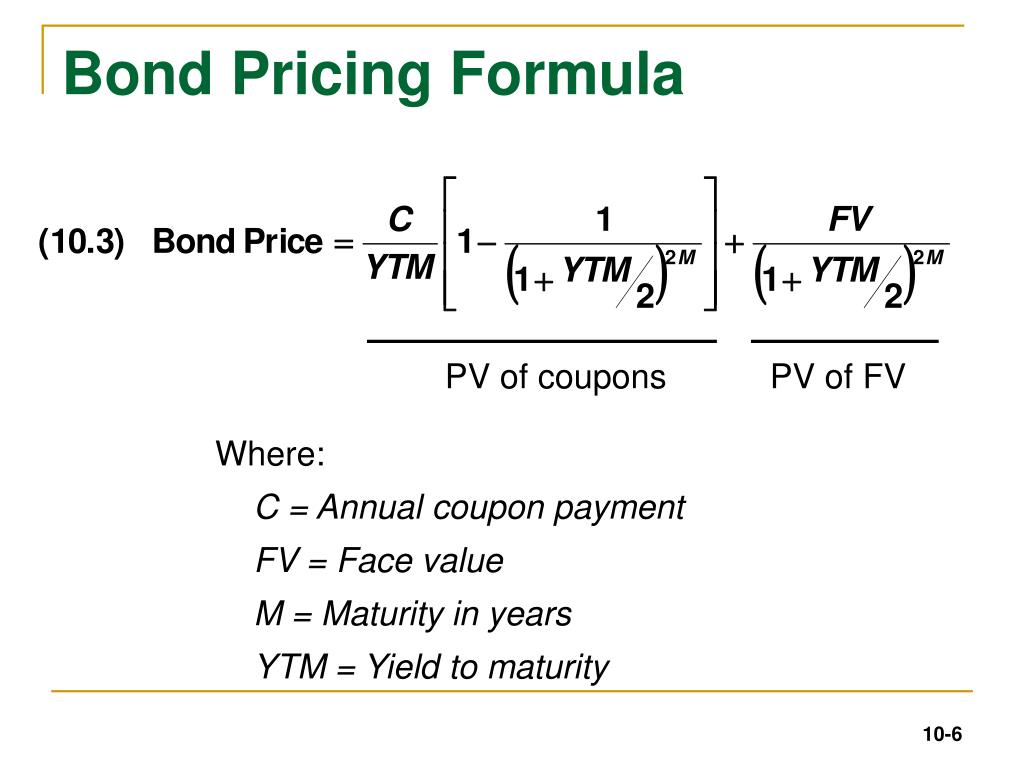
- Coupon Rate (c): Usually quoted as an annual rate. The periodic coupon payment is .
- Yield to Maturity (y): Also quoted as an annual rate. The periodic discount rate is .
- Maturity (M): Quoted in years. The total number of periods is .
For a typical U.S. corporate or government bond that pays semi-annually (frequency = 2), the formula becomes:
The following video provides a concrete example of pricing a semi-annual bond and highlights the crucial relationship between the coupon rate and the YTM.
Bond Valuation | Exam FM | Financial Mathematics Lesson 21 - JK Math
This video walks through a numerical example and explains how the yield impacts the price.
Watch the worked example. Focus on how the annual 10-year term, 5% coupon rate, and 6% yield are all converted into semi-annual figures (20 periods, 2.5% coupon rate per period, 3% yield rate per period) for the calculation. Continue through the next section, Premium, Discount, and Par, which demonstrates a key concept: If YTM > Coupon Rate, the bond trades at a discount (Price < Face Value). If YTM < Coupon Rate, the bond trades at a premium (Price > Face Value). If YTM = Coupon Rate, the bond trades at par (Price = Face Value).
Conclusion
In this lesson, we established the fundamental principle of bond valuation. You should now be able to formulate the price of a bond from its cash flows.
Here are the key takeaways:
- A bond's price is the sum of the present values of its future cash flows: a series of coupon payments (an annuity) and a final face value payment.
- The Yield to Maturity (YTM) is the single discount rate that equates the present value of these cash flows to the bond's market price.
- The bond pricing formula can be expressed in a compact, closed form derived from the formula for a geometric series.
- It is critical to adjust the coupon rate, YTM, and number of periods to match the bond's payment frequency (e.g., semi-annual).
In our next lesson, we will put this theory into practice. You will implement a Python function to price a bond using the formula we have derived today, which will be the first building block of our bond analytics toolkit.