Welcome to the next lesson in our journey through core data structures. In our previous session, we mastered the HashMap, a powerful tool for quick lookups and frequency counting, learning to leverage Java's built-in collections. Today, we shift from using pre-built structures to implementing fundamental algorithms from scratch. We will venture into the world of non-linear data structures by exploring the binary tree.
Our focus will be on tree traversal, which is the process of visiting every node in a tree. Specifically, you will learn to implement the three main depth-first traversal algorithms—preorder, inorder, and postorder—using recursion. This lesson builds directly on your foundational understanding of recursion and is a critical step in preparing you to tackle more complex tree-based problems, which are common in backend systems for tasks like managing hierarchical data or building efficient search structures.
1. Understanding Binary Trees and Traversal
Before we can traverse a tree, we first need to understand what it is. A binary tree is a hierarchical data structure where each node has at most two children, referred to as the left child and the right child. The topmost node is called the root. This structure is inherently recursive: every child of a node is also the root of its own smaller binary tree, called a subtree.
To represent this in code, we need a Node class. This class will hold the data for the node and two references (or pointers), one for its left child and one for its right.
The following video from Telusko provides an excellent explanation of building a Node class in Java from the ground up.
Tree Implementation in Java | DSA
This video demonstrates the creation of a Node class, which is the fundamental building block of a tree.
Please watch the segment from this point, where the instructor defines the Node class. Pay close attention to its three components: the data and the left and right references, which are themselves of type Node.
With the Node structure in place, we can now talk about traversal. This simply means visiting each node in the tree exactly once to perform an operation, like printing its value. There are two main strategies for this:
- Depth-First Search (DFS): Explores as far as possible along each branch before backtracking. This is what we'll focus on today.
- Breadth-First Search (BFS): Explores all nodes at the present depth level before moving on to the nodes at the next level. We'll cover this in our next lesson.
DFS itself has three common variations, defined by the order in which they visit the root node relative to its left and right subtrees. The mycodeschool channel provides a superb conceptual overview.
Binary tree traversal: Preorder, Inorder, Postorder
This video introduces the three depth-first traversal algorithms and the logic that distinguishes them.
Watch the introduction from the beginning. Focus on how Preorder, Inorder, and Postorder are just different permutations of three actions: visiting the Root, traversing the Left subtree, and traversing the Right subtree.
2. The Three Depth-First Traversal Algorithms
The key to understanding these traversals lies in the simple, recursive order of operations. The only thing that changes between them is the position of one step: visiting (processing) the current node's data.
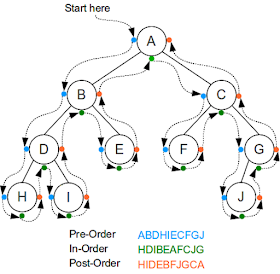
Preorder Traversal: (Root → Left → Right)
In preorder traversal, we "visit" the current node first, before recursively traversing its left and then its right subtrees. You can think of this as a "top-down" approach.
-
Algorithm:
- Visit the current node.
- Recursively call preorder on the left child.
- Recursively call preorder on the right child.
-
Result on example tree: A, B, D, H, I, E, C, F, G, J
The mycodeschool video provides a fantastic, detailed visualization of how the recursive calls work for preorder, including how the call stack manages the process. Understanding this is crucial for grasping recursion.
Binary tree traversal: Preorder, Inorder, Postorder
This segment walks through the preorder traversal algorithm, visualizing the recursive calls and the underlying call stack.
Watch from this section. Pay close attention to how the function calls itself, passing the address of the next node (e.g., preorder(150)), and how the program execution pauses and resumes as the call stack grows and shrinks.
Preorder traversal is particularly useful in specific scenarios. The following reading gives some excellent real-world examples.
Binary Tree Traversal Algorithms in Java: Complete Guide to ...
This article by Mahedee Hasan details the algorithms and provides excellent use cases for each.
Find the heading "Preorder Traversal". Read the section Use Cases & Applications. Note how creating a copy of a tree or representing a file system hierarchy are natural fits for this "parent-before-children" approach.
Inorder Traversal: (Left → Root → Right)
Inorder traversal visits the left subtree, then the current node, and finally the right subtree.
-
Algorithm:
- Recursively call inorder on the left child.
- Visit the current node.
- Recursively call inorder on the right child.
-
Result on example tree: H, D, I, B, E, A, F, C, J, G
This traversal has a very important special property when used with a Binary Search Tree (BST)—a specific type of binary tree where for any given node, all values in its left subtree are less than the node's value, and all values in its right subtree are greater. Inorder traversal on a BST will always visit the nodes in sorted ascending order.
Binary Tree Traversal Algorithms in Java: Complete Guide to ...
Let's return to the same article to explore the applications of inorder traversal.
Find the heading "Inorder Traversal". Read the section Use Cases & Applications. Focus on the first point about retrieving data from a BST in sorted order. This is a classic and powerful application.
Postorder Traversal: (Left → Right → Root)
Postorder traversal visits the left and right subtrees before visiting the current node itself. This "bottom-up" approach is useful when you need to operate on the children before you can operate on the parent.
-
Algorithm:
- Recursively call postorder on the left child.
- Recursively call postorder on the right child.
- Visit the current node.
-
Result on example tree: H, I, D, E, B, F, J, G, C, A
A classic use case for postorder traversal is deleting a tree from memory. You must delete the children before deleting the parent to avoid creating "dangling pointers" or memory leaks.
Binary Tree Traversal Algorithms in Java: Complete Guide to ...
Finally, let's look at the use cases for postorder traversal.
Find the heading "Postorder Traversal". Read the section Use Cases & Applications. Pay special attention to the first two points: tree deletion and postfix expression evaluation. Both demonstrate the "process children first" pattern.
3. Putting It All Together in Java
Now that you understand the concepts, let's see how to implement them. The following resource provides a complete, runnable Java program that builds a tree and implements all three recursive traversal algorithms. This is a perfect example to study, as it aligns with your preference for hands-on, project-oriented learning.
Binary Tree Traversal Algorithms in Java: Complete Guide to ...
This part of the article contains the full Java code for a TreeNode, a BinaryTree class with traversal methods, and a main method to run a demonstration.
Please study the code carefully, focusing on these parts: The TreeNode class: Start at the beginning to see a generic implementation of the node structure. The recursive methods: In the BinaryTree class, find and analyze the three pairs of public/private methods: preorderTraversal() and preorderHelper() here. inorderTraversal() and inorderHelper() here. postorderTraversal() and postorderHelper() here. Notice the pattern: a public method initializes the process, and a private helper method performs the actual recursion. The only difference between the three helper methods is the position of the result.add(node.element); line. The main method: Finally, look at the TreeTraversalDemo class, specifically the buildExampleTree() and demonstrateTraversals() methods here. This shows you how to instantiate the tree, add nodes, and call the traversal methods to see the output.
As you review the code, remember the time and space complexity. For all three DFS algorithms, the time complexity is O(n) because we visit each of the n nodes exactly once. The space complexity is O(h), where h is the height of the tree. This space is not used by an explicit data structure, but rather implicitly by the call stack to manage the recursive function calls.
Conclusion
In this lesson, you have moved beyond using built-in Java collections to implementing fundamental tree algorithms from first principles. You've learned the crucial difference between the three primary depth-first traversals and seen how a simple change in the order of recursive operations leads to vastly different results and use cases.
Key Takeaways:
- A binary tree is a recursive data structure composed of nodes, each with data and up to two children.
- Depth-First Search (DFS) traverses a tree by going as deep as possible down one branch before backtracking.
- The three main DFS traversals are distinguished by when they "visit" the root node:
- Preorder:
Root→ Left → Right (Useful for copying trees, file systems). - Inorder: Left →
Root→ Right (Produces sorted data on a BST). - Postorder: Left → Right →
Root(Useful for deletion, resource cleanup).
- Preorder:
- Recursive implementations are elegant and map directly to the definition of the traversal, but they use the call stack for memory, resulting in O(h) space complexity.
In our next lesson, we will explore the other main traversal strategy: Breadth-First Search (BFS). You will learn how to implement a level-order traversal, which visits the tree level by level, using a Queue instead of recursion.