Introduction
Hello! In our previous lesson, we broke down the Generalized Linear Model (GLM) into its three fundamental components: the random component, the systematic component, and the link function. We established that the random component specifies the probability distribution of your outcome variable, allowing you to choose one that matches your data—like the Binomial distribution for binary outcomes or the Poisson for counts.
In this lesson, we'll dive deeper into that random component. We'll explore the exponential family of distributions, a special class of probability distributions that forms the theoretical backbone of the entire GLM framework. Our goal is to understand what this family is and why its existence is so crucial for unifying seemingly different models like linear, logistic, and Poisson regression under a single theory. This will give you a much clearer picture of how GLMs work "under the hood."
What is the Exponential Family?
At its core, the exponential family is a set of probability distributions that can all be expressed in a specific mathematical format. This common format is what allows them to be treated in a unified way.
Let's begin with a video that introduces the concept of the exponential family and its general structure within the context of GLMs.
Explaining generalized linear models (GLMs) | VNT #15
This segment from the Very Normal channel will introduce the idea of the exponential family and show its general mathematical form.
Please watch the clip from 03:55 to 05:25. Focus on the core idea: it's a set of distributions that can be written in a specific structure that separates terms involving the data from terms involving the model parameters.
As the video explained, any distribution that can be algebraically rearranged into the following general form is a member of the exponential family. For a single parameter , the form is:
Don't worry too much about memorizing this equation. The key insight is its structure:
- It separates the data and the parameter .
- is called the natural parameter. It's often a function of the distribution's familiar mean parameter (e.g., or ).
- is the dispersion parameter, related to the variance. For some distributions like Poisson and Binomial, it's fixed, simplifying the equation further.
- The functions , , and are specific to each distribution.
The "magic" of GLMs comes from the fact that because many essential distributions (Normal, Binomial, Poisson, Gamma) fit this template, we can derive general properties and estimation methods that apply to all of them.
A Unifying Framework: Seeing is Believing
The claim that different distributions can be written in the same form might seem abstract. The best way to understand this unifying power is to see it in action.
Let's walk through an example. We'll see how the familiar Poisson distribution, used for count data, can be rearranged to fit the exponential family template.
Chapter 5 Generalized Linear Models: A Unifying Theory
This section from the 'Beyond Multiple Linear Regression' textbook provides a clear, step-by-step demonstration of how to write the Poisson probability mass function in the exponential family form.
Please read section 5.2.1, titled 'One-Parameter Exponential Family: Poisson'. You don't need to perform the algebraic steps yourself, but follow along to see how the standard Poisson formula is transformed into the exponential family structure. Notice how the final form allows them to identify the specific components, especially b(λ) = log(λ).
As you saw, through some algebraic manipulation involving logarithms and exponents, the Poisson distribution neatly fits the required format. The same can be done for other key distributions.
To get a broader sense of this unification, the following video explains the components of the exponential family form more generally and shows how making different choices for these components results in different common distributions.
The Exponential Family (Part 1)
This video from the Mutual Information channel provides a more detailed breakdown of the exponential family's structure and demonstrates its incredible generality.
Watch from 03:42 to 08:14 and then from 08:56 to 11:20. The first part breaks down the components of the general form (like t(x), the sufficient statistic). The second part shows how making simple choices for these components leads directly to the Bernoulli distribution, further illustrating the unifying concept.
This unifying principle is the answer to the question, "How can one estimation algorithm work for both logistic and Poisson regression?" It's because, after being expressed in their exponential family form, their mathematical structures look remarkably similar to the estimation engine.
The Role and Benefits of the Exponential Family in GLMs
So, why do we care about this? What functional advantage does this unification give us? The fact that the random component of a GLM belongs to this family provides several powerful benefits.
An introduction to the generalized linear model (GLM)
This article from Towards Data Science summarizes the practical advantages of the exponential family in statistical modeling.
Read the section titled 'Why is exponential family good?'. Focus on understanding these key points: Sufficient Statistics: The term T(y) in the formula is a sufficient statistic, meaning it captures all the information from the data y needed to estimate the parameter θ. General Formulas for Mean and Variance: The structure allows us to find a general formula for the mean (E[Y]) and variance (Var(Y)) of any distribution in the family. Notice the result: E[Y] = b'(θ). This is a powerful theoretical shortcut. Concave Likelihood: The log-likelihood function is always concave, which guarantees that we can find a single, optimal solution when we fit the model. This ensures the estimation process is stable and reliable.
The Canonical Link Function: A Natural Connection
Perhaps the most important consequence for our purposes is the direct link between the exponential family and the link function component of a GLM.
Remember the function from the exponential family form? The derivative of this function, , gives us the mean of the distribution, . The relationship between the mean and the natural parameter defines a special link function known as the canonical link.
This is the most "natural" mathematical link between the mean of the distribution and the linear predictor.
Let's see this in our examples:
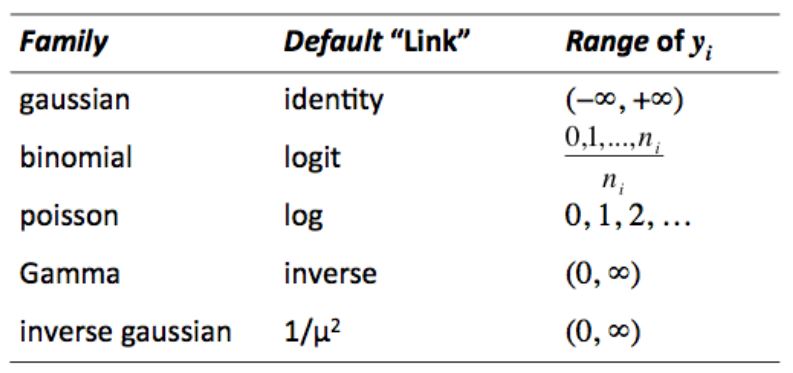
- Poisson Distribution: In the reading, we saw that for the Poisson distribution, . Since is the mean, the relationship is . This means the canonical (natural) link for a Poisson random component is the log link.
- Binomial Distribution: If we perform the same exercise for the Binomial distribution, we find that the natural parameter is , where is the probability of success (the mean). This is the logit function. The canonical link for the Binomial random component is the logit link.
- Normal Distribution: For the Normal distribution, the natural parameter is just the mean itself, . This means the canonical link is the identity link ().
This is why specific link functions are so closely associated with certain types of data. The canonical link provides a theoretically ideal starting point for connecting the random and systematic components of your GLM.
The table below summarizes the canonical link functions for the most common distributions in the exponential family used in GLMs.
Conclusion
In this lesson, we demystified the concept of the exponential family and its central role in the GLM framework. You now have the conceptual foundation to understand how GLMs can handle such a wide variety of data types in a coherent way.
Key Takeaways:
- The exponential family is a class of distributions that can be written in a common mathematical form, which separates data terms from parameter terms.
- This common structure is the unifying theory behind GLMs. It allows us to apply a single estimation procedure (like Iteratively Reweighted Least Squares) to many different models (Normal, Binomial, Poisson, etc.).
- Being a member of this family provides useful mathematical properties, such as having a sufficient statistic and a well-behaved likelihood function, which makes model fitting reliable.
- Most importantly, the exponential family form for a distribution gives rise to its canonical link function, which is the "natural" mathematical connection between the mean of the outcome and the linear predictor.
Preview of the Next Lesson:
We've now established that each distribution has a "natural" or canonical link. But are we forced to use it? In the next lesson, we will explore the link function component in greater detail. We will distinguish between canonical and non-canonical link functions and discuss the practical reasons why you might choose one over the other.