Hello! Welcome to the first lesson of your course on building a global payroll and tax compliance module. In our journey to design the business logic for this complex system, we'll start with the most fundamental concepts that form the bedrock of any payroll calculation, anywhere in the world.
This lesson is all about defining three key terms: gross pay, net pay, and deductions. While these concepts are universal, the rules governing them change dramatically from one country to another. Understanding this core framework is the essential first step before you can model the specific logic for India, the US, Germany, and Brazil. We'll establish the definitions and then immediately see how they apply in a global context.
Gross Pay vs. Net Pay: The Fundamental Equation of Payroll
At its heart, payroll processing is the journey from what an employee is promised to what they actually receive. This journey involves two key milestones: gross pay and net pay. The terms are often used interchangeably in casual conversation, but for a payroll system, the distinction is precise and critical.
To get a clear definition of these terms, we'll start with an excellent article from Bharat Payroll. While its examples are rooted in the Indian context—which aligns with your special focus—the core definitions are globally applicable.
Gross Pay vs Net Pay: Differences, Deductions, Calculations
This article provides a clear, no-jargon explanation of the fundamental concepts of payroll. It's a great starting point for building our conceptual model.
Please read the following sections: Start with "What Does Gross Pay Mean?" and the subsequent short section to get the basic definitions. Then, read the section "What Does Net Pay Mean?" Pay close attention to the table under "Gross Pay vs Net Pay: The Core Difference". This table neatly summarizes the distinctions you'll need to encode in your system's logic. Finally, look at the simple formula and the step-by-step process under "Calculating Net Pay Step by Step". Note the example provided at the end.
As you've just read, the relationship can be summarized by a single, powerful equation that is the foundation of all payroll calculations:
- Gross Pay is the starting point. It represents the total value of an employee's compensation for a given pay period before anything is taken out. It's the sum of all earnings.
- Net Pay (or "take-home pay") is the final destination. It's the actual amount of money that gets deposited into an employee's bank account.
- Deductions are everything that happens in between. They are the various amounts subtracted from the gross pay.
From a systems perspective, your software's primary job is to accurately calculate the "Deductions" bucket and apply it to the "Gross Pay" to arrive at the correct "Net Pay."
Deconstructing Gross Pay and Deductions
The terms "Gross Pay" and "Deductions" are themselves containers for many smaller components. A robust payroll system needs to understand and process each of these sub-components correctly.
Components of Gross Pay
Gross pay isn't just a base salary. It can include a variety of earnings types. The Bharat Payroll article you just reviewed lists some common ones:
- Regular wages and salary
- Overtime pay
- Bonuses and commissions
- Allowances (e.g., for housing, transport)
For example, in India, a gross salary is typically broken down into components like Basic Salary, House Rent Allowance (HRA), and various other special allowances. We will explore these in great detail in Module 2, but it's important to recognize now that "Gross Pay" is a composite value.
Types of Deductions
The "Deductions" bucket is where most of the jurisdictional complexity lies. These deductions are not all treated equally. The primary way to classify them is by their nature and their effect on taxes.
Let's return to the Bharat Payroll article to understand these classifications.
Gross Pay vs Net Pay: Differences, Deductions, Calculations
This part of the article breaks down the different types of deductions, a crucial concept for payroll logic.
Read the sections: "Payroll Deductions Explained", which introduces the critical difference between mandatory and voluntary deductions. "Pre-Tax vs Post-Tax Deductions", which explains the different points in the calculation at which deductions can be applied. This order of operations is fundamental to the logic you will build.
To summarize the key logic you'll need to model:
- Mandatory vs. Voluntary: Your system must distinguish between deductions required by law (like taxes and social security) and those elected by the employee (like contributions to a specific retirement plan or supplemental health insurance).
- Pre-tax vs. Post-tax: This is a vital concept for the calculation flow.
- Pre-tax deductions are subtracted from gross pay before income taxes are calculated. This reduces the employee's taxable income, and thus their tax liability. Common examples include contributions to certain retirement or health savings accounts.
- Post-tax deductions are taken out after all taxes have been calculated and withheld. Examples might include loan repayments or charitable donations made via payroll.
Therefore, a more precise formula for the calculation flow looks like this:
- Taxable Income = Gross Pay - Pre-Tax Deductions
- Tax Amount = ApplyTaxRates(Taxable Income)
- Net Pay = Taxable Income - Tax Amount - Post-Tax Deductions
This sequence is the logical backbone of any payroll calculation engine.
Deductions in a Global Context
Now, let's see how this plays out in the real world. The types and amounts of mandatory deductions vary enormously between countries. This is the core challenge in building a global HRMS.
The following video provides a quick tour of how deductions differ across several countries, including some that are key to your project.
Payroll Process Explained Step by Step | How Payroll Works?
Watch this segment from the "Payroll Process Explained" video by Leaders Talk to see concrete examples of statutory deductions in the US, India, and the UK.
Focus on the part explaining deductions for different countries, which starts around the explanation of social security and continues with examples from the US, India, and the UK. This will help you see the universal concept of deductions applied with country-specific rules.
As the video illustrates, a payroll system must be configured with the specific statutory deductions for each jurisdiction:
- USA: Federal income tax, state income tax, and FICA taxes (Social Security & Medicare).
- India: Tax Deducted at Source (TDS), Employee Provident Fund (EPF), and Employee State Insurance (ESI).
- UK: Pay As You Earn (PAYE) tax and National Insurance Contributions (NIC).
Let's look at two more of your target countries—Germany and Brazil—using some visual aids.
Germany
This image shows a sample German payslip calculation. You can clearly see the "Gross to Net" flow.
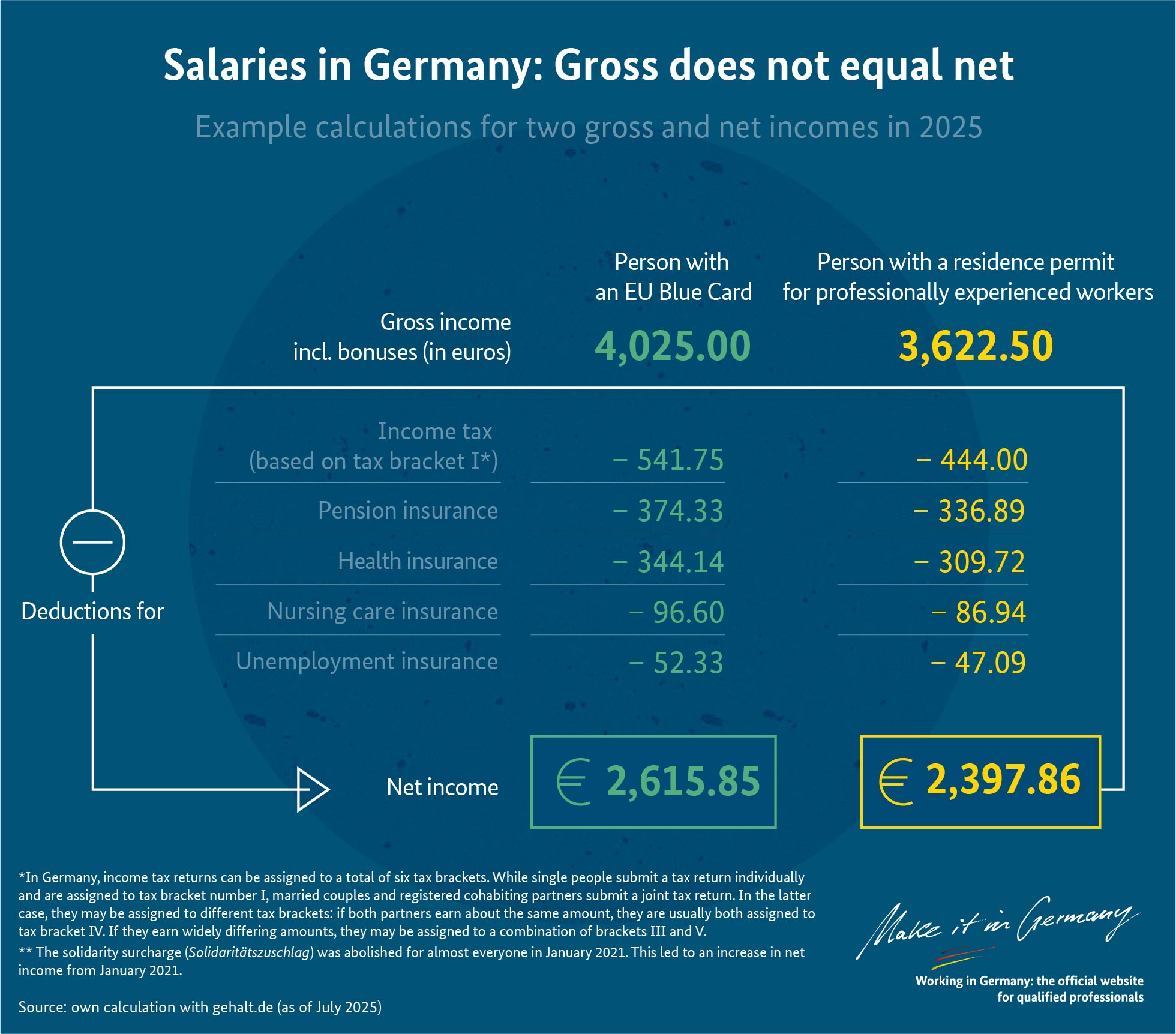
Notice the list of deductions. These are all statutory social security contributions. A German payroll module must have logic to calculate each of these five items before it can determine the final net pay.
Brazil
This graphic shows the high-level process for Brazil.
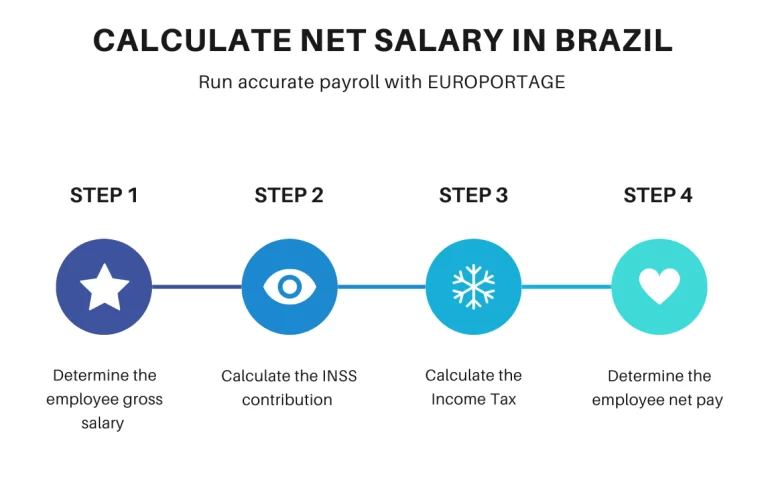
This flow reinforces the calculation sequence: you start with Gross, apply one type of deduction (INSS), then another (Income Tax), to finally arrive at Net Pay.
An Expanded View: Employer Contributions
So far, we've focused on the employee's payslip. But a complete payroll system must also handle another critical set of calculations: employer contributions. These are mandatory costs that the company must pay on top of the employee's gross salary. They do not come out of the employee's pay but are a direct payroll expense for the employer.
Your HRMS module will need to calculate these liabilities for accounting, budgeting, and compliance purposes. This concept is sometimes captured in the term Cost-to-Company (CTC), which you'll frequently encounter in the Indian context. CTC attempts to represent the total cost of employing someone, including both their gross salary and the employer's share of statutory contributions.
The following resource gives a fantastic overview of these employer-side costs across the globe.
Global Payroll Costs: What You'll Actually Pay per Country | eorHQ
This article shifts our perspective from the employee's net pay to the employer's total cost. Understanding this is crucial for building a comprehensive financial module.
Please read the introduction, "The Processing Fee Is the Smallest Part of Global Payroll Cost". Then, carefully study the table under the heading "The Real Cost".
Look at the dramatic differences in the "Employer Contribution Rate" in that table for your target countries:
- United States: 8–10%
- Germany: ~21%
- India: ~15%
- Brazil: 25–35%
This means that for a software developer with a €100,000 gross salary in Germany, the company's actual cost is approximately €121,000, plus administrative fees. Your payroll system must calculate both the employee's net pay of (for example) €65,000 and the company's total liability of €121,000. These are two sides of the same coin, and both are essential for financial reporting.
Conclusion
In this lesson, we've established the foundational vocabulary and logical flow of payroll. Let's summarize the key takeaways for the system you're planning to build.
Key Takeaways:
- Gross Pay is the sum of all earnings before any subtractions.
- Net Pay is the final take-home amount after all subtractions. The core function of payroll is to calculate the difference.
- Deductions are the bridge from gross to net. Your system must categorize them as mandatory vs. voluntary and apply them in the correct order based on whether they are pre-tax or post-tax.
- The specific rules for deductions are highly country-specific, which is the primary source of complexity in a global payroll system.
- A comprehensive payroll module must calculate not only employee deductions but also employer statutory contributions to determine the total cost of employment.
We've laid the groundwork. You now have a conceptual model that can be applied to any jurisdiction.
Preview of the Next Lesson:
Now that we have the overall framework, our next lesson, "Identify the key components of an employee's compensation package across different geographies," will zoom in on the first part of our equation: Gross Pay. We'll break down the various types of earnings, allowances, and benefits that make up an employee's total compensation package in different parts of the world, preparing you to model this crucial input to your payroll calculations.