Introduction
In our last session, we designed a framework for intentional living by applying timeboxing to your schedule. The goal was to create protected blocks for deep work, training, and leisure. Today, we'll focus on the content for one of those "training blocks." This lesson will equip you to perform rows and reverse flyes using your chest expander, essential movements for building upper back strength and improving posture.
As an engineering student, you likely spend a significant amount of time sitting and leaning over books or a computer. This can lead to a postural pattern sometimes called "student slouch," where the shoulders round forward and the upper back weakens. The exercises in this lesson are a direct antidote. They strengthen the muscles that pull your shoulders back—the rhomboids, trapezius, and posterior deltoids—creating a strong, balanced physique to complement the pushing exercises you've been working on.
Why Your Back Needs to be as Strong as Your Front
So far, your training has included pushing movements like push-ups and dips. These are excellent for developing the chest, front of the shoulders, and triceps. However, focusing only on pushing without balancing it with pulling can create muscular imbalances, potentially leading to poor posture and shoulder discomfort. Rows and reverse flyes are fundamental "pulling" exercises that ensure your upper body develops in a structurally sound and symmetrical way.
The benefits of these movements go beyond aesthetics; they are crucial for functional strength and health.
How to Do a Reverse Fly: Techniques, Benefits, Variations
This article from Verywell Fit explains the specific muscles targeted by the reverse fly and why strengthening them is so important, especially for those who spend a lot of time sitting.
Please read the section titled Benefits of The Reverse Fly. Pay attention to the connection it draws between these back muscles, counteracting a head-forward posture, and reducing pain.
The Reverse Fly: Targeting Posture and Shoulder Health
The reverse fly is an isolation exercise that specifically targets the muscles responsible for pulling your shoulder blades together (scapular retraction). It's an excellent movement for developing awareness and control of your upper back.
We'll use a video to learn the proper form. Although the instructor uses a standard resistance band, the mechanics are identical for your chest expander. The key is to focus on the form cues he provides.
How To: Resistance Band Reverse Fly
In this video, Scott Herman provides a detailed, step-by-step guide to the resistance band reverse fly, including common mistakes and how to correct them.
Watch the following segments carefully: Introduction: The instructor identifies the target muscles. Setup and Form: Pay close attention to the cues about keeping your elbows up and maintaining a tight core. Demonstration: Watch his demonstration of both correct and incorrect form. The difference in muscle engagement when he keeps his elbows high is the most critical takeaway.
To reinforce this, here are the steps in a simple, written format.

How to Perform the Reverse Fly:
- Stand with your feet shoulder-width apart, holding the chest expander handles in front of you with a neutral grip (palms facing each other). Your arms should be nearly straight, with a slight bend in the elbows.
- Keeping your core tight and torso upright, initiate the movement by squeezing your shoulder blades together.
- Pull the handles apart in a wide arc until your arms are extended out to your sides, roughly parallel to the floor.
- Pause for a second at the point of peak contraction, focusing on the squeeze in your upper back.
- Slowly and with control, return to the starting position. The resistance on the return (the eccentric phase) is just as important as the pull itself.
A common mistake is to use momentum or let the arms do all the work. The movement should originate from your back. To ensure you're doing this correctly and safely, let's review some common errors.
How to Do a Reverse Fly: Techniques, Benefits, Variations
This section of the Verywell Fit article details the most frequent errors people make when performing reverse flyes. Understanding these will help you maximize the exercise's effectiveness and minimize injury risk.
Please read the section titled Common Mistakes. Focus on the advice regarding rounding the back, swinging the weight, and lifting too heavy. With a chest expander, "lifting too heavy" means using too many springs, which compromises your form.
The Row: Building a Powerful Back
While the reverse fly isolates the smaller postural muscles, the row is a compound movement that builds overall mass and strength in your entire upper back, including the latissimus dorsi ("lats"). Using your chest expander, you can perform rows by anchoring one end to a sturdy object.
The article from Bells of Steel provides clear instructions for two excellent row variations. We will focus on the single-arm row, which is a fantastic unilateral movement for building a strong and stable back.
8 Best Chest Expander Exercises To Sculpt Your Body - Bells of Steel
This guide from Bells of Steel provides step-by-step instructions for several chest expander exercises, including two effective rowing variations.
Read the instructions for two exercises: First, focus on the Single-Arm Row. You will need a sturdy anchor point for this, like a doorknob (with the door securely closed) or a heavy piece of furniture. Next, look at the Seated Dual Arm Row. This is a great alternative if you don't have a suitable anchor point, as you use your own feet to anchor the expander.
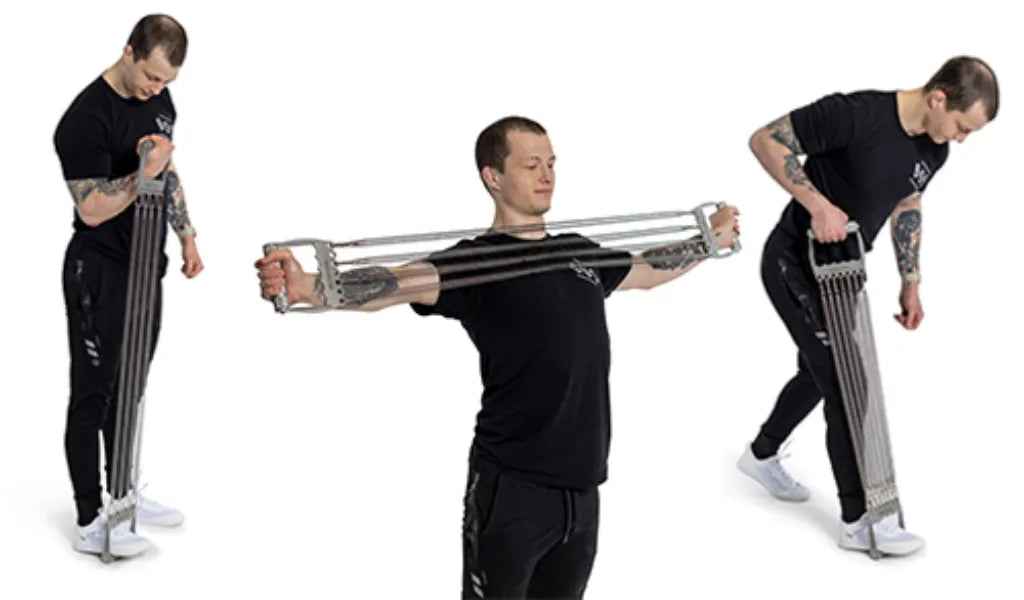
Key Cues for the Row:
- Maintain a Neutral Spine: Whether standing and hinged at the hips or sitting on the floor, your back must remain straight. Do not round your lower back.
- Drive with the Elbow: Think about pulling your elbow back towards your hip, not just pulling with your hand. This helps to engage the larger back muscles instead of relying on your biceps.
- Squeeze at the Top: Just like with the reverse fly, pause at the peak of the movement and consciously squeeze your shoulder blade toward your spine.
- Control the Eccentric: Don't let the spring snap your arm back to the start. Control the return phase over 2-3 seconds to maximize muscle engagement.
Putting It Into Your Workout
You now have two powerful back-building exercises to add to your routine. Here is a practical way to integrate them:
- Placement: Add these to your "pull" workouts, on the same day you perform table rows or other pulling movements.
- Sets and Reps: For both exercises, aim for 3 sets of 10-15 repetitions.
- Progressive Overload: Once you can comfortably complete 3 sets of 15 reps with good form, you can progress in one of several ways:
- Add Resistance: Add another spring to your chest expander.
- Increase Reps: Aim for a higher rep target, like 18-20.
- Improve Tempo: Slow down the movement, especially the eccentric (return) phase. Try a 3-second count as you return to the start.
Conclusion
In this lesson, you've learned not just how to perform chest expander rows and reverse flyes, but also why they are critical for your physical development. By strengthening your upper back, you are building a more resilient, balanced, and posturally sound body—a vital investment for anyone who spends long hours dedicated to their studies.
Key Takeaways:
- Balancing pushing exercises with pulling exercises like rows and reverse flyes is essential for preventing muscle imbalances and promoting good posture.
- The reverse fly is an isolation movement that targets the rhomboids and posterior deltoids, directly counteracting the effects of slouching. Proper form involves squeezing the shoulder blades together and keeping the elbows high.
- The row is a compound movement that builds overall back strength. The key is to maintain a neutral spine and think about driving your elbows back.
- You can apply progressive overload by adding springs, increasing repetitions, or slowing down the tempo of the exercise.
In our next training lesson, we will take a significant step forward in your pulling journey. The back strength you develop with these exercises will be the foundation for learning to perform negative (eccentric) pull-ups, the primary progression toward achieving your first full pull-up.