Introduction
Welcome to the next step in refining our experimental design. In the previous lesson, we established a detailed Ecological Momentary Assessment (EMA) schedule, giving us a plan to collect rich, high-frequency data on the satisfaction of each member of the vee triad. This data stream is the lifeblood of our N-of-1 experiment. However, the very nature of the triadic system—three interconnected individuals sharing experiences—introduces a critical statistical challenge that we must address before any analysis can be performed.
This lesson confronts that challenge head-on, fulfilling the learning outcome: Develop a strategy to handle statistically correlated outcomes arising from the interconnected system structure. The satisfaction scores of the three participants will not be independent; one person's mood will influence another's, and shared events will affect all three simultaneously. Standard statistical models assume independence, and violating this assumption leads to biased standard errors and incorrect conclusions. Given your background in statistics, you'll recognize this as a foundational issue. Our goal is to select and justify a modeling strategy that explicitly accounts for this non-independence, ensuring our causal inferences are valid.
1. The Problem of Non-Independence
When observations are not independent, the errors in a standard statistical model (like an ordinary least squares regression) become correlated. This has severe consequences for inference.
This video from Andy Field's channel provides an excellent and intuitive explanation of why hierarchical data structures lead to a violation of the independence assumption and why it matters.
Please watch the segment from "why do we care". The key takeaway is that dependency in the data leads to dependency in the model errors, which in turn biases standard errors, confidence intervals, and p-values. This means we might conclude an effect is significant when it isn't, or vice-versa.
In our vee triad, non-independence arises from multiple sources:
- Shared Environment: A stressful event at home (e.g., a financial concern) could lower the satisfaction of all three members at the same time.
- Direct Influence (Interference): The pivot's happiness might directly increase her partners' happiness, or conflict between the two partners might decrease the pivot's satisfaction.
Ignoring this structure is not an option. We need a method that acknowledges and models this interdependence. The two frameworks we will combine to achieve this are the Actor-Partner Interdependence Model (APIM) for the conceptual structure and Multilevel Modeling (MLM) for the statistical estimation.
2. A Conceptual Framework: The Actor-Partner Interdependence Model (APIM)
Before we get to the statistics, we need a conceptual language to describe the pathways of influence within the triad. The Actor-Partner Interdependence Model (APIM) provides this language. It was developed specifically for analyzing data from dyads (pairs), where the two members are interdependent.
"Actor Partner Interdependence Model" in
This encyclopedia entry by Campbell and Stanton offers a concise and authoritative overview of the APIM.
Please read the first two sections of the text: The initial paragraph defines the model and its two core components: the actor effect and the partner effect. The section "The APIM Conceptually" explains the theoretical basis for the model, rooting it in the concept of interdependence as a fundamental quality of close relationships.
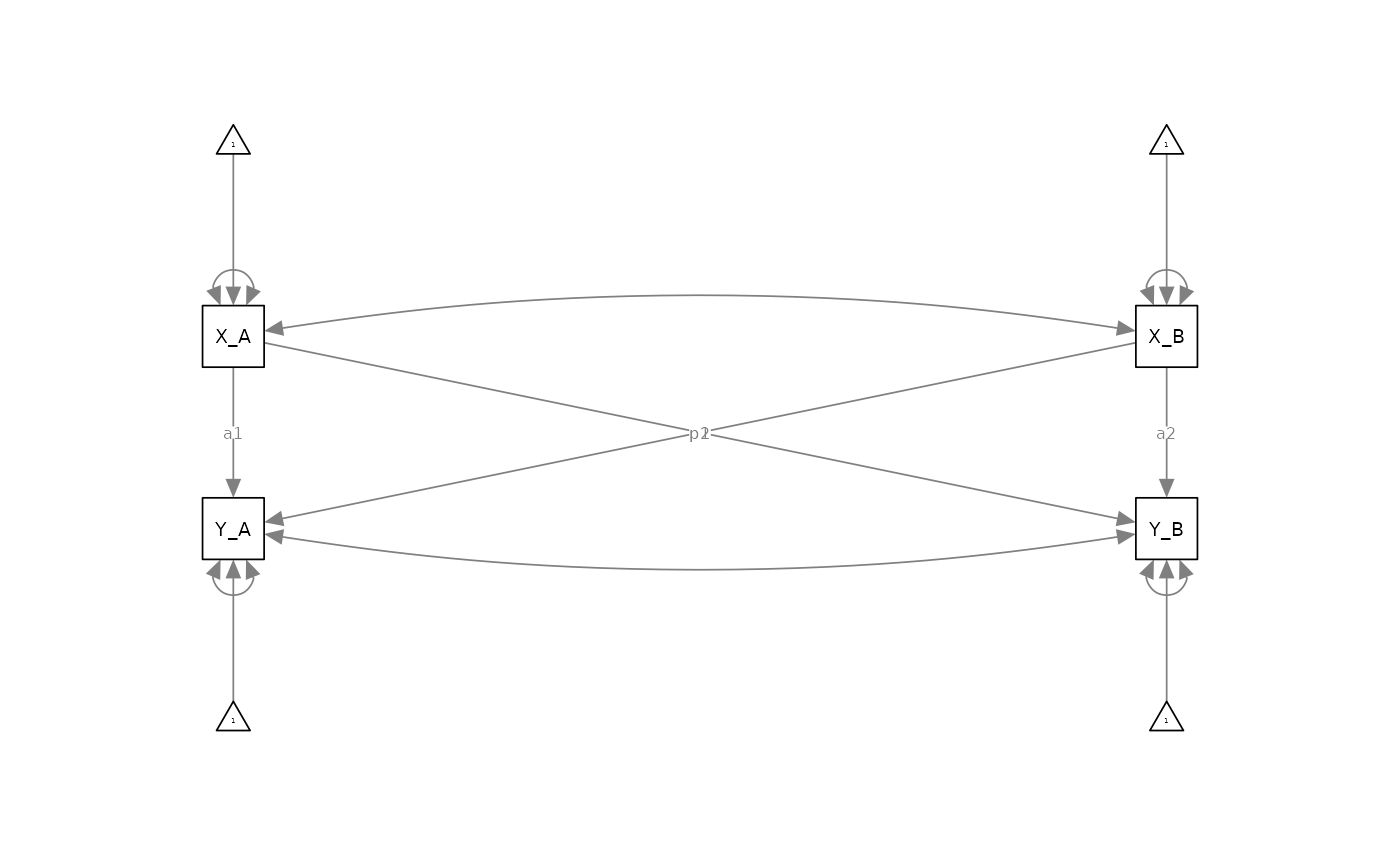
The APIM forces us to be precise about whose characteristics are affecting whose outcomes.
- Actor Effect: The effect of an individual's own predictor variable on their own outcome variable. For example, how does Partner A's sense of autonomy affect Partner A's satisfaction?
- Partner Effect: The effect of an individual's predictor variable on their partner's outcome variable. For example, how does Partner A's sense of autonomy affect the Pivot's satisfaction?
This is visually represented in a path diagram.
3. Extending the APIM to Our Vee Triad
The classic APIM is dyadic, but its logic extends seamlessly to our triadic system. For any given member, we simply have one actor effect and two partner effects.
Consider the pivot's (let's call her W) satisfaction. A model of her satisfaction would include:
- Actor Effect: The influence of W's own predictors (e.g., her perceived autonomy, security).
- Partner A Effect: The influence of Partner A's predictors on W's satisfaction.
- Partner B Effect: The influence of Partner B's predictors on W's satisfaction.
This triadic extension of APIM is a well-established method in family psychology research. It allows us to ask sophisticated questions about the system's dynamics. For example: "Is the pivot's satisfaction more strongly influenced by her own sense of security (actor effect) or by her partners' sense of security (partner effects)?"
Effortful Control and Health among Triads of Mothers and Twin ...
This paper by Miadich et al. provides a fantastic, real-world application of APIM to triadic data (a mother and her twin children). It demonstrates exactly the strategy we will be adopting.
Please read the following parts of the paper: Focus on the section "Dynamic Associations" in the introduction. It explains how they apply APIM to their triad, defining actor and partner effects. Skim the introduction to the results section and look at Figures 2, 3, and 4. You don't need to digest all the results, but observe how the path diagrams are structured to show actor effects (e.g., Mother's EC to Mother's Health) and partner effects (e.g., Twin's EC to Mother's Health) for all three members. This illustrates how the dyadic concept is expanded to a triad.
The Miadich et al. paper validates our approach, showing that APIM is a powerful and accepted method for modeling the interdependence in a three-person system.
4. The Statistical Engine: Multilevel Modeling (MLM)
The APIM provides the conceptual blueprint. Multilevel Modeling (MLM), also known as Hierarchical Linear Modeling (HLM), provides the statistical engine to estimate the actor and partner effects correctly. MLM is designed specifically for data with a nested or hierarchical structure, which is precisely what our EMA protocol will produce.
Our data will have at least two levels:
- Level 1 (The "Within" Level): The repeated EMA measurements (multiple satisfaction scores per day for each person).
- Level 2 (The "Between" Level): The three individuals, who are nested within the triad.
MLM handles the non-independence by partitioning the variance. Instead of one residual error term like in OLS, it estimates variance at each level of the hierarchy.
The core innovation of MLM is the use of random coefficients.
Andy Field's video again provides a brilliant visual explanation of the logic behind MLM.
Please watch these segments: The discussion on fixed vs. random coefficients. The key idea is that a "random" coefficient is one that is allowed to vary across contexts (in our case, across people). The graphical explanation of random intercepts and random slopes. This is the most crucial part. It shows how MLM can fit a separate regression line for each context (person) while estimating the overall average effect. The equation breakdown. This shows how the standard linear model equation is augmented with additional terms (u_j) to represent the variability of the intercepts and slopes across the higher-level units.
Here's how this applies directly to our experiment:
- Random Intercepts: We will allow the intercept of our model to vary for each of the three participants. This acknowledges that each person has their own unique baseline level of satisfaction, independent of any specific predictors. This models the stable, between-person differences.
- Random Slopes (Optional but powerful): We could also allow the effect of a predictor to vary. For example, the effect of "time spent together" on satisfaction (a slope) might be stronger for one person than for another. A model with random slopes would capture this nuance.
By explicitly modeling the variance between people (random intercepts), MLM accounts for the fact that observations from the same person are more similar to each other than to observations from another person. This resolves the non-independence problem and yields unbiased standard errors and valid p-values for our actor and partner effects.
Conclusion
We have now outlined a robust and sophisticated strategy for analyzing the data from our vee triad experiment. This strategy directly confronts and resolves the problem of statistical non-independence inherent in any interconnected system.
Key Takeaways:
- Non-Independence is a Critical Flaw: Standard statistical models are inappropriate for our data because they assume independence. Using them would lead to invalid conclusions.
- APIM Provides the Conceptual Map: The Actor-Partner Interdependence Model gives us the theoretical language to frame our research questions in terms of self-influence (actor effects) and mutual influence (partner effects).
- MLM is the Statistical Engine: Multilevel Modeling is the statistical technique we will use to estimate the APIM. By using random coefficients (especially random intercepts), MLM explicitly models the nested structure of our data (measurements within people), correcting for non-independence.
- Our Strategy: We will specify and estimate a Multilevel Actor-Partner Interdependence Model. This approach is the state of the art for analyzing intensive longitudinal data from small, interdependent groups.
With our measurement instrument designed, our EMA schedule set, and our analytical strategy in place, we are nearing a complete experimental plan. The final piece of the measurement puzzle is to decide how to synthesize the multiple facets of satisfaction we plan to measure. In the next lesson, we will focus on how to construct and justify a composite triadic satisfaction index, which can serve as a primary outcome variable in the MLM we've just designed.