Welcome to the fourth lesson in our module on N-of-1 experimental design. In our last session, we established a rigorous protocol for the timing of our experiment, moving beyond fixed schedules to a data-driven, steady-state strategy. This ensures that when we compare the triad's satisfaction across different living arrangements, we are comparing stable, meaningful states. Now, we turn our attention from the structure of the experiment to a more insidious threat to its validity: psychological bias.
The integrity of any experiment hinges on isolating the effect of the intervention from the expectations and beliefs of those involved. This is the role of blinding. In our case, where the intervention is a change in living arrangement, blinding the participants is impossible. This lesson confronts that challenge directly. Our goal is to design partial blinding strategies to mitigate bias when participant blinding is impossible. We will explore how to build layers of "blindness" into the later stages of the research process—from outcome assessment to statistical analysis and final interpretation—to protect the integrity of our findings.
1. The Challenge: Unavoidable Participant Awareness
In a classic randomized controlled trial (RCT), participants might be allocated to different groups without their knowledge, as illustrated in the "Blinded n-of-1 experiment" arm of a typical trial flow.

Our vee triad experiment, by its very nature, places our participants in the "Unblinded" arm. They will know if they are living together (Triadic Cohabitation), if one partner lives elsewhere (Anchor-Satellite), or if they all live separately (Dispersed Living). This awareness can introduce powerful biases:
- Expectation Effects: Participants might have pre-existing beliefs that one arrangement will be "better," causing them to report higher satisfaction under that condition, regardless of its true effect.
- Response Bias: They might report what they believe the researcher wants to hear, a phenomenon particularly strong in self-reported outcomes.
Since we cannot blind the participants, we must shift our focus to blinding everyone else involved in the research process. The following reading introduces the fundamental importance of blinding and the risks of failing to do so.
Blinding-in-randomised-clinical-trials-of-psychological-. ...
This article provides an excellent overview of why blinding is critical and the specific biases that arise in psychological trials when it is absent.
First, read the introduction to understand the evidence showing that a lack of blinding can lead to exaggerated treatment estimates. Then, read the subsection beginning with "Despite this apparent obstacle" in the Discussion. This part explains precisely how unblinded participants and providers can introduce bias through response expectancies and allegiance, which is directly relevant to our triad.
The key insight is that if the participants cannot be blind, we must ensure that their knowledge does not contaminate the data's collection, analysis, and interpretation.
2. A Multi-Layered Blinding Strategy
Even when participant blinding fails, other layers of the experimental process can and should be masked. This is our partial blinding strategy. We will systematically blind every role possible, creating a chain of ignorance that protects the final result.
The following comprehensive guide from the paper you just reviewed outlines how to approach this for each key role in a trial.
Blinding-in-randomised-clinical-trials-of-psychological-. ...
This reading provides a practical playbook for implementing partial blinding. Focus on the strategies for each role after the participant.
Read the sections within Box 1 that describe the blinding of: Outcome assessors: This is our first line of defense. Data managers: How to handle the raw data. Statisticians: Crucial for unbiased analysis. Conclusion makers: A sophisticated final step to prevent biased interpretation.
Let's operationalize these strategies for our vee triad experiment.
A. Blinded Outcome Assessment
This is the most common form of partial blinding. If we supplement our daily self-report diaries with, for example, semi-structured interviews about relationship dynamics, the interviewer should be blinded to the triad's current living arrangement.
Protocol:
- An independent researcher (the "outcome assessor") who is not involved in the day-to-day management of the trial will conduct the interviews.
- The participants will be explicitly instructed: "During this interview, please do not mention where you or your partners are currently living or refer to the specific phase of the experiment you are in."
- The assessor will be located separately from the main research team to minimize accidental unblinding.
The challenge, as the reading notes, is that for self-reported outcomes like our daily satisfaction diaries, the participant is the outcome assessor, making this strategy inapplicable for that specific data stream. This elevates the importance of the next layers.
B. Blinded Data Management and Statistical Analysis
This is a highly effective and robust strategy that your statistics background makes you well-equipped to appreciate and implement. It involves creating a firewall between the data collection and data analysis.
Protocol:
- Coding: At the start of the study, the three living arrangements (
Triadic Cohabitation,Anchor-Satellite,Dispersed Living) are randomly coded as "Condition A," "Condition B," and "Condition C." Only the unblinded primary researcher knows this key. - Data Handling: An unblinded data manager collects the daily satisfaction scores and any other data. They clean the data and organize it by date, but crucially, they label the treatment periods using only the A, B, C codes.
- Analysis: The dataset is then passed to a blinded statistician (which could be you, acting in a blinded capacity). Your task is to perform the entire pre-specified statistical analysis on the data, comparing outcomes for A, B, and C without knowing which is which. You would report: "Condition B showed a statistically significant 15% higher mean satisfaction score compared to Conditions A and C."
This prevents any conscious or unconscious desire to find a specific result from influencing analytical decisions, such as how to handle outliers or which covariates to include.
C. Blinded Interpretation of Conclusions
This is the final layer of protection, guarding against post-hoc rationalization. After the blinded statistician completes the analysis, the research team (acting as "conclusion makers") reviews the blinded results.
Protocol:
- The team receives the report: "Condition B is superior to A and C."
- They then write two versions of the study's abstract and conclusion:
- Version 1: Assumes B is
Triadic Cohabitation. "Our results show that living together full-time significantly improves satisfaction..." - Version 2: Assumes B is
Anchor-Satellite. "Our results show that the anchor-satellite model significantly improves satisfaction..." (And so on for all plausible interpretations).
- Version 1: Assumes B is
- Only after these interpretations are written and agreed upon is the blind broken by revealing the code key. The team then selects the pre-written abstract that matches the true result.
3. A Specialized Strategy: Masked Visual Analysis (MVA)
For single-case experimental designs (SCEDs) like ours, where visual analysis of time-series data is common, there's another powerful technique called Masked Visual Analysis (MVA). This is particularly useful given our "steady-state" approach from the last lesson.
The role of single case experimental designs in evidence creation in ...
This section introduces a clever blinding technique designed specifically for single-case studies.
Read the section on Masked Visual Analysis. Focus on the core concept: separating the intervention and analysis teams and blinding the analysts to when the intervention began.
In MVA, the blinded analysis team receives the entire time-series of satisfaction data, but with the phase-change lines (marking the switch between living arrangements) removed. Their task is to visually inspect the graph and guess where the phase changes occurred based on shifts in the data's level, trend, or variability.
This serves two purposes:
- It provides an objective assessment of whether the intervention had an effect large enough to be visually detected.
- It prevents the analyst's knowledge of when a change should have occurred from influencing their perception of whether a change did occur.
This strategy fits perfectly with our design and provides a complementary approach to the formal statistical analysis.
4. Maintaining the Blind
Implementing blinding is one thing; maintaining it is another. Subtle cues can unintentionally break the blind.
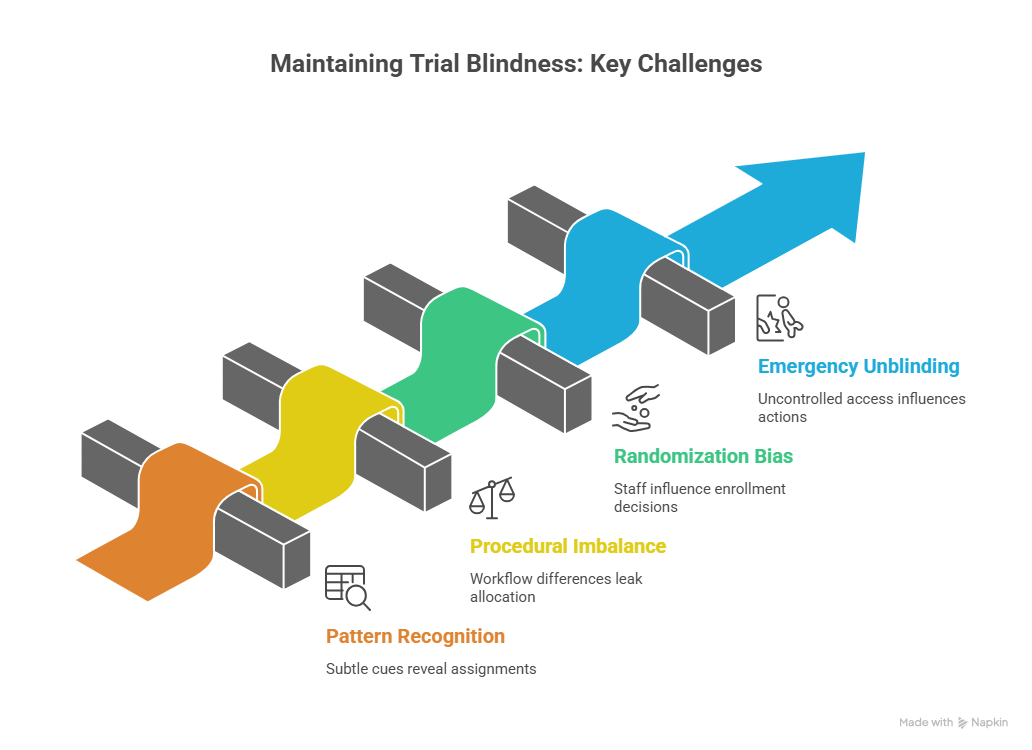
This reinforces the need for a multi-layered strategy. If one layer is compromised (e.g., an outcome assessor becomes unblinded), the blinding of the statistician and conclusion makers remains intact, preserving the integrity of the final analysis.
Conclusion
While the nature of our behavioral intervention makes participant blinding impossible, it does not give us a license to ignore bias. Instead, it compels us to be more rigorous in other areas. We have designed a robust, multi-layered partial blinding strategy that protects the research process from expectation and confirmation biases.
Key takeaways from this lesson are:
- When participants cannot be blinded, the focus must shift to blinding outcome assessors, data managers, statisticians, and conclusion makers.
- A practical protocol involves coding treatments, having an unblinded team manage participants, and a blinded team perform all data analysis and initial interpretation.
- For single-case designs, Masked Visual Analysis (MVA) offers a specialized method to reduce bias in the interpretation of time-series data.
- This layered approach creates a firewall, ensuring that even if one layer is compromised, others remain to protect the integrity of the study's conclusions.
In our next lesson, we will continue to refine our experimental protocol by addressing another source of bias: participant reactions to the experiment itself. We will tackle the learning outcome: Define meaningful control conditions and protocols to manage demand characteristics in the behavioral experiment.