Welcome back. In our previous lesson, we established a causal map for the vee triad, identifying the treatments, outcomes, and the complex web of mediators and confounders that define the system. We now have a clear hypothesis about what causes what. The next logical step is to determine how to design an experiment capable of testing these hypotheses and estimating the causal effects.
This lesson addresses precisely that challenge. Our learning outcome is to justify the choice of a within-subject crossover design over alternatives for a single, interconnected triadic system. We will explore why traditional experimental designs are ill-suited for our unique scenario and argue for a single-system approach, often called an N-of-1 trial. By the end of this lesson, you will understand the theoretical and practical rationale for using each participant (or in our case, the entire triad) as their own control.
1. The Inadequacy of a Between-Subjects Design
The gold standard in many fields is the between-subjects Randomized Controlled Trial (RCT), where a large sample of units is randomly assigned to either a treatment or a control group. Given your background in experimental design, you are intimately familiar with this paradigm. However, applying it to our vee triad presents fundamental problems.
First and most obviously, we have a sample size of one: a single, unique triadic system. A between-subjects design is, by definition, impossible. But even if we could hypothetically clone this triad to create a large sample, the core assumptions of an RCT would be violated.
The central issue is the masking of individual variability. Group designs rely on averaging effects across many subjects, which can obscure crucial individual-level responses. This is especially problematic when the goal is to find an optimal solution for a specific, heterogeneous unit.
Advantages of Single Subject Designs in ABA | BCBA® Task List Study Guide D4 | ABA Exam Review
This video from the ABA Exam Review channel, while focused on behavior analysis, provides an excellent rationale for why group-based data can be misleading when the individual is the true unit of interest.
Watch the introductory segment that explains the focus on the individual in single-subject research. Then, pay close attention to the section explaining how group data masks variability and individual performance. The graph shown around 05:32 is a powerful illustration of how a stable group mean can hide dramatic but opposing changes in the individuals within that group. Finally, the video provides a concise summary of this core idea.
In our triad, we are not interested in what works for the "average" vee relationship. We are pursuing a personalized answer for this specific system. Furthermore, a standard RCT assumes no interference between units (SUTVA). Our triad is the epitome of an interconnected system where interference is not a bug to be eliminated, but a core feature of the dynamic. The satisfaction of one member is conditional on the states of the other two. A between-subjects design that treats individuals as independent units would fundamentally misrepresent the system we are trying to model.
2. The Within-Subject Alternative: N-of-1 Trials
If we cannot compare our triad to others, the only remaining option is to compare the triad to itself under different conditions. This is the principle of a within-subject design, where the experimental unit serves as its own control. The most rigorous formalization of this for a single unit is the N-of-1 trial.
An N-of-1 trial is essentially a multi-period crossover experiment conducted on a single subject (or system). The subject is exposed to a sequence of different treatments (and/or a placebo/control) over time, with outcomes measured repeatedly. The order of treatments is randomized to control for time-based confounders.
The following resource provides a comprehensive justification for this approach, particularly in contexts with high treatment heterogeneity—a defining feature of our behavioral experiment.
Personalizing Behavioral Interventions Through Single-Patient (N-of ...
This paper from Health Psychology makes a compelling case for N-of-1 trials as a tool for personalized medicine and behavioral science. It directly contrasts them with between-subject RCTs.
First, read the abstract and the "Overview" section. Note the key argument: between-subject RCTs are ill-suited for within-subject variations in dynamic processes. Next, read the section on "Conventional Between-Subject RCTs." The authors highlight that these designs cannot answer the clinically relevant question of how a specific individual will respond. This is the central problem we face. Then, turn to the core section, "Unconventional Single-Patient (N-of-1 or Within-Subject) RCTs." Focus on the definition: an N-of-1 trial is a multiple crossover trial designed to find the optimum treatment for a single patient (or system). Finally, examine Table 1. This table provides a checklist of conditions under which an N-of-1 trial is appropriate. Mentally apply each row to our vee triad experiment (e.g., "Nature of the disorder" can be mapped to the relationship state; "Nature of treatments" to our living arrangements).
For a quick animated summary of the N-of-1 concept, the following video is helpful.
This short video from the "Very Normal" channel provides a clear, high-level explanation of how N-of-1 trials work.
Watch from the beginning. The key takeaways are that the single participant acts as their own control through a crossover design and that this method, like a traditional RCT, allows for causal statements, but for the individual.
3. Justification for the Vee Triad Experiment
Based on the principles above, we can construct a robust justification for choosing an N-of-1 crossover design for our triad.
- Single Unit of Analysis: We have one triad. A within-subject design is the only experimental framework that can operate on a single unit.
- Heterogeneity and Personalization: The goal is to find the optimal arrangement for this specific triad, not to generalize to all polyamorous triads. The N-of-1 design is explicitly built for this kind of personalized inquiry.
- Control of Inter-Unit Confounding: By using the triad as its own control, we eliminate all time-invariant confounding variables between units. The triad's unique history, shared values, and baseline personality traits are constant across all treatment periods. The only things that change are the randomly ordered treatments and time itself.
- Management of Interference: Instead of being a methodological problem, interference is an object of study. The triad is the "subject." We apply a treatment (a living arrangement) to the entire system and measure the outcome for the system as a whole and for its components (individuals and dyads). The design inherently accommodates the interconnectedness.
- Causal Inference: Because an N-of-1 trial randomizes the sequence of treatments, it allows for valid causal inference about the effects of the living arrangements for this triad, controlling for simple time trends.
4. Critical Assumptions and Limitations
While the N-of-1 design is the best fit, it is not without its own set of strong, crucial assumptions. Your background in experimental design makes it important to address these head-on, as they will dictate the structure of our experiment.

- Carryover Effects: The experience of one living arrangement might influence how the triad members perceive the next one. For example, a period of
Triadic Cohabitationmight make a subsequentDispersed Livingarrangement feel either liberating or lonely in a way that wouldn't have happened otherwise. This is the primary threat to the validity of a crossover design.- Mitigation: The primary tool to combat this is the washout period, a period of "no treatment" or a return to baseline between experimental conditions. The length of this period must be sufficient for the effects of the prior condition to dissipate.
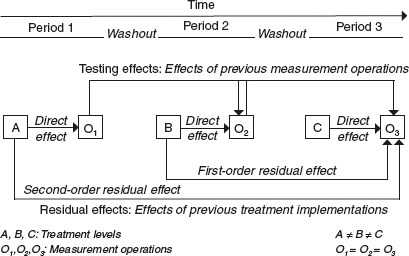
-
Reversibility: The treatments must be reversible. If a living arrangement induces a permanent change in the relationship dynamic, then the system at the start of Period 2 is fundamentally different from the system at the start of Period 1, invalidating the comparison. While perfect reversibility is unlikely in human relationships, the changes must be transient enough that a washout period can plausibly return the triad to a comparable baseline state.
-
Period Effects (Time Trends): The relationship will naturally evolve over the course of the experiment, independent of the living arrangements. For example, the members might simply become more comfortable with each other over time.
- Mitigation: This is where randomization is key. By randomizing the order of the living arrangements, we can ensure that no single arrangement is systematically favored or disadvantaged by being placed early or late in the experiment. The period effects can then be statistically modeled and separated from the treatment effects.
The academic paper below, which you may find interesting, discusses crossover designs in the broader context of identifying causal mechanisms. It formalizes the critical role of the "no carry-over effect" assumption.
Experimental designs for identifying causal mechanisms
This paper by Imai, Tingley, and Yamamoto discusses advanced experimental designs. While its main focus is on mediation, its treatment of the crossover design is relevant for us.
Please read the section "Crossover design" (pages 15-18). Pay particular attention to Assumption 7 (consistency and no carry-over effects). The authors state that this assumption is what allows researchers to "observe two potential outcomes for each unit at different treatment conditions sequentially while holding the value of the mediator constant." In our case, it's what allows us to compare outcomes across different treatment periods for our single triad.
Conclusion
In this lesson, we have established the rationale for selecting a within-subject experimental design for our study of the vee triad. Traditional between-subjects designs are unworkable due to a sample size of one and their inability to handle the profound interconnectedness and heterogeneity of our system.
Here are the key takeaways:
- A within-subject (N-of-1) design is necessary when the experimental unit is a single, unique system, and the goal is to find a personalized solution.
- This design uses the system as its own control, exposing it to a randomized sequence of treatments over time in a crossover fashion.
- The N-of-1 approach inherently accommodates interference by treating the entire interconnected system as the unit of analysis.
- The validity of this design hinges on critical assumptions, namely that treatments are reversible and that carryover effects between periods can be minimized, typically through washout periods.
We have justified our choice of design. Now, we must confront its challenges. Our next lesson will address the learning outcome: Design a randomized treatment sequence to balance period effects and minimize carryover for the living arrangement experiment. We will move from justification to the practical construction of an experimental schedule that makes our causal estimates as robust as possible.