Introduction
In our last lesson, we navigated the complexities of identifying direct and spillover effects in your triadic system. We concluded that these effects are identifiable if the joint interventional distribution is identifiable, which typically relies on the backdoor criterion and our ability to measure and adjust for all common causes. But what happens when a critical confounder—like the pre-existing emotional dynamics of the triad—is unobservable? This is a common and challenging problem in social science research.
This lesson introduces a powerful solution for such scenarios: Judea Pearl's front-door criterion. We will explore how this criterion allows us to identify a causal effect that is confounded by an unmeasured variable, provided we can observe an isolated mechanism through which the treatment operates. You will learn to state the conditions for the front-door criterion, understand its logic, and apply it to identify a mediated effect within your vee-triad experiment, such as the effect of a living arrangement on satisfaction as mediated by a 'sense of autonomy'.
1. The Front-Door Scenario: A Detour Around Confounding
The front-door criterion is an identification strategy you can employ when the backdoor criterion fails due to an unmeasured confounder.
Imagine we want to estimate the causal effect of a treatment on an outcome . However, there is an unobserved confounder that affects both and . This relationship is depicted in the classic Directed Acyclic Graph (DAG) for the front-door criterion.
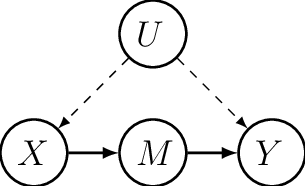
Because is unobserved, we cannot condition on it to block the backdoor path . Therefore, a simple regression of on would yield a biased estimate of the causal effect.
The front-door criterion offers a way out if we can find a mediating variable that satisfies a specific set of conditions. The blog post "Causality: The front-door criterion" provides an excellent motivation using the classic example of smoking and cancer.
Causality: The front-door criterion
This post by David Salazar clearly explains the problem that the front-door criterion solves.
Please read the introduction, starting from the motivation section, and then review the smoking-cancer example. The key takeaway is that when an unobserved variable (like "Genotype") prevents us from using the backdoor criterion, we need an alternative strategy.
2. The Logic of the Front-Door: Chaining Causal Links
The intuition behind the front-door criterion is that we can decompose the total causal effect into two parts and estimate each one separately. If the entire causal flow from to passes through the mediator , we can identify the effect by:
- Estimating the causal effect of the treatment on the mediator .
- Estimating the causal effect of the mediator on the outcome .
- "Chaining" these two effects together to recover the total effect of on .
The following video provides a clear, step-by-step breakdown of this logic.
5.3 - The Frontdoor Adjustment
Brady Neal's video on "The Frontdoor Adjustment" visually explains the intuition behind chaining two identifiable causal effects.
Watch the segment from the beginning. Focus on how each step relies on a different identification argument: Step 1: Identify P(M|\text{do}(T)). As explained from this point, this is possible because there are no open backdoor paths from treatment T to mediator M. Step 2: Identify P(Y|\text{do}(M)). As shown from this point, this is possible by applying the backdoor criterion—we can block the path M \leftarrow T \leftarrow W \to Y by adjusting for T. Step 3: Combine them. The final step, explained from here, shows how to multiply and sum these identified components to get the overall effect, P(Y|\text{do}(T)).
3. Formal Conditions and the Formula
For the front-door logic to hold, the mediator must satisfy three formal conditions relative to the treatment and outcome .
A set of variables satisfies the front-door criterion if:
- Full Mediation: intercepts all directed (causal) paths from to . This means only affects through .
- No X-M Confounding: There is no unblocked backdoor path from to . This ensures we can estimate the causal effect of on directly.
- Conditional M-Y Deconfounding: All backdoor paths from to are blocked by . This ensures we can estimate the causal effect of on by adjusting for .
When these conditions are met, the causal effect of on is identifiable and is given by the front-door formula:
Let's break this down:
- : This is the observational probability of the mediator given the treatment . Due to condition 2, this is equal to the interventional probability . This is the effect of on .
- : This is the backdoor adjustment for the effect of on , using as the adjustment set. Due to condition 3, this is equal to . This is the effect of on .
The formula essentially says: for each possible state of the mediator, find the probability that treatment causes that state (). Then, multiply it by the probability that state , in turn, causes outcome (). Finally, sum over all possible states of the mediator .
The video from Shaw Talebi walks through these conditions and the formula with a clear example.
Causal Effects via DAGs | How to Handle Unobserved Confounders
This video provides a methodical check of the three front-door conditions on a sample DAG and explains the structure of the front-door formula.
Please watch the segment dedicated to the Front-Door Criterion. Pay close attention to how each of the three conditions is systematically verified on the graph.
4. Application to the Vee-Triad Experiment
Now, let's apply this to your study. Suppose you want to identify the effect of a new 'Communication Protocol' () on 'Triadic Satisfaction' (). A major challenge is the unobserved confounder of 'Pre-existing Group Dynamics' (), which influences both the protocol the triad is willing to adopt and their overall satisfaction.
This creates an unblockable backdoor path: .
However, you might hypothesize that the communication protocol works primarily by enhancing each member's 'Sense of Autonomy' (). If we can argue that satisfies the front-door conditions, we can still identify the causal effect.
Let's check the assumptions for this scenario:
-
Full Mediation: You must assume that the communication protocol () affects triadic satisfaction () only through its influence on their sense of autonomy (). This is a very strong assumption. It implies there's no other pathway (e.g., protocol improves satisfaction by reducing scheduling conflicts, independent of autonomy). The validity of the FDC hinges on this assumption.
-
No T-M Confounding: You must assume that the pre-existing group dynamics () do not directly cause changes in 'sense of autonomy' (), except via the choice of communication protocol. For instance, if a group with a history of conflict () has a lower baseline sense of autonomy () regardless of the protocol in place, this condition would be violated. The DAG would have an arrow , opening a backdoor path .
-
Conditional M-Y Deconfounding: You must assume that adjusting for the communication protocol () is sufficient to remove confounding between autonomy () and satisfaction (). The key backdoor path is . Conditioning on successfully blocks this path. This condition is the most likely to hold in our example.
If these three (admittedly strong) conditions are met, you can identify the causal effect of the protocol on satisfaction, even with the unobserved group dynamics.
5. Empirical Estimation and Advanced Topics
From a practical standpoint, especially in a linear regression framework, the front-door estimand is remarkably intuitive. It corresponds to multiplying the coefficients from two separate regressions.
The paper by Bellemare and Bloem provides a superb "how-to" guide.
Estimating Treatment Effects Using the Front-Door Criterion
This paper provides a detailed, practical guide for applying the FDC in a regression context and explores what happens when its assumptions are violated. This is perfect for bridging theory to application.
First, read Section 2, "Theory and Practice". This section formalizes the three conditions and shows how the FDC estimand \beta = \delta \times \gamma arises from two simple linear regressions (Equations 7 and 8). Next, review Section 3.1, "Simulation Results". This will solidify your understanding by showing how the FDC method correctly recovers the true Average Treatment Effect (ATE) where a naïve regression fails. Finally, given your advanced background, skim Section 4, "Departures from the Ideal Case". Focus on the implications of: Multiple Mechanisms (Section 4.1): What if a treatment works through several parallel pathways? Violations of Strict Exogeneity (Section 4.2): What if the confounder U also affects the mediator M? The discussion on how the FDC's performance degrades with the degree of endogeneity is highly relevant for real-world sensitivity analysis.
The key takeaway from the Bellemare and Bloem paper is that even if the FDC assumptions are not perfectly met, the framework provides a powerful tool for causal mediation analysis. For instance, if Condition 1 (full mediation) is violated, the FDC estimand can be interpreted as the indirect effect of on through , which is often the quantity of interest in itself.
For a full implementation with code, the Monte Carlo simulation in David Salazar's blog post is an excellent resource.
Causality: The front-door criterion
This part of the blog post walks through the derivation and provides a full-fledged simulation in R.
Please read from the section "Consecutive applications" to the end of the simulation. As you have a strong background in statistics and R, you will appreciate how the front-door formula is derived and then implemented using both a two-stage regression and a multivariate Bayesian model (ulam). The code directly demonstrates that the FDC recovers the true causal effect where a simple backdoor adjustment is impossible.
Conclusion
This lesson has equipped you with a crucial tool for your causal inference toolkit. When faced with unobserved confounding between a treatment and an outcome, the front-door criterion provides a path to identification that bypasses the need to measure the confounder directly.
Key Takeaways:
- The front-door criterion is an identification strategy used when the backdoor path between treatment and outcome is blocked by an unobserved confounder .
- It works by identifying a fully observed mediating variable that lies on the causal path from to .
- Identification relies on three strict conditions: (1) fully mediates the effect, (2) the relationship is unconfounded, and (3) the relationship is unconfounded conditional on .
- The causal effect is estimated by chaining two identifiable effects: the effect of on and the effect of on . In a regression context, this often simplifies to multiplying two coefficients.
- Even when its assumptions are violated, the FDC provides a robust framework for causal mediation analysis.
In our next lesson, we will broaden our perspective on identification challenges. Building on today's topic, we will systematically assess identifiability when various key confounders or mediators in the triadic model are unmeasured, exploring the limits of what can be estimated from observational data.