Introduction
In our last lesson, we investigated the consequences of spontaneously breaking a continuous U(1) symmetry in a complex scalar field theory. We discovered that while the potential's "uphill" radial direction gave rise to a massive particle, fluctuations along the "brim" of the Mexican hat potential—the direction of the broken symmetry—manifested as a massless particle. You rightly concluded that this was a general feature, and today we will formalize that crucial insight.
This lesson is dedicated to stating and proving Goldstone's Theorem. This remarkable theorem establishes a direct and profound connection between spontaneously broken continuous global symmetries and the necessary existence of massless, spin-0 particles in the theory's spectrum. We will see that the massless mode you discovered was not an accident but a necessity. The theorem is a cornerstone of modern physics, with deep implications in both particle physics, where it explains the properties of particles like pions, and in your area of interest, condensed matter physics, where it describes excitations like magnons in ferromagnets and phonons in crystals.
Stating the Theorem: Intuition from the Vacuum Manifold
Before diving into a formal proof, let's solidify the physical intuition. The key idea, as we saw previously, is that spontaneous symmetry breaking (SSB) implies the existence of a vacuum manifold, , a continuous space of degenerate ground states. The original symmetry transformations of the theory act to move the system from one point on this manifold to another.
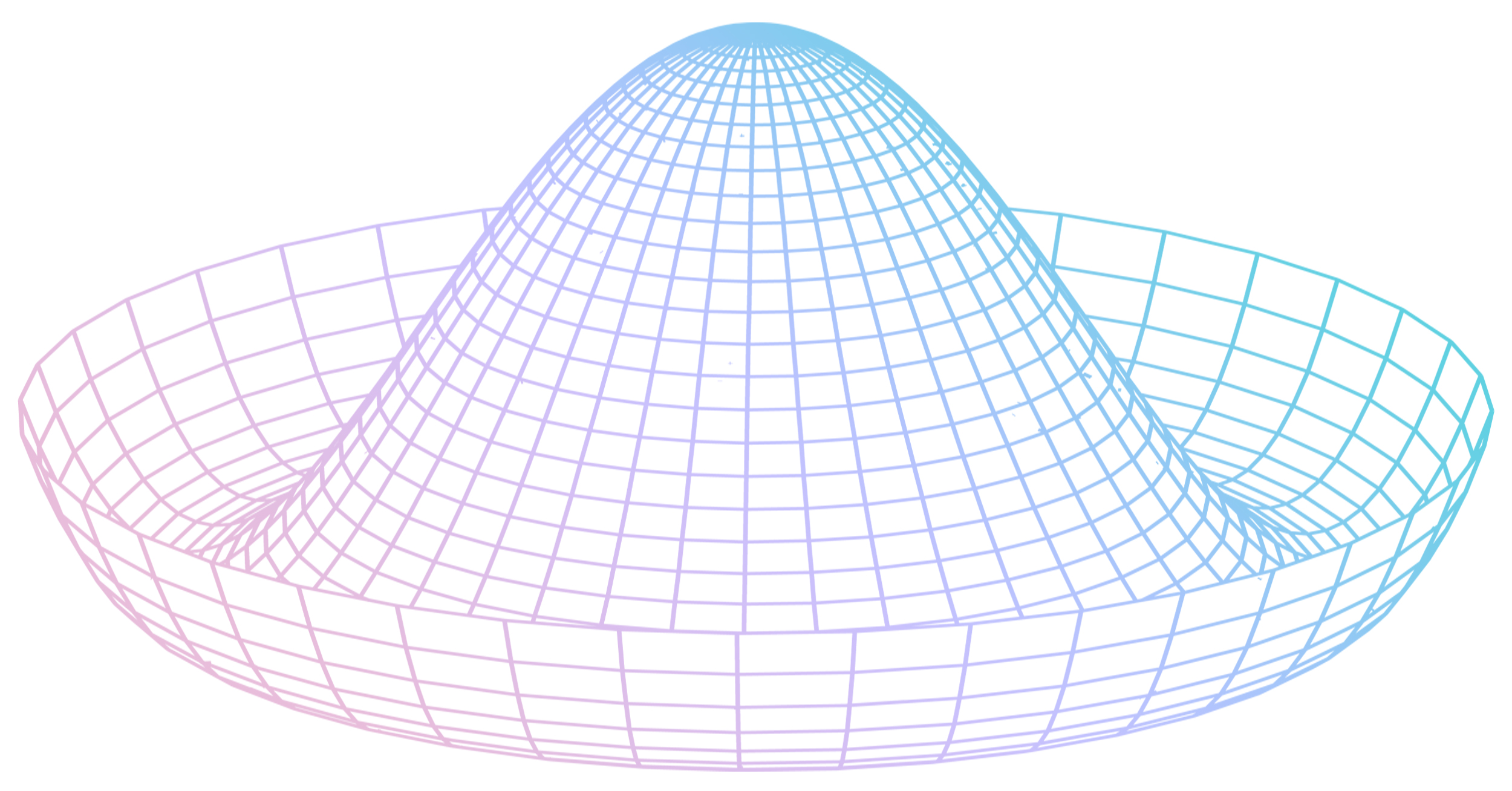
Since all points on the vacuum manifold have the same minimum energy, long-wavelength fluctuations that move the system along this manifold can have arbitrarily low energy. In a quantum field theory, a particle is an excitation of a field. An excitation with zero energy at zero momentum is, by definition, a massless particle. These massless particles associated with broken continuous symmetries are called Goldstone bosons (or Nambu-Goldstone bosons).
The following short video provides a clear visualization of this concept.
Spontaneous Symmetry Breaking and The Higgs Mechanism
This segment from "Spontaneous Symmetry Breaking and The Higgs Mechanism" offers an excellent conceptual walkthrough of how massless modes arise from a continuous broken symmetry.
Please watch from this point. The narrator clearly distinguishes between the massive radial fluctuations and the massless azimuthal fluctuations, which correspond to the Goldstone bosons.
The video also touches on counting these massless modes. The number of distinct Goldstone bosons is not arbitrary; it's precisely determined by the structure of the symmetry breaking. This leads us to the formal statement of the theorem.
Goldstone's Theorem:
Let a theory possess a continuous global symmetry group . If this symmetry is spontaneously broken down to a subgroup (the stability group of the vacuum), then for each generator of that is not a generator of (i.e., for each "broken generator"), there exists a corresponding massless scalar particle in the spectrum.
The number of Goldstone bosons is therefore:
where is the coset space which can be identified with the vacuum manifold .
Proof in Classical Field Theory
Your background in QFT and mathematics makes you well-prepared for a rigorous proof. We will start with the classical field theory version, which is elegant and transparent. The argument hinges on analyzing the mass matrix of the scalar fields.
The core of the proof is laid out with exceptional clarity in David Tong's lecture notes.
This resource provides a standard and rigorous proof of Goldstone's theorem in the classical field theory context.
Please read the subsection Proof of Goldstone's Theorem. Focus on understanding each step of the derivation, particularly how the invariance of the potential leads to a condition on the mass matrix.
Let's walk through the logic of the proof together.
-
Setup: We consider a theory of scalar fields with a potential that is invariant under the transformations of a Lie group . SSB occurs if the vacuum expectation value (VEV) is non-zero and minimizes the potential.
- Symmetry Invariance: For any transformation , . For an infinitesimal transformation generated by , , this means the potential does not change. To first order in , this implies: This equation must hold for any field configuration , not just the vacuum.
-
The Mass Matrix: The particles of the theory are excitations around the vacuum . Their masses are determined by the curvature of the potential at this minimum. The mass-squared matrix is given by the second derivatives:
A massless particle corresponds to a zero eigenvalue of this matrix.
-
The Crucial Step: We now differentiate the symmetry condition from step 1 with respect to another field component, , and then evaluate the expression at the vacuum .
When we set , the second term vanishes because is a minimum of the potential (). We are left with:
-
Interpretation: This is an eigenvalue equation: , where the vector is . It tells us that for any generator where the vector is non-zero, that vector is an eigenvector of the mass-squared matrix with an eigenvalue of zero.
- A generator for which is, by definition, a broken generator—it moves the vacuum state.
- A generator for which is an unbroken generator; it belongs to the stability subgroup .
- Therefore, there is one massless Goldstone boson for each broken generator. This completes the proof.
To see this argument presented in a lecture format, you can watch the following segment.
Advanced quantum field theory, Lecture 16
This lecture by Tobias Osborne provides a detailed walkthrough of the classical proof of Goldstone's theorem, which will reinforce your reading.
Watch the derivation from the formal statement of the theorem to the end of its proof. This covers exactly the same ground as the text, but hearing it explained may provide additional clarity.
The Quantum Mechanical Picture
While the classical proof is powerful, the full significance of Goldstone's theorem is revealed in quantum field theory. In QFT, scalar masses are notoriously unstable; quantum corrections (loops) tend to drive them up to the highest energy scale in the theory (the "hierarchy problem"). A massless scalar is therefore considered "unnatural" unless its masslessness is protected by a symmetry. Goldstone's theorem provides precisely such a protection mechanism.
The quantum proof is more abstract but equally elegant. It relies on Noether's theorem, which you've studied previously.
This section presents the quantum argument for Goldstone's theorem, which is non-perturbative and provides deep insight into why these bosons are protected.
Now, please read the subsection Goldstone's Theorem in QFT, up to the discussion of the Källén-Lehmann decomposition.
The core argument is as follows:
- A continuous symmetry group implies the existence of conserved Noether currents and their associated conserved charges .
- "Conserved" means the charges commute with the Hamiltonian: .
- SSB means the vacuum state is not annihilated by all the charges. For a broken generator , we have .
- Now consider the state . Since , this new state must have the same energy as the vacuum:
- We have found a new state, created by acting with the charge on the vacuum, that is degenerate in energy with the vacuum. This state can be identified as a zero-momentum particle state. A particle with zero momentum and zero excitation energy must be massless.
This non-perturbative argument guarantees that Goldstone bosons are exactly massless to all orders in perturbation theory. Their mass is protected by the very symmetry whose breaking creates them.
Conclusion
In this lesson, we have moved from the specific observation of a massless mode in the Mexican hat model to a general and rigorously proven theorem. This completes a crucial step in your understanding of how symmetries govern the fundamental properties of physical systems.
Key Takeaways:
- Goldstone's Theorem Stated: The spontaneous breaking of a continuous global symmetry group down to a subgroup results in the appearance of massless scalar particles, known as Goldstone bosons.
- Classical Proof: The theorem can be proven classically by showing that the invariance of the potential forces the mass-squared matrix to have zero eigenvalues, with the corresponding eigenvectors being generated by the action of the broken symmetry generators on the vacuum.
- Quantum Proof: In QFT, the existence of a conserved charge that does not annihilate the vacuum () implies the existence of a zero-energy state degenerate with the vacuum, which corresponds to a massless Goldstone boson at zero momentum.
- Physical Significance: Goldstone bosons are not just a theoretical curiosity; they are real physical phenomena. They represent the low-energy excitations of a system that correspond to moving through its degenerate ground states.
Preview of the Next Lesson:
Having established the theorem, our next step is to explore its manifestation in a concrete physical system that should be familiar from your condensed matter studies: the ferromagnet. We will see how the spontaneous breaking of rotational symmetry at the Curie temperature gives rise to Goldstone bosons known as magnons, or spin waves. This will provide an excellent real-world application of the abstract principles we've discussed today.