Introduction
In our last lesson, we delved into the ferromagnetic phase transition, analyzing it as a concrete example of spontaneous symmetry breaking (SSB) where the continuous SU(2) rotational symmetry of the microscopic Hamiltonian is broken down to a residual U(1) symmetry. We identified the resulting massless excitations—magnons—as Type-II Goldstone bosons, distinguished by their quadratic dispersion relation .
Today, we shift our focus to another canonical condensed matter system that exhibits SSB: the superfluid. This system provides a pristine example of a broken continuous global U(1) symmetry. We will see how this leads to a different class of Goldstone boson, one with a linear dispersion characteristic of relativistic particles. This exploration will not only deepen your understanding of SSB but also serve as the essential foundation for our next topic: the Higgs mechanism, which arises when this same symmetry is made local.
A Relativistic Model for Global U(1) Symmetry Breaking
Before diving into the specifics of superfluids, it is instructive to analyze the breaking of a global U(1) symmetry in the clean language of relativistic quantum field theory. This approach provides a universal template that we can then adapt to the non-relativistic condensed matter context.
Consider a theory described by a complex scalar field , with a Lagrangian given by:
We choose a potential that is a function of , which ensures the Lagrangian is invariant under the global U(1) phase transformation , where is a constant. The canonical choice for this potential is the "Mexican hat" potential:
where for stability.
The structure of the vacuum state depends critically on the sign of :
- Symmetric Phase (): The potential has a single minimum at . The ground state, or vacuum, respects the U(1) symmetry, and the elementary excitations of the field correspond to a massive particle with mass .
- Broken-Symmetry Phase (): The origin becomes a local maximum, and the potential develops a continuous ring of minima at a radius where .
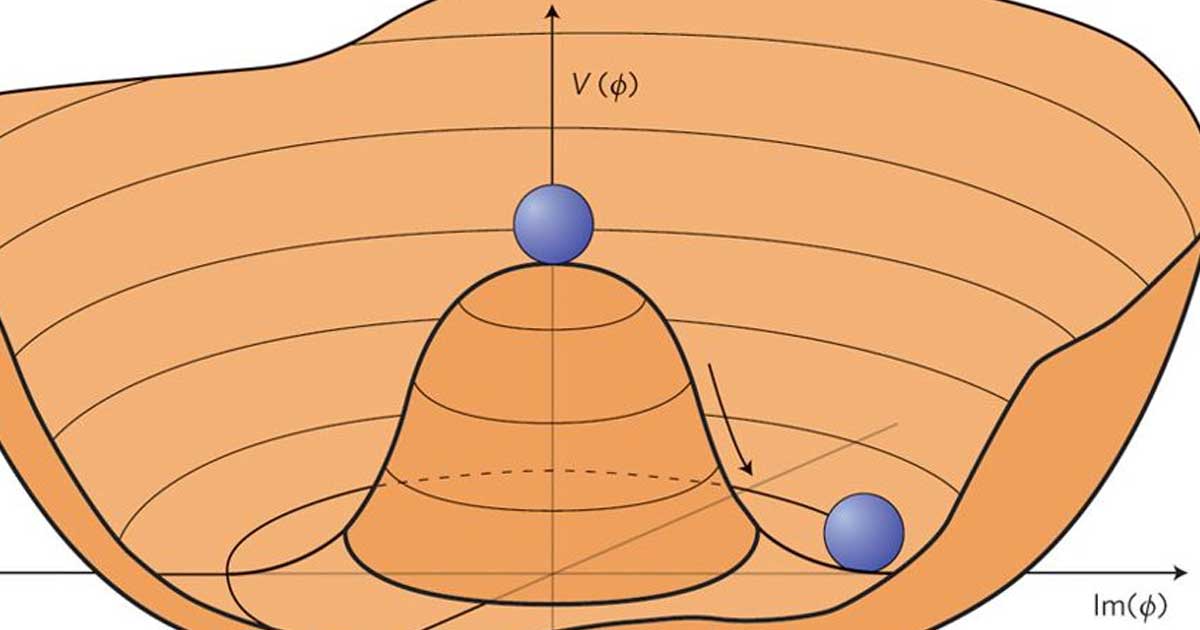
The system must "choose" one of these degenerate ground states to live in. Let's say it settles in the state where is real and positive, so the vacuum expectation value (VEV) is . This non-zero VEV signals that the U(1) symmetry has been spontaneously broken.
To find the spectrum of excitations around this new vacuum, we parameterize the field in terms of fluctuations. A clear way to do this is to expand around the VEV using two real scalar fields, and , representing fluctuations in the radial and angular directions, respectively:
Substituting this back into the Lagrangian and analyzing the quadratic terms reveals the masses of the excitations.
[PDF] Spontaneous Symmetry Breaking and the Higgs Mechanism - arXiv
This section from the pedagogical review "Spontaneous Symmetry Breaking and the Higgs Mechanism" provides an excellent QFT-based derivation of the mass spectrum after SSB.
Please read the subsection on global U(1) symmetry. Pay close attention to how the expansion of the field around the new vacuum, \phi(x) = v + \eta(x) + i\xi(x), leads to a massive \eta field and a massless \xi field. This is the essence of Goldstone's theorem in this context.
As the text demonstrates, the particle associated with the field (radial fluctuations, climbing up the potential well) is massive, with . The particle associated with the field (azimuthal fluctuations, moving along the valley of degenerate vacua) is massless, . This massless particle is the Nambu-Goldstone boson of the broken global U(1) symmetry. It is a Type-I Goldstone boson, and in a relativistic theory, it has a linear dispersion relation, .
The Landau-Ginzburg Theory of Superfluidity
Now, let's connect this field-theoretic model to the physical phenomenon of superfluidity. Superfluidity, observed in systems like Helium-4 below the lambda point ( K), is characterized by the loss of all viscosity. The Landau-Ginzburg phenomenological theory provides a powerful framework for describing this phase transition, and you will find it formally identical to the QFT model we just discussed.
In this theory, the state of the superfluid is described by a macroscopic, complex order parameter field, . This can be intuitively understood as the wavefunction of the Bose-Einstein condensate. The system's Helmholtz free energy, , is expressed as a functional of . Because the physics cannot depend on an overall global phase of a wavefunction, the free energy can only depend on powers of . Near the critical temperature, , this leads to the Ginzburg-Landau free energy functional:
Here, and are positive constants, and the coefficient is assumed to vary linearly with temperature near : with .
You can immediately see the parallels:
- : . The minimum free energy is at . This is the normal fluid phase, which is symmetric under U(1) phase rotations.
- : . The minimum of the potential part is at a finite value . The system enters the superfluid phase, acquiring a non-zero order parameter and spontaneously breaking the global U(1) symmetry.
The following video lecture by Prof. Mehran Kardar provides a masterclass on this topic, deriving the Ginzburg-Landau model and applying it to superfluids.
3. The Landau-Ginzburg Approach Part 2
This part of the lecture "The Landau-Ginzburg Approach Part 2" from MIT OpenCourseWare introduces the complex order parameter for superfluids and constructs the corresponding free energy functional based on symmetry principles.
Please watch from the section on superfluids. The lecturer explains how choosing a complex order parameter \psi(x) and demanding invariance under phase rotations naturally leads to the "Mexican hat" or "wine bottle" potential, establishing the U(1) SSB framework for this system.
Goldstone Modes and the Mermin-Wagner Theorem
Having established that a superfluid is a realization of a spontaneously broken global U(1) symmetry, Goldstone's theorem guarantees the existence of a massless excitation. In the QFT model, this was the field, corresponding to phase fluctuations. The same is true here. The low-energy excitations of a superfluid are long-wavelength variations in the phase of the order parameter, , where .
The energy cost for such a phase twist comes from the gradient term, . The resulting collective excitation is a sound wave, also known as a phonon in this quantum context. These are the Goldstone bosons of broken U(1) symmetry in a neutral superfluid, and they exhibit a linear dispersion relation, , where is the speed of sound.
An extremely important consequence of these gapless phase fluctuations is revealed when their effects are properly calculated. The fluctuations are so significant in low dimensions that they can destroy the very long-range order that was assumed to exist. This is the essence of the Mermin-Wagner theorem, which states that a continuous symmetry cannot be spontaneously broken at any finite temperature in dimensions .
The next segment of Prof. Kardar's lecture provides a detailed and insightful derivation of this result, a cornerstone of modern statistical mechanics. Given your background in QFT and condensed matter, this analysis of fluctuations beyond the mean-field saddle-point approximation will be particularly illuminating.
3. The Landau-Ginzburg Approach Part 2
This section analyzes the energy cost of phase distortions and calculates the fluctuations of the phase. It culminates in the Mermin-Wagner theorem.
Watch from this analysis of fluctuations. Focus on how the calculation of the phase-phase correlation function \langle (\theta(\boldsymbol{r}) - \theta(0))^2 \rangle leads to a divergence in d=1 and d=2, implying that long-range phase coherence is destroyed by thermal fluctuations.
Superconductors: A Brief Outlook
The learning outcome also mentions superconductors. A superconductor can be thought of as a charged superfluid. The microscopic mechanism involves the formation of electron pairs (Cooper pairs), which are bosons and undergo Bose-Einstein condensation. The order parameter is again a complex scalar field representing this condensate, and the transition into the superconducting state involves the spontaneous breaking of a global U(1) symmetry associated with charge conservation.
However, the fact that the order parameter is charged means it couples to the electromagnetic field, which is described by a local U(1) gauge symmetry. The interplay between the spontaneously broken global symmetry and the exact local gauge symmetry leads to a remarkable phenomenon: the Higgs mechanism. The would-be massless Goldstone boson is absorbed by the gauge field (the photon), which in turn acquires a mass. This massive photon inside the superconductor is what explains the Meissner effect—the expulsion of magnetic fields.
We will explore this mechanism in full detail in our next lesson. For now, it is sufficient to recognize that the underlying principle for both superfluids and superconductors is the spontaneous breaking of a global U(1) symmetry.
Spontaneous Symmetry Breaking: Its Successes, ...
This short section from Prof. Anthony Leggett's notes provides a high-level overview connecting the phenomenology of superconductors and superfluids to the spontaneous breaking of U(1) symmetry.
Please read the section titled "Superconductivity and Superfluidity". This will reinforce the central idea and explicitly mentions the "Higgs-like" mechanism that gives the photon a mass, setting the stage for our next discussion.
Conclusion
In this lesson, we have explored the spontaneous breaking of a global U(1) symmetry, a mechanism of fundamental importance across physics. Starting from a relativistic field theory model, we saw how a "Mexican hat" potential leads to a non-zero vacuum expectation value, breaking the symmetry and giving rise to a massless Nambu-Goldstone boson corresponding to phase fluctuations.
Key Takeaways:
- Superfluidity is described by the spontaneous breaking of a global U(1) symmetry, with the complex condensate wavefunction serving as the order parameter.
- The transition is governed by a Ginzburg-Landau free energy functional that is formally identical to the "Mexican hat" potential in field theory.
- The broken U(1) symmetry gives rise to a massless Goldstone boson, which in a neutral superfluid is the phonon (a sound wave) with a linear dispersion relation, . This is a Type-I Goldstone boson.
- Fluctuations of this massless mode are so strong in low dimensions that they prevent the breaking of a continuous symmetry for , a result known as the Mermin-Wagner theorem.
- Superconductors share the same underlying U(1) SSB mechanism but involve a charged order parameter, which will lead us to the Higgs mechanism.
Preview of the Next Lesson:
Having laid the groundwork with global symmetry breaking, we are now perfectly positioned to tackle one of the most crucial concepts in the Standard Model. In the next lesson, we will investigate what happens when the broken U(1) symmetry is also a local gauge symmetry. This will lead us directly to the Abelian Higgs mechanism, explaining how gauge bosons can acquire mass—the very mechanism responsible for the Meissner effect in superconductors.