In our last lesson, we explored the Wigner-Eckart theorem, a profound result of SU(2) rotational symmetry in spacetime. We saw how it separates the geometrical from the dynamical aspects of physical processes, providing powerful selection rules and simplifying complex calculations. Today, we will take the entire mathematical framework of SU(2) that we've so carefully developed for angular momentum and apply it to a completely different, abstract domain: the internal properties of elementary particles.
Our goal is to understand the concept of isospin, an approximate internal symmetry that provides a powerful scheme for classifying strongly interacting particles, known as hadrons. We will see how the proton and neutron, once thought to be fundamentally distinct, can be understood as two different states of a single entity, the "nucleon," a realization that marked a pivotal step toward our modern understanding of matter's fundamental constituents. This lesson will serve as a beautiful example of how physicists leverage symmetry principles to uncover deeper structures in nature.
The Nucleon and the Birth of Isospin
In the 1930s, after the discovery of the neutron, physicists were struck by a remarkable coincidence: the mass of the proton () and the neutron () are nearly identical. Furthermore, experiments showed that the strong nuclear force, which binds protons and neutrons together in the nucleus, seems to act on both particles in the same way, independent of their electric charge.
This led Werner Heisenberg to a bold hypothesis: what if, from the perspective of the strong force, the proton and neutron are not distinct particles at all, but rather two different states of a single particle, which he called the nucleon?
This is perfectly analogous to the spin of an electron. An electron is a spin-1/2 particle, and in the absence of a magnetic field, its "spin up" and "spin down" states are degenerate. Heisenberg proposed a new quantum number, which he called isotopic spin or simply isospin, to describe the nucleon. The nucleon is an isospin-1/2 particle (), and its two states—the proton and the neutron—correspond to the two possible projections of its isospin, and , respectively.
The following video introduces this foundational concept.
L2.2 Symmetries: Flavor Symmetry
This video from MIT OpenCourseWare introduces the concept of flavor symmetry and isospin.
Please watch the first two segments. The first part, "What is Isospin?", explains Heisenberg's original motivation for treating the proton and neutron as a doublet of a single particle, the nucleon. The second part, "Isospin Conservation", discusses the crucial consequence of this idea: if the strong force is invariant under isospin transformations, then isospin must be a conserved quantity in strong interactions.
The SU(2) Algebra of Isospin
The analogy with spin is not merely conceptual; it is mathematically precise. The symmetry group that transforms the proton and neutron into each other is SU(2), the same group that governs rotations for spin-1/2 particles. However, these are not rotations in physical space, but in an abstract, internal "isospin space."
We describe the nucleon states as vectors in a 2D complex vector space:
The generators of SU(2) transformations in this space are the isospin operators . These operators obey the same commutation relations as the angular momentum operators :
In the fundamental (doublet) representation, these generators are given by the Pauli matrices: . The operator is diagonal, and its eigenvalues distinguish the members of the multiplet:
The operators act as raising and lowering operators, changing a neutron into a proton and vice-versa (up to a factor):
The statement that the strong interaction Hamiltonian, , is invariant under isospin rotations is formally expressed as . This immediately implies that both the total isospin squared, , and its third component, , are conserved in any process mediated by the strong force.
It's crucial to remember that isospin is an approximate symmetry. The electromagnetic force is not invariant under isospin rotations because it couples to electric charge, clearly distinguishing the proton from the neutron. This is why the proton and neutron masses are not exactly equal. The weak force violates isospin symmetry even more strongly.
Hadron Classification: Isospin Multiplets
Since the strong force is the dominant interaction for hadrons, all hadrons should fall into irreducible representations of isospin SU(2). We can classify them into isospin multiplets, where all members of a multiplet have the same total isospin but different values of , from to . Physically, this means all particles in a multiplet have very similar masses but different electric charges.
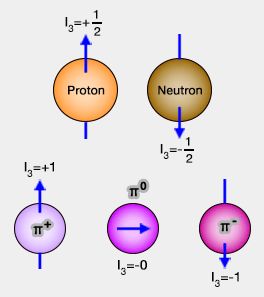
Here are some key examples:
- Isodoublets ():
- Nucleons: (), ()
- Kaons: (), ()
- Isotriplets ():
- Pions (pions): (), (), ()
- Isoquartets ():
- Delta baryons: , , , (with )
- Isosinglets ():
- Particles like the Lambda baryon () or the eta meson (), which have no other similarly-massed partners. They have .
The following notes formalize this classification scheme.
LECTURE 3 – SU(2) - Particle Physics Department
This document from the Particle Physics Department at Rutherford Appleton Laboratory provides a concise overview of hadronic isospin.
Please read the section titled "Hadronic Isospin". Focus on the classification of the nucleon doublet and pion triplet with their (I, I_3) quantum numbers. Pay attention to the discussion of how electric charge breaks the perfect symmetry.
An immediate question arises: how is the electric charge of a particle within a multiplet related to its isospin component ? The relationship was found empirically by Gell-Mann and Nishijima:
Gell-Mann–Nishijima Formula:
where is the hypercharge, defined as the sum of the baryon number and the strangeness quantum number , . For the familiar non-strange particles (p, n, ), , so .
- For nucleons (): .
- Proton () . Correct.
- Neutron () . Correct.
- For pions (): . This directly explains their charges of +1, 0, and -1.
The Quark Model: The Origin of Isospin
The isospin symmetry of hadrons is not fundamental but rather emerges from the properties of their constituents: quarks. The strong interaction, described by Quantum Chromodynamics (QCD), is "flavor-blind"—it interacts with all quark flavors equally. The two lightest quarks, the up (u) and down (d), have very small and similar masses. Therefore, the strong force treats them as nearly identical.
This allows us to form a fundamental isospin doublet out of the u and d quarks:
- u-quark: . It has charge and baryon number .
- d-quark: . It has charge and baryon number .
Now, we can construct hadrons by combining quarks, and their isospin properties emerge from the rules of adding angular momentum (which you mastered in previous lessons). A meson is a state and a baryon is a state.
- Proton (uud): Combining three objects. The total isospin can be or . The proton belongs to the multiplet. Its total .
- Neutron (udd): Also in the multiplet. Its total .
- Pion (): The isospin of an antiquark is the same as its corresponding quark, but its value is opposite. So for , . Combining () and (), we get a total . This combination of two objects forms an triplet.
The following text delves into the mathematics of constructing meson and baryon states from quark states using the formal machinery of SU(2).
LECTURE 3 – SU(2) - Particle Physics Department
This part of the document shows how to apply the SU(2) machinery for combining states to the quark model.
Please read the sections titled "Combining States", followed by "Meson States" and "Baryon States". This is a direct application of the angular momentum addition you've already studied. You'll see how combining two spin-1/2 (isospin-1/2) quarks gives 1 \oplus 0 (triplet and singlet), and combining three gives 3/2 \oplus 1/2 \oplus 1/2 (quartet and two doublets).
Isospin Conservation in Action
Isospin conservation is more than a classification scheme; it yields concrete physical predictions. Since the S-matrix for strong interactions must be an isospin invariant, matrix elements for different processes that are related by isospin rotations must be related. This is where the Wigner-Eckart theorem becomes immensely powerful.
Consider pion-nucleon scattering (). We are combining a pion () and a nucleon (). The total isospin of the system can be . This means any scattering process must proceed through either a total isospin channel or an channel.
The scattering amplitude for any specific reaction, like , can be written as a linear combination of the amplitudes for these pure isospin channels, and . The coefficients of this combination are just Clebsch-Gordan coefficients.
[PDF] Chapter 4 SU(2) - Rutgers Physics
This document from a graduate quantum mechanics course at Rutgers University provides a fantastic application of isospin symmetry to scattering processes.
Please read from the paragraph starting with "Although isospin was introduced in nuclear physics...". This section will show you: How the \Delta^{++} resonance, seen in \pi^+ p scattering, must have I=3/2 and therefore implies the existence of three other \Delta particles. How the Wigner-Eckart theorem (in the form of Clebsch-Gordan coefficients) predicts the branching ratios for the decay of the \Delta^+ particle into p\pi^0 vs. n\pi^+. How all the various low-energy \pi N scattering cross-sections can be described by just two underlying amplitudes, a_{3/2} and a_{1/2}. This is a beautiful demonstration of the predictive power of symmetry.
Conclusion
Today we have seen one of the most elegant applications of SU(2) symmetry in physics. By treating the near-degeneracy of the proton and neutron mass as evidence of a hidden symmetry, physicists unlocked a powerful organizational principle for the zoo of strongly interacting particles.
Key Takeaways:
- Isospin is an abstract SU(2) symmetry of the strong interaction, treating particles with similar masses and strong interactions but different charges as members of a single isospin multiplet.
- This symmetry is approximate and is broken by the electromagnetic and weak interactions.
- The isospin of hadrons is an emergent property arising from the near-identical masses of the up and down quarks, which form a fundamental isospin doublet.
- The entire mathematical formalism of angular momentum addition, including Clebsch-Gordan coefficients and the Wigner-Eckart theorem, can be directly applied to isospin.
- Isospin conservation provides testable physical predictions, such as relationships between scattering cross-sections and decay rates for different reactions.
The success of isospin was a major clue that a deeper structure existed beneath the level of protons and neutrons. When new particles with a property called "strangeness" were discovered, physicists naturally tried to extend this symmetry framework. This led to the "Eightfold Way," a classification scheme based on a larger group, SU(3), which we will begin to explore in our next module.