Welcome to our next lesson on symmetries in crystalline solids. In our previous session, we explored how the spatial symmetries of a crystal, captured by the point group, allow us to classify electronic states and predict degeneracies at high-symmetry points in the Brillouin zone. We learned that the set of degenerate Bloch states at a given wavevector must form a basis for an irreducible representation of the "little group" of .
In this lesson, we will introduce a fundamentally different kind of symmetry: time reversal. Unlike the spatial rotations and reflections we have studied so far, time-reversal symmetry is not described by a geometric operation in real space. Nevertheless, it imposes powerful constraints on the energy spectrum of quantum systems. We will investigate how this symmetry affects electronic band structures, culminating in the derivation of one of the most important results in condensed matter physics: Kramers' degeneracy theorem. This theorem guarantees that for electrons in a time-reversal symmetric crystal, energy bands must have a certain minimum degeneracy, a result with profound consequences for materials with strong spin-orbit interaction and topological phases of matter.
The Time-Reversal Operator in Quantum Mechanics
To understand the consequences of time-reversal symmetry, we must first establish how it is represented in quantum mechanics. A classical system is time-reversal invariant if, for any trajectory , the time-reversed trajectory is also a valid solution to the equations of motion. A simple example is a particle moving in a static potential, governed by Newton's second law, , which is second-order in time derivatives and thus insensitive to the sign of .
In quantum mechanics, the dynamics are governed by the Schrödinger equation:
This equation is first-order in time. If we simply replace with , the left side changes sign while the right side does not. This means that is not, in general, a solution. However, if the Hamiltonian is a real operator (as it is for a spinless particle in a real potential), taking the complex conjugate of the entire equation gives:
Replacing with in this new equation, we find:
This shows that the state evolves correctly according to the original Schrödinger equation. This suggests that the quantum operation for time reversal involves not only but also complex conjugation.
This leads us to define a time-reversal operator, denoted by , such that the time-reversed state is given by . From our simple example, it's clear that must involve complex conjugation. Such an operator cannot be linear; it belongs to a class of operators known as antilinear or antiunitary.
To delve deeper into the formal properties of , the following video provides an excellent introduction.
Quantum Theory, Lecture 14: Time Reversal. Anti-Unitary Operators. Lattice Symmetry. Band Structure.
This lecture from Alexander Maloney's Quantum Theory course introduces time-reversal symmetry and justifies the need for an antiunitary operator.
Please watch the first two segments. The first, The Time Reversal Operator, introduces the concept in both classical and quantum mechanics, showing why complex conjugation is necessary. The second segment, Anti-Unitary Operators, formally defines the properties of anti-unitary operators and shows that a time-reversal invariant Hamiltonian must commute with the time-reversal operator, [H, \Theta] = 0.
As the video explains, an antiunitary operator has the following key properties:
- Antilinearity: For any states and complex numbers :
- Inner Product Transformation: It preserves the norm of states but conjugates inner products:
- Action on Operators: Just as classical time reversal leaves position unchanged but flips momentum (), the quantum operator must transform the corresponding operators accordingly: This also implies that orbital angular momentum reverses sign: . We postulate that spin angular momentum transforms in the same way: .
A Hamiltonian is said to possess time-reversal symmetry if it is invariant under this transformation, meaning it commutes with :
This is the condition we will explore in the context of crystal Hamiltonians. Hamiltonians of the form are time-reversal invariant. The primary way to break this symmetry in a non-magnetic material is to apply an external magnetic field. Spin-orbit coupling, which we will see is crucial, is an internal effect and does not break time-reversal symmetry.
Consequences for Electronic Band Structures
Now, let's apply these ideas to the electronic states in a crystal. A Bloch state is an eigenstate of both the Hamiltonian and the translation operator, characterized by an energy and a wavevector .
If the crystal's Hamiltonian is time-reversal invariant (), and is an eigenstate with energy , then must also be an eigenstate with the same energy. What is the wavevector of this new state?
The action of the time-reversal operator on a Bloch state is to take its complex conjugate. For a plane wave , complex conjugation flips the sign of the wavevector: . A similar argument holds for a general Bloch state. This means that the time-reversed state is a Bloch state with wavevector . Since both states must have the same energy, we arrive at our first key constraint:
This relationship holds for any band structure in a material with time-reversal symmetry. Note that if the crystal also has inversion symmetry (a point group operation that sends ), then is already guaranteed. Time-reversal symmetry ensures this relation holds even in crystals without inversion symmetry.
The following resource provides a concise mathematical derivation of this property.
Bloch theorem and Energy band II
This document provides a clear summary of how time-reversal symmetry impacts Bloch states.
Please read section 4.2, titled "Symmetry of Ek and E-k". This short section shows how applying the time-reversal operator \Theta to a Bloch state |\psi_k\rangle results in a state with wavevector -k, leading directly to the conclusion that E_k = E_{-k}.
Kramers' Degeneracy
The relation is interesting, but the most dramatic consequences of time-reversal symmetry emerge when we consider its interplay with electron spin. To do this, we need to examine the operator , which corresponds to applying the time-reversal operation twice.
- For a spinless particle, the time-reversal operator is effectively just complex conjugation, . Applying it twice returns the original state: .
- For a particle with spin, the situation is different. As must reverse the spin direction () and is antilinear, the operator for a single spin-1/2 particle takes the form . Let's see what happens when we apply this twice:
Wait, let's be more careful. The operator conjugates everything to its right.
Since , its complex conjugate is .
Therefore, So for a single spin-1/2 particle, .
This remarkable result generalizes: for any quantum system, if the system contains an even number of half-integer spin particles (fermions), and if it contains an odd number of fermions. Since an electron is a fermion, any system with a single electron (or any odd number of electrons) will have .
This leads to Kramers' theorem:
In any time-reversal invariant system with an odd number of electrons (or other half-integer spin particles), every energy level must be at least doubly degenerate.
Proof of Kramers' Theorem:
Let be an energy eigenstate of a time-reversal invariant Hamiltonian .
Then is also an eigenstate with the same energy.
Now, let's assume, for the sake of contradiction, that this energy level is non-degenerate. This would mean that and must describe the same state, so they can only differ by a phase factor:
Let's apply a second time:
But for a system with an odd number of electrons, we know . This gives us:
This is a contradiction. Our initial assumption of non-degeneracy must be false. Therefore, and must be linearly independent, meaning the energy level is at least doubly degenerate. This guaranteed pair of degenerate states, and , is called a Kramers pair.
The following reading provides a detailed derivation of both the property and Kramers' theorem itself.
This comprehensive set of notes from UC Berkeley gives a rigorous treatment of time reversal.
First, read Section 11, "Time Reversal and Spin", to see the derivation of the time-reversal operator for spin systems. Then, study Section 18, "Kramers Degeneracy". This section proves that \Theta^2 = -1 for systems with an odd number of fermions and provides the elegant proof of Kramers' theorem that we just discussed.
Kramers' Degeneracy in Band Structures
How does this apply to band structures?
For an electron in a crystal, the states are labeled by both wavevector and spin (e.g., ). The time-reversal operator flips both the wavevector and the spin:
Kramers' theorem tells us that the states and are distinct, orthogonal states with the same energy. This implies a degeneracy:
This holds at every point in the Brillouin zone.
A special case occurs at time-reversal invariant momenta (TRIMs), which are points in the Brillouin zone where is equivalent to . This means for some reciprocal lattice vector . The most obvious TRIM is the point (). Other TRIMs exist at the center and corners of the Brillouin zone boundary.
At a TRIM, and its time-reversed partner are both at the same -point. Kramers' theorem thus guarantees that at these specific points, every energy level must be at least doubly degenerate. Each band must "stick together" with another band at these points.
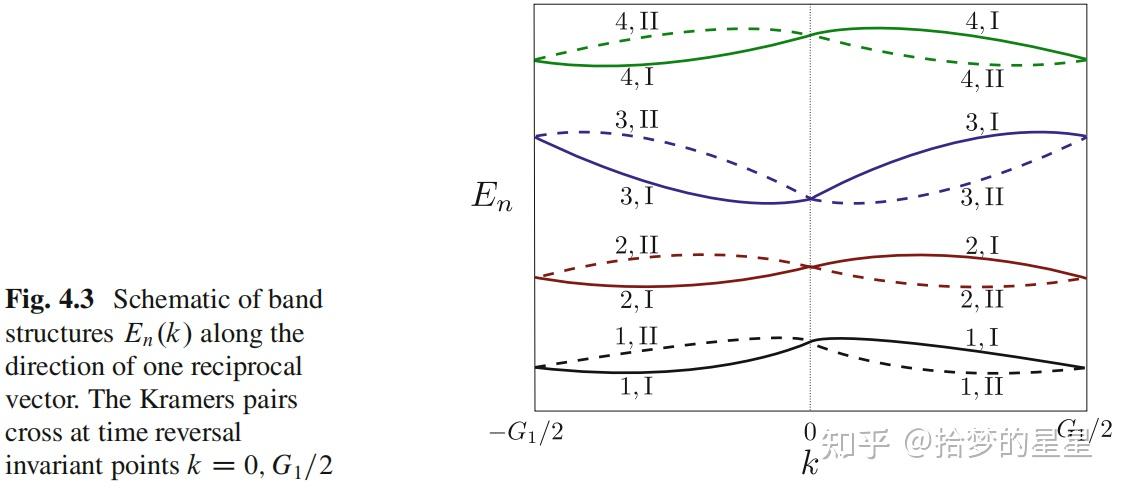
This degeneracy is a direct consequence of time-reversal symmetry for spin-1/2 particles and cannot be broken unless time-reversal symmetry itself is broken (e.g., by applying a magnetic field). Spin-orbit coupling, an interaction that links an electron's spin to its motion, can split spin-up and spin-down bands, but it respects time-reversal symmetry. Therefore, even in materials with strong spin-orbit coupling, Kramers' degeneracy remains at the TRIMs.
The following video discusses spin-orbit interaction and explicitly mentions the resulting Kramers doublets.
Quantum Transport, Lecture 10: Spin-Orbit Interaction
This lecture from a Quantum Transport course discusses the practical effects of spin-orbit interaction.
Watch the segment on Kramers doublets. The speaker explains that even though spin-orbit interaction mixes spin states, time-reversal symmetry ensures that the resulting energy eigenstates still come in degenerate pairs, which are called Kramers doublets. This provides a concrete physical context for the theorem.

Conclusion
In this lesson, we have moved beyond spatial symmetries to explore the profound impact of time-reversal symmetry on the electronic states in solids.
Key Takeaways:
- Time reversal in quantum mechanics is represented by an antiunitary operator that involves complex conjugation.
- For a system with spin-1/2 particles like electrons, applying the time-reversal operator twice gives .
- Kramers' theorem states that for any time-reversal invariant system with an odd number of electrons, every energy level must be at least doubly degenerate.
- In the context of band structures, this theorem guarantees that throughout the Brillouin zone.
- At special time-reversal invariant momenta (TRIMs) like the point, Kramers' theorem requires that every energy band be degenerate with another, forming what are known as Kramers pairs. This degeneracy is robust and persists even in the presence of strong spin-orbit coupling.
These constraints are fundamental to our modern understanding of electronic materials. The protection of degeneracies at specific points in the Brillouin zone is a cornerstone of the theory of topological insulators, where these principles guarantee the existence of exotic electronic states.
In our next and final lesson of this module, we will combine our knowledge of both spatial and time-reversal symmetries to understand how they dictate the selection rules for optical transitions between electronic bands.