Welcome to your next lesson on the symmetries of crystalline solids. In our previous session, we established a crucial link between the real-space periodicity of a crystal and the structure of its momentum space. We saw that the group of discrete lattice translations gives rise to a reciprocal lattice, and that the unique irreducible representations of this translation group are labeled by wavevectors within the first Brillouin zone.
Today, we will build directly on that foundation to derive Bloch's theorem, a cornerstone of solid-state physics. This theorem provides the explicit mathematical form of wavefunctions for particles, like electrons, moving in a periodic potential. You will see how the translational symmetry we've studied rigorously dictates that these wavefunctions must be plane waves modulated by a periodic function. This lesson will not only furnish the proof of the theorem from a group-theoretic standpoint but also explore its profound consequences, namely the origin of the electronic band structure that governs the properties of all crystalline materials.
Deriving Bloch's Theorem from Translational Symmetry
The essence of Bloch's theorem is a direct consequence of the Hamiltonian's invariance under the crystal's translation group. Since you have a strong background in quantum mechanics, we can frame this quite elegantly using operators.
The Hamiltonian for an electron in a crystal includes a potential that has the periodicity of the Bravais lattice:
for any lattice vector .
Let's introduce the translation operator , whose action on any function is . The invariance of the potential means that the Hamiltonian commutes with every lattice translation operator:
where is the set of all Bravais lattice vectors. Furthermore, since the translation group is abelian (), all translation operators commute with each other.
This mutual commutativity allows us to find a basis of states that are simultaneous eigenfunctions of the Hamiltonian and all translation operators . Let be such an eigenstate. Then:
The eigenvalues are the characters of the irreducible representations of the translation group, which we identified in the last lesson. The group property implies that the characters must satisfy . This functional equation is solved by for some vector .
Thus, any energy eigenstate in a periodic potential must satisfy:
This equation is the first form of Bloch's theorem. It tells us that an eigenfunction is not itself periodic, but rather picks up a specific phase factor under a lattice translation, with the phase determined by the wavevector that labels its irreducible representation.
To arrive at the more common statement of the theorem, we define an auxiliary function . Let's see how this new function transforms under a lattice translation:
The function has the same periodicity as the lattice. By rearranging, we find . This completes the proof.
David Tong's lecture notes provide a very clear and formal presentation of this operator-based proof.
Please read the sections "Bloch's Theorem in One Dimension" and "Bloch's Theorem" in higher dimensions. The logic is the same in both, but seeing the 1D case first can be helpful for clarity. Focus on how the properties of the translation operator T_l lead directly to the two forms of the theorem.
We can summarize our findings in a formal statement.
Bloch's Theorem: The eigenstates of the one-electron Schrödinger equation with a periodic potential can be chosen to have the form of a plane wave multiplied by a function with the periodicity of the Bravais lattice:
where . The wavevector is the crystal momentum and is confined to the first Brillouin zone. The index is the band index, which we will explore next.
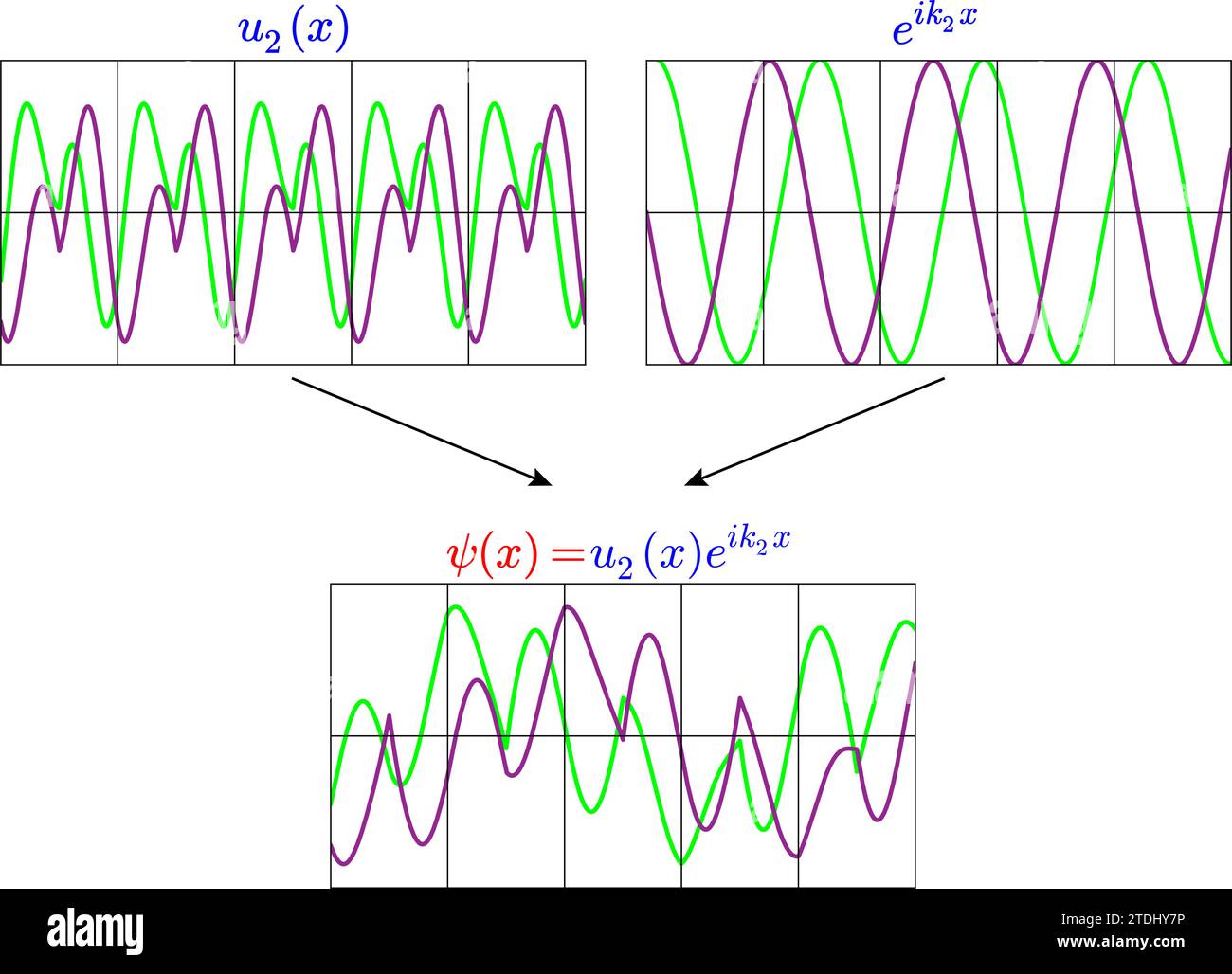
The k-dependent Hamiltonian and the Birth of Bands
Bloch's theorem is not just a statement about the form of the wavefunctions; it fundamentally simplifies the problem of finding them. By substituting the Bloch form into the Schrödinger equation, we can transform the problem from one defined over an infinite crystal to one defined within a single primitive unit cell.
Let's substitute into the time-independent Schrödinger equation:
We need to evaluate the action of the Laplacian on the product. Using the identity , we find . Substituting this and cancelling the common factor yields a new eigenvalue equation for the periodic function :
This can be written as , where is an effective, -dependent Hamiltonian.
Solid State Physics SISSA | Lecture 11: Bloch's theorem
The video "Solid State Physics SISSA | Lecture 11: Bloch's theorem" provides a detailed walkthrough of this derivation and its implications.
Watch the segment from this part of the lecture. The lecturer substitutes the Bloch form into the Schrödinger equation to derive the new eigenvalue equation for the periodic part u_{\vec{k}}(\vec{r}). This transforms a problem over infinite space into a more manageable problem within a single unit cell, with boundary conditions that are now periodic.
For each fixed value of in the Brillouin zone, this is a standard eigenvalue problem for defined on a finite volume (the unit cell) with periodic boundary conditions. Such problems generally have a discrete spectrum of solutions. We label these discrete solutions with an integer , which we call the band index.
For each , we get a ladder of energy eigenvalues: . As we vary continuously across the Brillouin zone, these energy levels trace out continuous functions , which are known as the electronic bands. The collection of all these bands is the band structure of the material.
Solid State Physics SISSA | Lecture 11: Bloch's theorem
Let's continue with the same video to see how this leads to the concept of bands.
Now watch from this section. It explains how solving the \vec{k}-dependent equation for each \vec{k} gives a discrete set of energies, and how these energies form continuous bands E_n(\vec{k}) as \vec{k} is varied. This is the origin of the band diagrams you have likely seen in your condensed matter course.
The band structure contains a vast amount of information about the material, determining whether it is a metal, insulator, or semiconductor.
Alternative Viewpoints and Practical Construction
Your background in QFT and research makes it worthwhile to consider alternative perspectives on Bloch's theorem.
1. The Scattering Perspective
A free electron is in a plane wave state , an eigenstate of momentum. In a crystal, the periodic potential can be expanded in a Fourier series over the reciprocal lattice: . The matrix element for the potential to scatter a state to is:
This integral is non-zero only if . This means the lattice potential can only change an electron's momentum by a reciprocal lattice vector. An eigenstate in the potential will therefore not be a single plane wave, but a superposition of all plane waves that are coupled by the lattice:
The term in parentheses is a sum of plane waves with wavevectors from the reciprocal lattice, which is manifestly a periodic function. This again yields the Bloch form .
2. The LCAO Construction
The group-theoretic approach is not just abstract; it provides a concrete recipe for constructing Bloch waves using projection operators. In the tight-binding or Linear Combination of Atomic Orbitals (LCAO) approximation, we build the crystal wavefunctions from the atomic orbitals of the constituent atoms.
If is an atomic orbital at the origin, a Bloch function with wavevector can be constructed by forming a symmetry-adapted linear combination:
This sum runs over all lattice sites . The phase factor is precisely the character of the IR labeled by for the translation . This formula is a direct application of the projection operator for the translation group.
(46) Bloch's theorem identifies the important features of ...
The document from Iowa State University provides an excellent, explicit derivation of this LCAO approach and its application. It's a great example of how the abstract group theory translates into a practical calculation method used in computational materials science.
Please read section (48), "Bloch Functions for L.C.A.O. Methods", which shows how to use the projection operator to build Bloch functions. Then, continue with section (49), "Electronic Wavefunctions and Energies in 1-d", which applies this to a 1D chain of atoms with s-orbitals. This will show you how the energy bands E_n(\vec{k}) are explicitly calculated in this model, resulting in the famous cosine-like dispersion relation.
Conclusion
In this lesson, we have derived Bloch's theorem, demonstrating that the translational symmetry of a crystalline solid imposes a strict structure on its quantum mechanical wavefunctions. This is a powerful illustration of how symmetry principles are not merely descriptive but have profound predictive power.
Key Takeaways:
- Bloch's Theorem: Eigenstates of a periodic Hamiltonian can be written as , where has the periodicity of the lattice. This follows directly from the fact that these states must form bases for the irreducible representations of the translation group.
- Crystal Momentum: The wavevector labels the irrep and is known as the crystal momentum. It is a conserved quantity modulo a reciprocal lattice vector.
- Band Structure: For each in the first Brillouin zone, there is a discrete spectrum of energy eigenvalues , labeled by the band index . As varies, these levels form the electronic band structure.
- Computational Simplification: Bloch's theorem reduces the problem of solving the Schrödinger equation for an infinite crystal to solving a -dependent equation within a single unit cell.
In our next lesson, we will expand our scope from pure translations to the full symmetry of the crystal. We will introduce space groups, which combine translations with point group operations (rotations, reflections), and explore how these more complex symmetries further constrain the properties of electrons and phonons in solids.