Welcome. In our previous lesson, we defined the parity (P) and charge conjugation (C) transformations, which act as mirror operations on spacetime and internal charges, respectively. We now arrive at the last of the fundamental discrete spacetime symmetries: Time Reversal (T). As you will see, T is conceptually deeper than P and C, demanding a unique mathematical structure within quantum theory.
This lesson aims to define the time reversal transformation and, crucially, to explain its anti-unitary nature in quantum mechanics and quantum field theory. We will explore why a simple, linear operator is insufficient and leads to physical contradictions, motivating the introduction of anti-unitary operators. We will then construct the time reversal operator for Dirac fields, completing our toolkit of discrete symmetries and preparing for the celebrated CPT theorem.
The Subtlety of Reversing Time
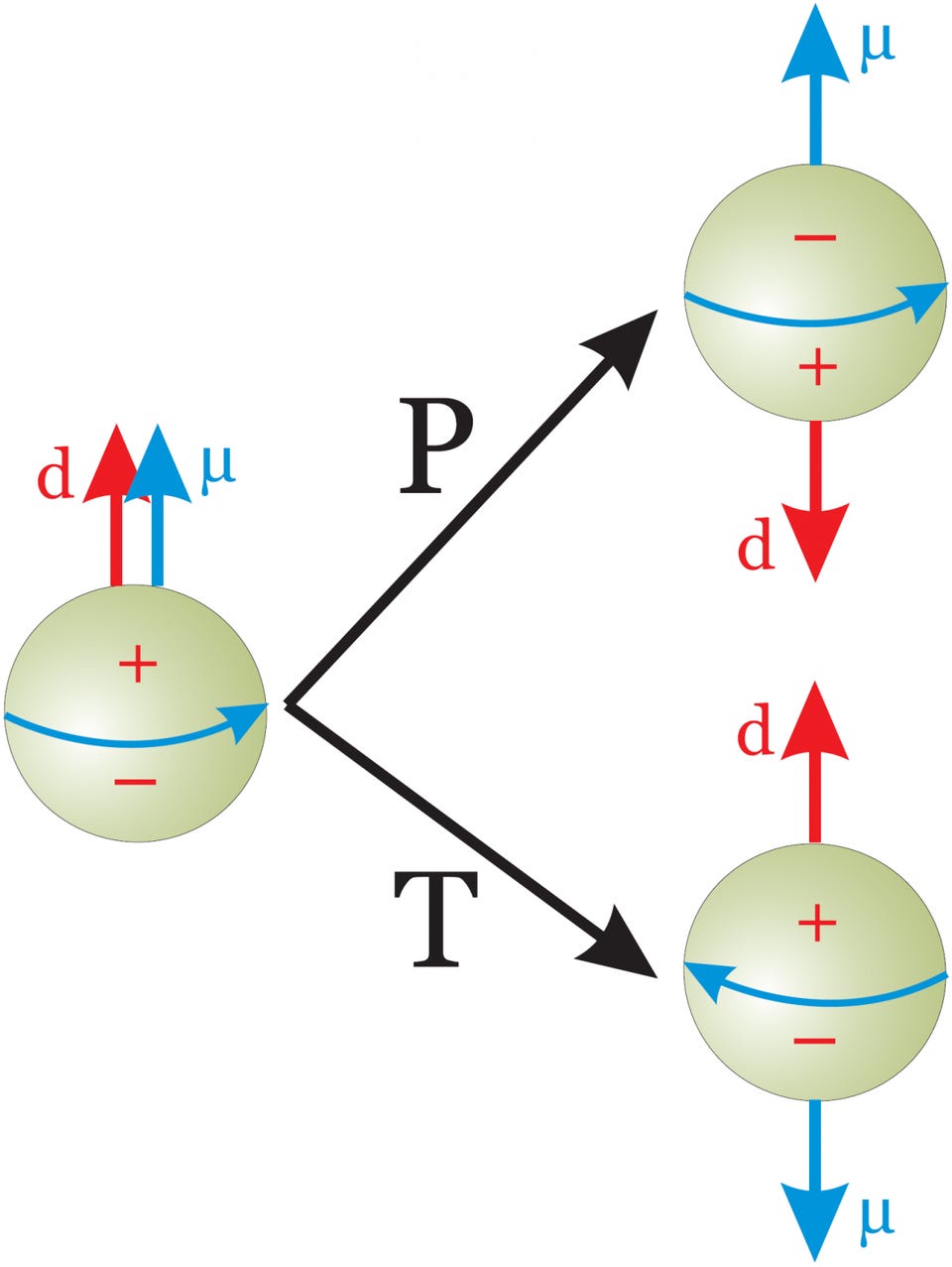
Classically, time reversal is straightforward. For a trajectory , the time-reversed motion is simply . This implies that while position is even under T, , velocity and momentum are odd, . Consequently, angular momentum is also odd, .
However, translating this into quantum mechanics reveals a profound difficulty. Let's denote the time-reversal operator by . Based on the classical analogy, we expect it to transform the quantum operators for position and momentum as:
Now, let's see what this implies for the canonical commutation relation (CCR), . Applying the transformation to the CCR gives:
On the other hand, if we assume is a standard unitary (and thus linear) operator, it would act on the right-hand side as:
Comparing the two results, we reach the contradiction . This is a powerful argument showing that cannot be a unitary operator.
A second compelling argument comes from the Schrödinger equation itself, . A time-reversal symmetry should map a solution into another valid solution that evolves backward in time.
If we simply flip the sign of time, , the left side becomes , which changes sign relative to the right side, . So, is not a solution.
However, if we also take the complex conjugate of the entire equation, we get . For a typical Hamiltonian where is real (e.g., a particle in a real potential), . Now, making the substitution gives . This shows that the complex-conjugated, time-reversed state is a valid solution. This strongly suggests that the time-reversal operation must involve complex conjugation.
Wigner's Theorem and Anti-Unitary Operators
These arguments force us to expand our understanding of symmetry in quantum mechanics. A foundational result, known as Wigner's theorem, states that any symmetry transformation that preserves the probabilities of all measurement outcomes (i.e., preserves for all states) must be represented on the Hilbert space by an operator that is either unitary and linear or anti-unitary and anti-linear.
While most symmetries (rotations, translations, P, C) are unitary, time reversal is the canonical example of one that must be anti-unitary.
An operator is anti-linear if, for any states and complex numbers :
Notice the complex conjugation of the coefficients. An operator is anti-unitary if it is anti-linear and also satisfies .
An anti-unitary operator transforms inner products as follows:
This still preserves the absolute value squared, , satisfying the condition of Wigner's theorem.
With this definition, our earlier contradictions are resolved. For the CCR, if is anti-unitary:
This now matches the result from transforming the operators, restoring consistency.
The following reading provides a rigorous but clear explanation of the mathematical properties of anti-linear operators, which are essential for a deep understanding of time reversal.
Time Reversal for Dirac Fields
Now we can construct the time-reversal transformation for a Dirac field . The full transformation involves both a matrix acting on the spinor indices and the anti-linear operation of complex conjugation. We write the time-reversal operator in the factorized form , where is the operator of complex conjugation and is a unitary matrix in spinor space that we need to determine.
The transformed field is then defined as:
This acts at a single spacetime point. The full transformation that reverses the direction of time evolution is:
where is an intrinsic phase factor.
To find the matrix , we impose the physical requirement that spin, like orbital angular momentum, must be odd under time reversal: .
The spin operators for a Dirac field are . The requirement that they flip sign under leads to a constraint on the matrix . A detailed derivation shows that in any representation of the gamma matrices, one can choose to be a matrix that satisfies:
In the common Weyl/chiral representation, where are real and is imaginary, a suitable choice is .
The following notes provide an elegant derivation of the form of the time-reversal operator by requiring it to correctly transform the angular momentum operators.
Implications of Time-Reversal Symmetry in Quantum ...
This document by Howard Haber provides a concise and clear derivation of the time-reversal operator for a general angular momentum state.
Read section 2. The time reversal operator acting on states of definite angular momentum. Focus on how the condition \Theta \vec{J} \Theta^{-1} = -\vec{J} is used, along with the properties of the angular momentum matrices under complex conjugation (Eq. 14), to arrive at the explicit form \Theta = \eta \exp(-i\pi J_y/\hbar)K (Eq. 15). This general result applies directly to the spin part of the Dirac field.
Kramers' Degeneracy
A remarkable consequence of time-reversal symmetry arises when we consider its action twice. Let's apply to an angular momentum eigenstate :
(The phase factor convention may vary, but the physics remains the same). Now, let's apply it again:
So, we arrive at the crucial result:
This means:
- For systems with integer spin (bosons, ), .
- For systems with half-integer spin (fermions, ), .
This has a profound consequence known as Kramers' Degeneracy. Consider a system with a time-reversal invariant Hamiltonian, , and half-integer total spin. Let be an energy eigenstate, . The state must also be an energy eigenstate with the same energy. Are and the same state?
Suppose they are, so for some phase . Then .
But for a half-integer spin system, we must have . This is a contradiction.
Therefore, and must be linearly independent. This means that for any system with half-integer spin and time-reversal symmetry, every energy level must be at least two-fold degenerate. This is Kramers' theorem, and it has vast implications in condensed matter physics for electronic band structures.
Conclusion
In this lesson, we delved into the unique nature of the time-reversal transformation in quantum theory. We established that its faithful representation requires an anti-unitary operator, a concept supported by both physical arguments and the rigorous foundation of Wigner's theorem.
Key Takeaways:
- Time Reversal (T) reverses the direction of motion: . Classically, this makes momentum and angular momentum odd under T.
- In quantum mechanics, the time-reversal operator must be anti-unitary. A unitary operator would lead to contradictions with the canonical commutation relations and imply an unstable energy spectrum.
- An anti-unitary operator is anti-linear and satisfies . It acts on linear combinations by conjugating the scalar coefficients and transforms inner products to their complex conjugates.
- For a Dirac field, the time-reversal transformation is , where is a unitary matrix in spinor space (e.g., in the Weyl basis).
- A fundamental property of time reversal is that . This is for bosons (integer spin) and for fermions (half-integer spin).
- For any time-reversal invariant system with half-integer spin, all energy levels are guaranteed to be at least two-fold degenerate (Kramers' degeneracy).
Preview of the Next Lesson:
Having now defined P, C, and T individually, we are equipped to combine them. Our next lesson will introduce the CPT theorem, one of the most fundamental and robust theorems in quantum field theory. It asserts that all interacting quantum field theories consistent with Lorentz invariance and locality are symmetric under the combined action of C, P, and T. We will explore its proof and profound consequences, including the equality of mass and lifetime for particles and their anti-particles.