Welcome to our next lesson on the symmetries of SU(3). In our previous session, we moved from the one-dimensional world of su(2) to the two-dimensional weight diagrams of su(3). We constructed these diagrams on a case-by-case basis for specific representations like the fundamental (3), the adjoint (8), and the symmetric tensor product (6). This gave us a feel for the geometric patterns that emerge, but it left a crucial question unanswered: how can we classify and construct all possible irreducible representations of SU(3)?
Today, we will answer that question by introducing one of the most powerful and elegant results in representation theory: the Theorem of the Highest Weight. This theorem provides a complete classification scheme, showing that every irreducible representation of SU(3) is uniquely specified by a single "highest" weight, which can be labeled by a pair of non-negative integers. We will not only state this theorem but also learn a practical, step-by-step recipe to construct the entire weight diagram of any irreducible representation, including the multiplicity of each weight, starting from just these two integers.
The Concept of a Highest Weight
In our study of su(2), the concept of a highest weight was straightforward. For a given spin- representation, the highest weight state was the one with the maximum eigenvalue of , namely . All other states in the representation could be generated by repeatedly applying the lowering operator to this state. The highest weight state was uniquely defined as the one annihilated by the raising operator: .
We can generalize this core idea to su(3). However, since the weights live in a 2D plane, "highest" is no longer a simple maximum value. Instead, we must define it based on the action of the algebra's raising and lowering operators.
First, recall the root diagram of su(3), which describes the algebra's structure.

Just as su(2) had one raising operator () and one lowering operator (), su(3) has multiple pairs. We need a convention to distinguish them. We do this by choosing a direction. Any root with a positive projection along a chosen (but arbitrary) line through the origin is called a positive root, and its corresponding operator is a raising operator. The negatives of these are negative roots, and their operators are lowering operators.
A standard convention, for instance, takes and as simple roots, and the set of positive roots is . With this, we can formally define a highest weight.
A weight is a highest weight of a representation if its corresponding weight vector, , is annihilated by all raising operators (i.e., the operators associated with all positive roots).
This mirrors the su(2) condition , but now it's a more stringent requirement. The remarkable fact is that, just like in su(2), this single highest weight vector is unique (up to normalization) for any irreducible representation, and the entire representation can be generated from it by applying the lowering operators.
For a more formal definition of highest weights, you can consult the following text.
[PDF] Representation theory of semi-simple Lie algebras: Example su(3)
This document by Michael Flohr provides a rigorous treatment of su(3) representation theory.
Please read the section titled "Highest weights". Focus on the lemma that defines a highest weight vector as one that is annihilated by a specific set of operators, E_{i,j} with i < j. This formalizes the idea of being annihilated by all "raising" operators.
The Theorem of the Highest Weight
With the concept of a highest weight established, we can now state the central theorem that provides a complete classification of all finite-dimensional irreducible representations (irreps) of su(3).
The theorem has two common and equivalent formulations. The first is practical and constructive, while the second is more abstract and general.
Theorem (Constructive Formulation):
For every pair of non-negative integers , there exists a unique (up to isomorphism) finite-dimensional irreducible representation of su(3), denoted , whose highest weight is given by in the basis used in our video resources.
This is a powerful statement. It means that the entire, infinite set of possible su(3) irreps is in one-to-one correspondence with pairs of non-negative integers like (1,0), (0,1), (1,1), (2,0), and so on.
The second formulation uses the language of dominant weights, which is central to the general theory of Lie algebras.
Lie Algebra Representation Theory – SU(3)
This document by Christoph Koerber provides a physics-oriented perspective connecting the abstract theory to applications.
Please read the section on weights, focusing on the definitions of a weight, a dominant weight, and a fundamental weight. Then, read Proposition 2.8, which is the formal statement of the theorem. A "dominant weight" is one that can be written as a non-negative integer linear combination of fundamental weights, which directly corresponds to the integers (k,l).
So, the pairs of integers are simply the coordinates of the highest weight in a special basis called the fundamental weights. We will explore this connection more in a later lesson on Dynkin diagrams. For now, the key takeaway is that every irrep is uniquely labeled by two non-negative integers.
A Recipe for Constructing Weight Diagrams
The theorem guarantees that for any pair , an irrep exists. But how do we find its structure? The following video provides a brilliant and intuitive four-step recipe for constructing the full weight diagram, including multiplicities, starting from just .
Lie groups and Lie algebras: Classification of SU(3) representations
In his video "Classification of SU(3) representations," Jonathan Evans lays out the theorem and the first part of the construction recipe.
Watch the beginning of the video from the end of step 2. This will cover: The statement of the theorem, associating a unique irrep \Gamma_{k,l} to each pair of non-negative integers (k,l). Step 0: Defining the highest weight \lambda from (k,l). Step 1: Reflecting \lambda using the Weyl group to find the vertices of the outer boundary of the weight diagram. Step 2: Taking the convex hull of these points to define a polygon that contains all weights.
The first two steps give us the shape of the weight diagram. Now, we need to fill in the interior points. Not every point inside the polygon is a valid weight. As we learned formally from the LINK PDF, all weights in an irrep must differ by an integer combination of roots. This means all weights must lie on a translated version of the root lattice.
Lie groups and Lie algebras: Classification of SU(3) representations
The next segment of the video explains this crucial step of filling the interior.
Please watch from the explanation of multiplicities. This covers Step 3, which is to select only the points inside the polygon P that are of the form \lambda + r, where r is an element of the root lattice.
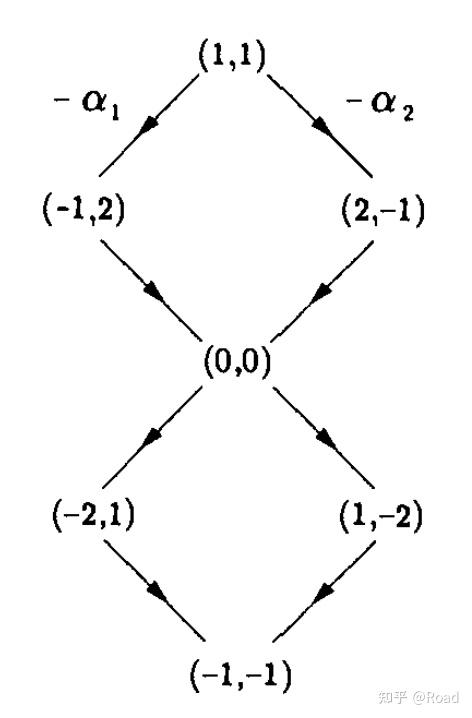
This idea of generating all weights from the highest weight by subtracting roots is visualized nicely in the diagram below. Starting from a highest weight, like the one at (1,1), we can reach other weights by moving along directions corresponding to negative roots (e.g., , ).
Step 4: Determining Weight Multiplicities
We now have the locations of all the weights in our diagram. The final step is to determine their multiplicity, which is the dimension of the corresponding weight space. For su(2), all multiplicities in an irrep are 1. For su(3), they can be greater than 1, particularly for weights in the interior of the diagram.
There are complex formulas (like Freudenthal's formula) to calculate these, but for su(3) there is a simple and elegant graphical algorithm.
Lie groups and Lie algebras: Classification of SU(3) representations
The next part of the video explains the 'shell-stripping' algorithm for finding multiplicities.
Watch from the start of the examples to learn this algorithm. The rules are: The outermost shell of weights always has multiplicity 1. Strip off the outer shell. To find the multiplicity of the new outer shell, check the shape of the shell you just removed. If the removed shell was a hexagon, the new shell's multiplicity is one greater than the removed shell's. If the removed shell was a triangle, the new shell's multiplicity is the same as the removed shell's. Repeat until all weights are assigned a multiplicity.
This algorithm is best understood through examples. The remainder of the video walks through several cases, showing how the interplay of hexagonal and triangular shells determines the pattern of multiplicities.
Lie groups and Lie algebras: Classification of SU(3) representations
Let's see this algorithm in action with a few examples from the video.
Please watch the three examples from the end of the video: \Gamma_{2,0}: A representation with a triangular boundary. Notice that all multiplicities are 1. \Gamma_{6,1}: A case where stripping a hexagon and then a triangle leads to multiplicities of 1 and 2. \Gamma_{3,3}: A more complex case where repeated stripping of hexagons leads to multiplicities that grow towards the center (1, 2, 3, 4).
Conclusion
In this lesson, we have taken a major step forward in our understanding of SU(3). We've moved beyond constructing individual examples to a complete and systematic classification scheme provided by the Theorem of the Highest Weight. This framework is not only fundamental to su(3) but generalizes to all semi-simple Lie algebras, forming a cornerstone of modern particle theory.
Key Takeaways:
- The Theorem of the Highest Weight states that every irreducible representation of SU(3) is uniquely labeled by a pair of non-negative integers , which specify its highest weight.
- A highest weight vector is the state in a representation that is annihilated by all raising operators.
- The entire weight diagram of the representation can be constructed from the highest weight using a four-step recipe:
- Reflect the highest weight using the Weyl group to get the outer vertices.
- Take the convex hull to define the boundary.
- Fill the interior with points from the root lattice shifted to the highest weight.
- Determine multiplicities using the graphical shell-stripping algorithm.
- The shape of the boundaries (hexagons vs. triangles) determines how multiplicities change from outer to inner shells.
Now that we have this powerful general machinery, our next lesson will be dedicated to applying it to the most physically significant low-dimensional representations of SU(3): the fundamental representations 3 () and its conjugate 3-bar (), and the adjoint representation 8 (). We will see how these mathematical structures provide the exact framework needed for the Eightfold Way classification of quarks, antiquarks, and mesons.