Welcome back. In our previous lessons, we have meticulously constructed a powerful toolkit for understanding the SU(3) group. We learned to visualize its representations using weight diagrams, classify them with Dynkin labels, decompose composite systems with Young Tableaux, and characterize each multiplet with the invariant eigenvalues of its Casimir operators. Now, the time has come to apply this machinery to one of the landmark achievements of 20th-century physics.
This lesson will transport us to the 1950s and early 1960s, a time of both excitement and confusion in particle physics. Accelerators were uncovering a bewildering variety of new, strongly interacting particles, the hadrons, leading to what was known as the "particle zoo." We will see how the mathematical framework of SU(3) provided the key to taming this zoo, bringing a new level of order and understanding. This effort, known as the Eightfold Way, not only classified the known particles but also led to the revolutionary hypothesis that hadrons themselves are not fundamental, but are composed of even smaller entities: the quarks.
The Particle Zoo and the Search for Order
By the mid-20th century, physicists had identified several quantum numbers that were conserved in strong interactions and could be used to label particles. You are already familiar with some of these from our study of SU(2):
- Electric Charge (Q)
- Baryon Number (B): A number assigned to distinguish heavy particles like protons and neutrons (baryons, B=1) from lighter ones like pions (mesons, B=0).
- Isospin (I) and its projection (I₃): This SU(2) symmetry grouped particles like the proton and neutron into an "isospin doublet," treating them as different states of a single entity, the nucleon.
However, a new class of "strange" particles began to appear. They were produced copiously in strong interaction experiments, yet they decayed much more slowly than expected, suggesting their decay was governed by the weak force. This implied that the strong force was forbidden from mediating their decay, which pointed to a new, conserved quantum number. This quantity was aptly named Strangeness (S).
The challenge was to organize the dozens of known hadrons using these quantum numbers. The video below provides an excellent introduction to this historical context and the classification scheme that emerged.
Eightfold Way (in Particle physics) | Why Quarks?
This video, from the "For the Love of Physics" channel, introduces the historical problem of the "particle zoo" and describes how the Eightfold Way organized hadrons into geometric patterns.
First, watch the introductory segment from the beginning, which draws an insightful analogy between the Eightfold Way and the periodic table of elements. Then, continue watching the detailed explanation of the hadron multiplets from the baryon octet. Pay close attention to how particles are plotted on a 2D grid using strangeness and a charge-related quantum number as axes, forming distinct geometric shapes.
The Eightfold Way: SU(3) Weight Diagrams in Disguise
As the video explains, Murray Gell-Mann and Yuval Ne'eman independently discovered that if they plotted the known hadrons on a 2D grid, striking patterns emerged. The axes for these plots were chosen to be two quantum numbers that are conserved in strong interactions and commute with each other. From your study of Lie algebras, you know this is precisely the role played by the generators of the Cartan subalgebra.
For SU(3), which has rank 2, there are two such commuting generators. One is naturally identified with the isospin projection, . The other is a linear combination of isospin and strangeness, called Hypercharge (Y), defined as:
When hadrons were plotted on a vs. diagram, they formed multiplets that looked exactly like the weight diagrams of low-dimensional SU(3) irreducible representations.

The key identifications were:
- The eight lightest spin-1/2 baryons (p, n, , , ) formed a hexagonal pattern identical to the weight diagram of the adjoint representation, .
- The eight lightest spin-0 mesons (, K, ) formed the same pattern.
- A group of nine (at the time) spin-3/2 baryons (, , ) formed a large triangular pattern. This matched the weight diagram of the representation.
This was a spectacular success, but its most stunning confirmation came from a prediction. The weight diagram for the representation required ten particles, but only nine were known. The spot at the bottom vertex, with charge -1 and strangeness -3, was empty. Gell-Mann predicted the existence of a new particle, the Omega-minus (), with precisely these properties and a predictable mass. In 1964, it was discovered experimentally at Brookhaven National Laboratory, providing dramatic validation for the Eightfold Way.
To make the connection between the physics and the mathematics explicit, we must relate the physical quantum numbers (Q, S, B) to the basis elements of the su(3) algebra.
Lie Algebra Representation Theory – SU(3)
This document provides a concise, formal link between the observed particle multiplets and SU(3) representation theory.
First, read the section "From Atoms to Quarks" to get a summary of the historical context leading to the "particle zoo" (the final sentence). Next, read the section "The Eightfold Way". This is the crucial part. It visually shows the octets and decuplet and provides the mathematical formulas that identify the physical operators for charge Q and strangeness S (or hypercharge Y = B+S) with the diagonal generators T_3 and T_8 of the su(3) algebra.
As the reading shows, the charge operator and hypercharge operator are identified with linear combinations of the two diagonal generators and that form the Cartan subalgebra:
The electric charge is then given by the Gell-Mann–Nishijima formula:
These relations firmly establish that the observed hadron multiplets are physical manifestations of the irreducible representations of SU(3).
A Deeper Reality: The Quark Model
The Eightfold Way was a triumph of classification, but it left a deep question unanswered: why do hadrons only appear in and dimensional multiplets? Why not the simplest, fundamental -dimensional representation?
Drawing analogy with the periodic table—where the patterns of chemical elements are explained by their composition from a few fundamental particles (electrons, protons, neutrons)—Gell-Mann and George Zweig independently proposed a radical idea. They suggested that hadrons were not fundamental at all. Instead, they were composite particles built from a new set of truly elementary particles. Gell-Mann called them quarks.
These hypothetical quarks were postulated to transform according to the simplest non-trivial representations of SU(3):
- Quarks (q) are in the fundamental representation , with Dynkin labels (1,0).
- Anti-quarks () are in the conjugate representation , with Dynkin labels (0,1).
There were three "flavors" of quarks needed to build the known hadrons: up (u), down (d), and strange (s). By assigning appropriate quantum numbers to these three quarks (and their antiquarks), the entire spectrum of hadrons could be constructed.
The following video segment explains this brilliantly.
Eightfold Way (in Particle physics) | Why Quarks?
This part of the video explains how the idea of quarks provided a deeper explanation for the Eightfold Way patterns.
Please watch from the introduction of the quark model. This section explains how three fundamental quarks (up, down, strange) in the \mathbf{3} representation can be combined to form the observed hadron multiplets. Then, watch the final segment from the properties of quarks, which demonstrates how the properties of hadrons, like the charge of a neutron or proton, can be calculated by simply summing the properties of their constituent quarks.
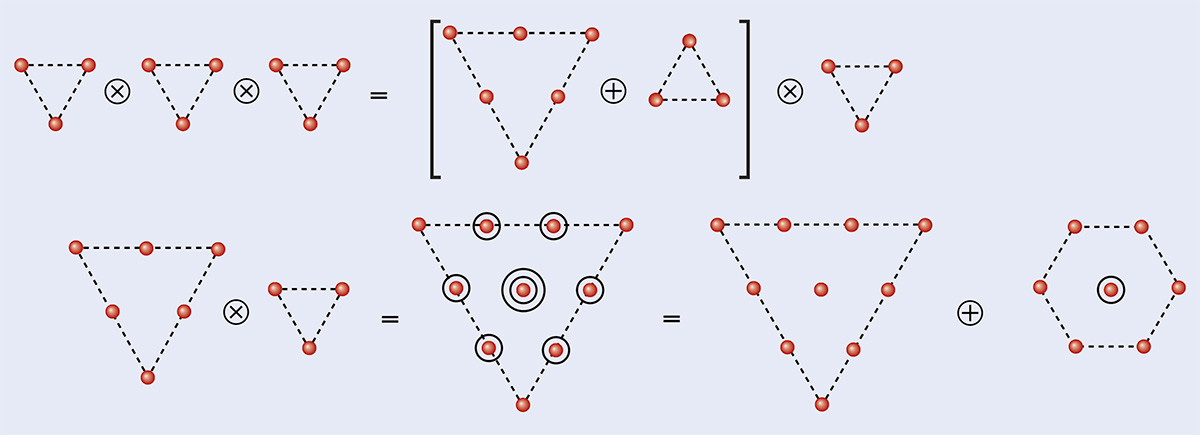
The quark model provides a stunningly simple explanation for the observed multiplet structure using the tensor product decompositions you learned to calculate with Young Tableaux.
-
Mesons (B=0) are quark-antiquark () bound states. The tensor product decomposition is:
This naturally explains the existence of the meson octet and an additional particle, the meson singlet.
-
Baryons (B=1) are three-quark () bound states. The tensor product is:
This decomposition perfectly accounts for the baryon decuplet () and the baryon octet (). The model even predicts two distinct octets and a singlet, which correspond to different symmetry properties under the exchange of quarks.
The model required quarks to have fractional electric charges ( for the up quark, for the down and strange quarks), a bizarre proposition at the time, as no such fractionally charged particle had ever been seen in isolation. This led to the idea of confinement: that quarks are permanently bound inside hadrons and can never be observed as free particles.
SU(3) as an Approximate Symmetry
If SU(3) flavor symmetry were an exact symmetry of nature, all particles within a given multiplet would have the same mass. A glance at the particle data shows this is not the case. For example, in the baryon octet, the proton has a mass of 938 MeV/c², while the has a mass of 1315 MeV/c².
The symmetry is broken. The primary source of this breaking is the difference in the masses of the quarks themselves.
- The up and down quarks are very light and have nearly equal masses (). This is why SU(2) isospin is a very good symmetry.
- The strange quark is significantly heavier ().
This mass difference breaks the SU(3) flavor symmetry. However, the symmetry is not completely destroyed. It is an approximate symmetry, and the pattern of its breaking is itself highly regular. This regularity led to the development of the Gell-Mann-Okubo mass formula, which successfully predicted the masses of the particles within the multiplets, further cementing the validity of the model.
Conclusion
In this lesson, we have seen the power of symmetry methods in full display. The abstract mathematics of SU(3), which we have developed over this module, found a direct and profound application in organizing the subatomic world.
Key Takeaways:
- The "particle zoo" of the 1950s was organized by plotting hadrons on a 2D grid of Hypercharge vs. Isospin .
- The emerging geometric patterns—the Eightfold Way—were identified as the weight diagrams of SU(3) irreducible representations, specifically the (octet) and (decuplet).
- This model's predictive power was confirmed by the discovery of the particle, which filled a vacant spot in the baryon decuplet.
- The quark model provided a deeper explanation, proposing that hadrons are composite particles built from fundamental constituents (quarks) transforming under the and representations of SU(3).
- Tensor product decompositions correctly predict the observed multiplet structure: mesons () form , and baryons () form .
- SU(3) flavor is an approximate symmetry, broken by the mass difference between the strange quark and the up/down quarks.
This concludes our deep dive into SU(3) and its role in particle physics. Having explored the application of continuous symmetries in the quantum realm, we will now shift our focus. In the next module, we will explore the power of discrete symmetries in describing the periodic structures of crystals, a topic central to your interest in condensed matter physics. We will develop the tools to understand Bravais lattices, space groups, and their consequences for the properties of solids.