Welcome back to our exploration of continuous symmetries. In the previous lesson, we established the formal definition of a Lie group as a smooth manifold with a compatible group structure, and we met some of the key players in physics: SO(3), SU(2), U(1), and SO(2). We saw that their smoothness is their defining characteristic, allowing us to apply the tools of calculus to the study of symmetry.
Today, we will leverage that smoothness to perform a crucial conceptual leap: we will linearize the Lie group. Instead of working with the full, often geometrically complex, group manifold, we will construct a "flat" vector space that captures the group's local structure around the identity. This vector space is called the Lie algebra, and its elements are known as the generators of the group. Our goal is to understand how to derive these generators by studying curves within the group, specifically those with a simple additive structure known as one-parameter subgroups.
1. The Generator: Tangent to the Group
Imagine a curve on the manifold of a Lie group , where is a real parameter. Let's ensure this curve passes through the identity element, say at , so . Since the group is a smooth manifold, we can ask for the tangent vector to this curve at the identity. This tangent vector is precisely what we call a generator. It describes the "direction" of an infinitesimal transformation away from the identity.
Mathematically, the tangent vector is found by taking the derivative of the curve with respect to its parameter and evaluating it at the point corresponding to the identity:
This matrix is an element of the Lie algebra . This simple procedure is the core recipe for finding generators.
Let's see this in action for a familiar case: a rotation in SO(3) about the z-axis. The one-parameter family of rotation matrices is given by:
This is a curve in the SO(3) manifold parameterized by , passing through the identity matrix at . To find the generator of these rotations, we differentiate and evaluate at :
This matrix is the generator of rotations about the z-axis. It is an element of the Lie algebra . The following video provides a clear and intuitive walkthrough of this idea, starting from the inverse perspective of building the group from the generator.
Spinors for Beginners 16: Lie Groups and Lie Algebras
The video "Spinors for Beginners 16: Lie Groups and Lie Algebras" by eigenchris gives a concrete demonstration of how to obtain the generator from the group element.
Please watch from this segment. The presenter lays out the straightforward recipe: take the derivative with respect to the parameter, then set the parameter to zero. This is then applied to the XY rotation matrix, confirming the result.
2. The Lie Algebra as the Tangent Space
We've defined a generator as the tangent vector to a curve at the identity. This points to a deeper geometric meaning. For any point on a manifold, the set of all possible tangent vectors at that point forms a vector space, known as the tangent space.
The Lie algebra of a Lie group is formally defined as the tangent space at the identity element, .
Each generator we calculate is simply one vector in this space. The set of all such generators, which can be obtained by considering all possible smooth curves through the identity, spans the entire vector space . This is a profound simplification: we have moved from a curved manifold to a flat vector space .

This geometric picture is fundamental. The structure of the group in an entire neighborhood of the identity is captured by this linear space of "infinitesimal" transformations.
Spinors for Beginners 16: Lie Groups and Lie Algebras
The same video by eigenchris provides an excellent conceptual summary of this geometric interpretation.
I recommend watching the short segment from this timestamp. It visualizes the Lie algebra as a flat "tangent space" attached to the curved Lie group manifold at the identity element.
3. One-Parameter Subgroups and the Exponential Map
The curves we've considered, like , are special. They satisfy the property . This means that composing two transformations is equivalent to adding their parameters. Such a curve is called a one-parameter subgroup. Formally, it is a Lie group homomorphism .
There is a fundamental theorem in Lie theory that connects generators and one-parameter subgroups:
For every generator in the Lie algebra , there exists a unique one-parameter subgroup in such that its tangent vector at the identity is .
This establishes a one-to-one correspondence between elements of the Lie algebra and one-parameter subgroups of the Lie group. This unique curve is generated by the exponential map:
For matrix Lie groups, this is simply the standard matrix exponential, defined by its Taylor series: .
This closes the loop beautifully:
- Start with a one-parameter subgroup in .
- Find its generator by differentiating: .
- Recover the entire one-parameter subgroup by exponentiating the generator: .
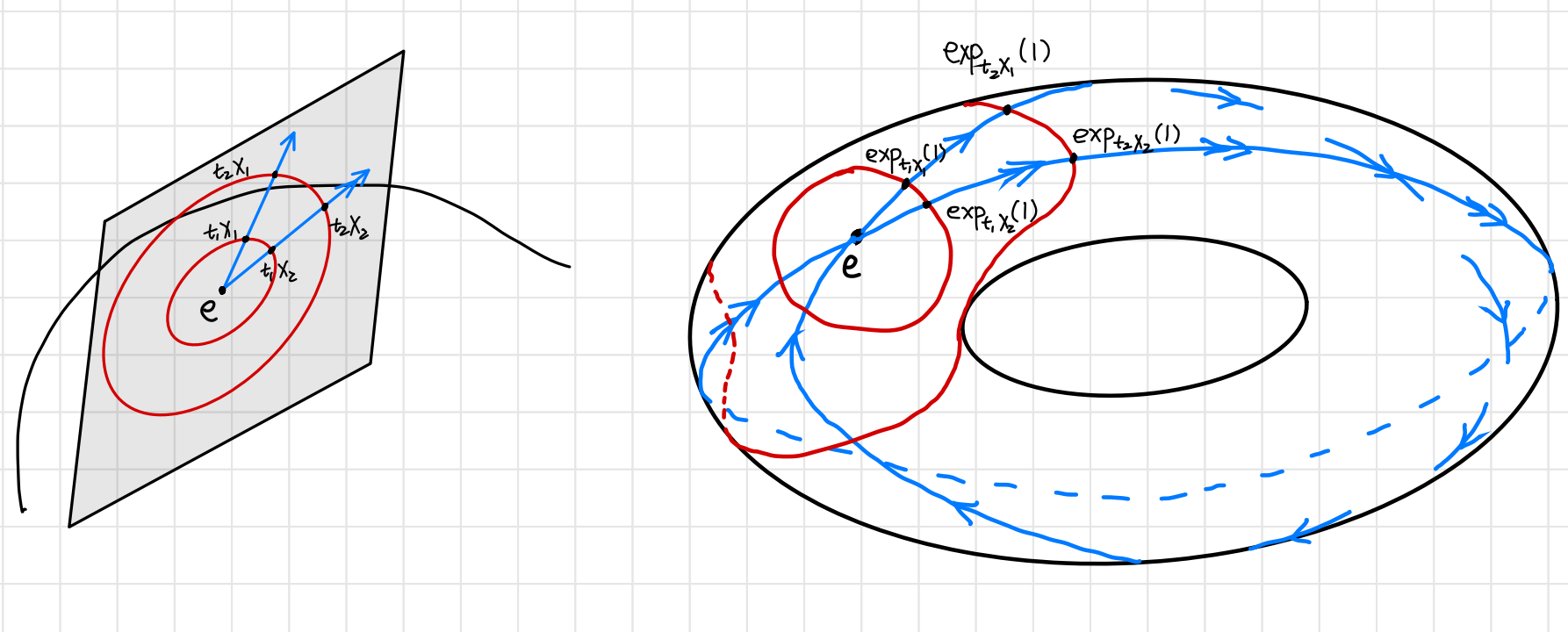
The following reading provides an excellent physicist's perspective on this connection, bridging the intuitive notion of infinitesimal transformations with the more formal structure of one-parameter subgroups.
Lie Groups and Lie Algebras for Physicists
These lecture notes by Harold Steinacker offer a clear and concise discussion that directly relates to our learning goal.
Please read Section 5.2, "One-parameter subgroups". This section explicitly defines a one-parameter subgroup, shows how its derivative at the identity yields the generator, and then introduces the general definition of the exponential map that reconstructs the group from the algebra.
Given your background in differential geometry from courses like General Relativity, it's worth noting that this structure can be described even more abstractly. The generator can be used to define a left-invariant vector field over the entire manifold . The one-parameter subgroup is then the unique integral curve of this vector field that passes through the identity. This powerful formulation, detailed in resources like the lecture notes by Frederic Schuller or Gregory Moore, guarantees the existence of the exponential map for any Lie group, not just matrix groups.
4. Deriving Lie Algebras for the Classical Groups
We can now put this formalism to work to derive the Lie algebras for the groups we met in the last lesson. The strategy is to consider a curve and enforce the defining conditions of the group on . This will reveal the constraints that must satisfy, thereby defining the Lie algebra.
The Orthogonal Algebra
Let . The defining property is that its elements are real matrices satisfying and .
Consider a curve near the identity. We must have:
Using the property , this becomes:
Differentiating with respect to at using the product rule gives:
Since the right-hand side is constant (), its derivative is 0. Thus, we must have:
So, the Lie algebra consists of all real anti-symmetric matrices. The determinant condition imposes an additional constraint, which for matrices near the identity is . For anti-symmetric matrices, the diagonal elements are zero, so their trace is automatically zero. Thus, the condition is satisfied.
This method is extremely powerful. The reading below applies it to derive the algebras for the other main matrix groups.
Lie Groups and Lie Algebras for Physicists
These sections of the same lecture notes by Steinacker provide worked examples of deriving Lie algebras for the most common matrix groups.
Please read Section 5.2.1, "The classical subgroups". This section systematically derives the Lie algebras \mathfrak{sl}(n), \mathfrak{u}(n), and \mathfrak{su}(n) using the exponential map. Then, quickly review Section 5.3, "Example: SO(3) and SU(2)", which shows the explicit basis generators for the two 3-dimensional Lie algebras we have been studying.
Conclusion
In this lesson, we have forged the critical link between a Lie group and its Lie algebra. We established a concrete procedure for deriving the generators of the group and gave this procedure a deep geometric meaning.
Key Takeaways:
- The Lie algebra of a Lie group is the tangent space to the group at the identity element, . Its elements are called generators.
- A generator can be derived from a one-parameter subgroup by taking the derivative at the identity: .
- Conversely, a one-parameter subgroup can be reconstructed from its generator via the exponential map: .
- This procedure allows us to determine the properties of the Lie algebra. For example:
- is the algebra of real anti-symmetric matrices.
- is the algebra of complex traceless anti-hermitian matrices.
We have successfully linearized the problem of continuous symmetries. Instead of the curved group manifold, we now have a flat vector space of generators to work with. However, this vector space is not just a set of vectors; it has its own rich algebraic structure, defined by a product called the Lie bracket. In our next lesson, we will explore how this bracket arises from the group multiplication law and how to compute the commutation relations that define the Lie algebra.