Welcome to our next lesson. In our previous discussion, we saw how the cosets of a normal subgroup can themselves be treated as elements of a new, simpler group called the quotient group . This construction introduced a "natural homomorphism" , a map that elegantly connected the original group to its simplified quotient.
This lesson will generalize that idea. We will formally define what it means for a map between two groups to be "structure-preserving." This leads to the concepts of homomorphisms and isomorphisms, which are the fundamental tools for comparing, relating, and classifying groups. Understanding these maps allows us to recognize when two physically distinct systems—like the algebra of quaternions and the matrices used to describe quantum spin—share the exact same underlying symmetry structure.
1. Homomorphisms: Structure-Preserving Maps
The central idea of a homomorphism is to provide a mapping between two groups that "respects" their respective group operations.
Lecture 10 - Group homomorphisms and examples
To begin, let's get a clear and formal definition of a group homomorphism. This video from NPTEL-NOC IITM lays out the definition and provides an excellent intuitive way to think about it.
Please watch the first part of the lecture, from the beginning until 4:43. Pay close attention to the explanation that a homomorphism gives the same result whether you first multiply elements in the domain group and then map the result, or first map the individual elements to the codomain group and then multiply them there.
As the video explains, a function between two groups and is a group homomorphism if for all , it satisfies the property:
This single condition ensures that the algebraic structure of is faithfully translated—though not necessarily perfectly replicated—into the structure of . A homomorphism preserves the fundamental relationships between elements.
Let's explore a few concrete examples to make this idea tangible.
Lecture 10 - Group homomorphisms and examples
The same lecture provides several excellent examples that highlight key features of homomorphisms, such as how they can handle groups with different operations.
Please watch the following two examples: First, from 7:22 to 14:31, observe the map from the integers under addition (\mathbb{Z}, +) to the group \{1, -1\} under multiplication. This is a great illustration of a homomorphism connecting two groups with different binary operations. Second, watch from 16:01 to 20:44 to see why the determinant function is a homomorphism from the group of invertible n \times n matrices, GL_n(\mathbb{R}), to the group of non-zero real numbers, \mathbb{R}^*. This is a very important example in physics and mathematics.
The property that is precisely the homomorphism condition. You have used this property countless times in linear algebra; now you can recognize it as a statement about preserving group structure.

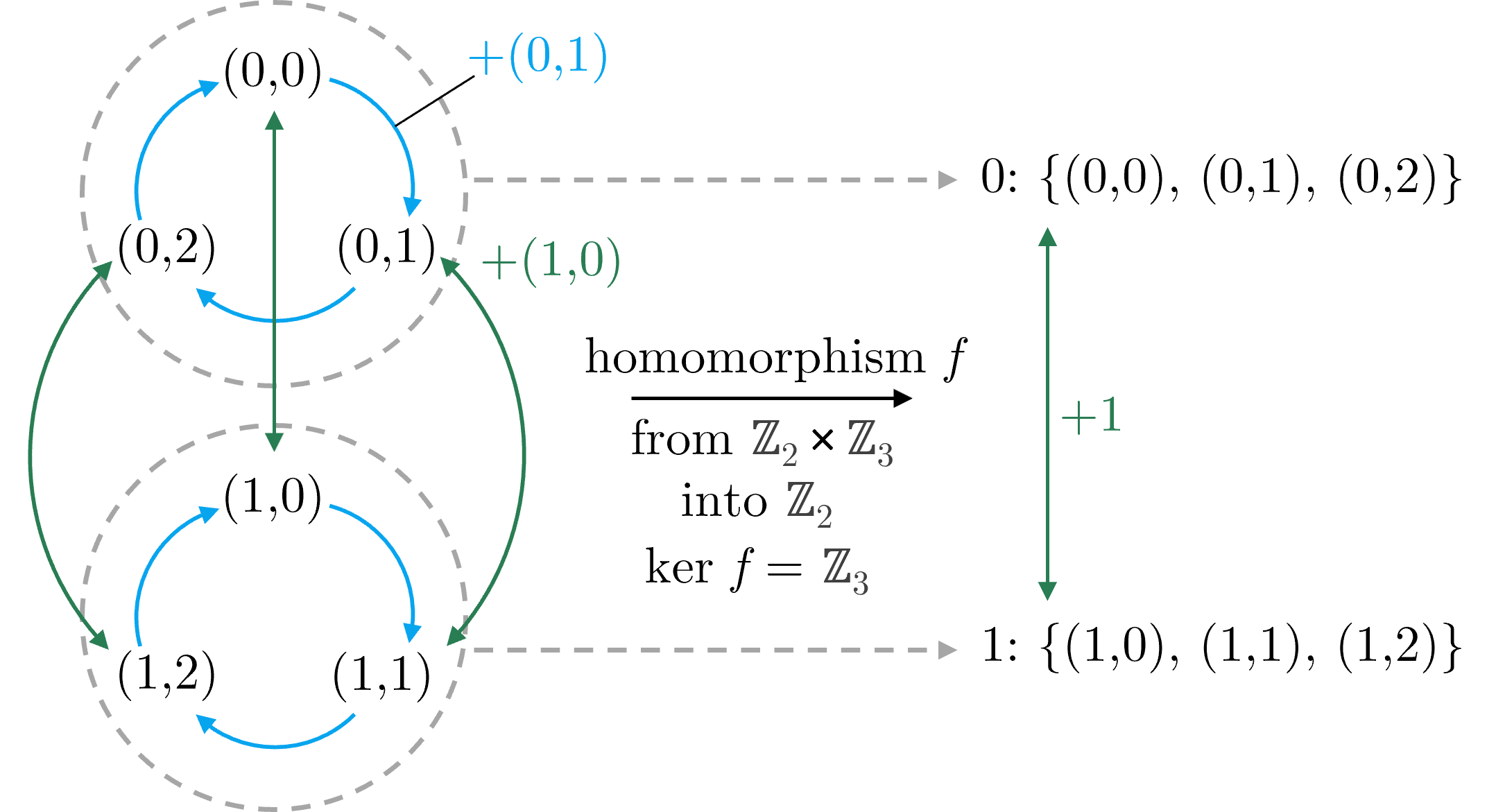
This diagram illustrates a key point: a homomorphism does not need to be one-to-one. Multiple elements from the domain group can map to the same element in the codomain group.
2. Kernel and Image: The Subgroups Defined by a Homomorphism
Every homomorphism naturally defines two important subgroups: the kernel and the image.
Unit 1: Groups, Invertible Symmetries, and Categories
This document from Purdue University provides concise definitions of the kernel and image and states their properties.
Please read the section that starts with the paragraph "You can check..." and continues down to the definition of the kernel and image, ending at "...is a subgroup of H.".
Let be a group homomorphism.
-
The image of , denoted , is the set of all elements in the codomain that are actually "hit" by the map:
The image is always a subgroup of .
-
The kernel of , denoted , is the set of all elements in the domain that map to the identity element in :
The kernel is always a normal subgroup of .
This last point is a profound connection to our previous lessons. The property of normality, which we found was required to construct a quotient group, emerges naturally from the concept of a homomorphism.
Let's revisit the determinant homomorphism, .
- The image is all of , because for any non-zero real number , we can construct a matrix whose determinant is (e.g., a diagonal matrix with in the first entry and 1s elsewhere). So, .
- The kernel consists of all matrices that map to the identity element of , which is 1. This is the set of all matrices with determinant 1. This group has a special name: the special linear group, . Because the kernel of any homomorphism is a normal subgroup, we have demonstrated that is a normal subgroup of .
3. Isomorphisms: Structurally Identical Groups
A homomorphism preserves structure, but it can also collapse it. An isomorphism is a special kind of homomorphism that perfectly preserves the structure without any loss of information.
Unit 1: Groups, Invertible Symmetries, and Categories
This section of the same document provides the formal definition of an isomorphism.
Read the definition of a homomorphism and isomorphism.
An isomorphism is a homomorphism that is also bijective (both one-to-one and onto). If there exists an isomorphism between two groups and , we say they are isomorphic and write .
Two isomorphic groups are, for all intents and purposes, the "same" group. They may have different-looking elements and operations, but their internal multiplication tables are identical. An isomorphism is like a perfect dictionary that translates from one to the other without ambiguity. For an isomorphism :
- (since the map is one-to-one, only the identity can map to the identity).
- (since the map is onto).
A beautiful physical example of an isomorphism is the relationship between the group of unit quaternions and the special unitary group , which is central to the description of spin in quantum mechanics.
Spinors for Beginners 6.1 - Equivalence of Quaternions, Sigma Matrices, and SU(2)
This video from the channel eigenchris provides an outstanding physical demonstration of what it means for two groups to be isomorphic. It shows that the group of unit quaternions and the group SU(2) are not only algebraically equivalent but also perform the same physical job: rotating vectors.
Please watch the following segments: First, get a quick refresher on quaternions and Pauli matrices from 0:58 to 4:56. Next, the most important part: from 4:56 to 7:59, the video explicitly constructs the mapping between the quaternion imaginary units and combinations of Pauli matrices. It proves the isomorphism by showing that the mapped elements obey the same fundamental multiplication rules (i^2=j^2=k^2=ijk=-1). Finally, watch 7:59 to 13:39 to see how both unit quaternions and SU(2) matrices are used to perform 3D rotations, solidifying the idea that they are two different mathematical descriptions of the same physical reality (the group Spin(3)).
This equivalence, , is a powerful example of an isomorphism. It shows that two seemingly different mathematical constructions have identical group structures, a fact that has deep implications for both computer graphics (where quaternions are used for efficient rotation calculations) and quantum physics (where SU(2) governs the behavior of spin-1/2 particles).
4. A Key Physical Homomorphism: The Map
We now turn to one of the most important homomorphisms in theoretical physics: the map from to . This map is a homomorphism but not an isomorphism, and its properties reveal the peculiar nature of quantum mechanical spin. is the group of rotations in 3D space, which you might think of as the "classical" rotation group. , as we've just seen, also performs 3D rotations, but in the context of quantum mechanical state vectors (spinors).
The following resource provides a graduate-level derivation of this homomorphism. We will walk through the key results.
[PDF] SU(2) to SO(3) homomorphism
This paper constructs the homomorphism from SU(2) to SO(3), proves it is a homomorphism, and calculates its kernel. This is a complete example of the concepts we've discussed.
Your task is to extract the main results from this paper: First, understand how the map \phi is constructed. Read the section "Derivation" up to the point where it establishes that \phi_U is in O(3). The key idea is that conjugating a vector (represented as a linear combination of Pauli matrices) by an SU(2) matrix U corresponds to a rotation of that vector in \mathbb{R}^3. Next, verify that this map is a homomorphism. Read the subsection "Proving that ϕ is a group homomorphism". This is a direct check of the homomorphism property \phi_{UV} = \phi_U \phi_V. Finally, find the kernel of this map. Read the subsection "Finding the kernel of ϕ", which shows that the elements of SU(2) that map to the identity rotation in SO(3) are the identity matrix I and its negative, -I.
Let's assemble the results. We have a surjective homomorphism whose kernel is . This two-element group is isomorphic to .
This result has profound physical consequences and beautifully ties together our last few lessons:
- The kernel is a normal subgroup of .
- The fact that the kernel is not trivial () means the map is not an isomorphism. It is a two-to-one map: for every rotation matrix , there are two corresponding matrices in , namely and , such that .
- This is called a double cover. is the double cover of .
- This explains the famous property of spin-1/2 particles: a rotation by does not return the wavefunction to its original state; it multiplies it by -1. A full rotation of is required to return to the original state. The rotation corresponds to moving from to in , which both map to the same identity rotation in , but represent distinct states for a spinor.
Using the concepts from our last lesson, the First Isomorphism Theorem (which we will cover formally later) states that . Applying this here gives:
The group of classical 3D rotations, , is isomorphic to the quotient group of by its center. This is a cornerstone result in modern physics.
Conclusion
In this lesson, we have defined the essential concepts of group homomorphisms and isomorphisms, which are the mathematical tools for relating the structure of different groups.
Key takeaways include:
- A homomorphism is a map that preserves the group operation: .
- The kernel of a homomorphism is the set of elements mapping to the identity, and it is always a normal subgroup.
- The image of a homomorphism is the set of elements reached by the map, and it is always a subgroup.
- An isomorphism is a bijective homomorphism. Isomorphic groups have identical structures.
- We saw that the group of unit quaternions is isomorphic to , demonstrating that two different mathematical systems can represent the same physical symmetry.
- The crucial physical map is a two-to-one homomorphism, not an isomorphism. Its structure reveals that is the double cover of , which is the mathematical origin of the properties of quantum spin.
We have now explored how to build groups from smaller pieces (quotient groups) and how to compare them (homomorphisms). In our next lesson, we will examine another fundamental construction: the direct product group. This allows us to build larger, more complex groups from simpler components, a process that is essential for describing physical systems that possess multiple independent symmetries.