Introduction
Hello again! In our last lesson, we focused on word stress, learning to emphasize the correct syllable within a single word, like in con-fi-gu-**RA**-tion. This is a vital skill for making individual words clear.
Today, we are taking the next step up, from the rhythm of words to the rhythm of sentences. This lesson is about sentence stress, which is how we emphasize certain words within a sentence to make our meaning clear and our speech sound natural. Mastering this will allow you to control exactly what your listener focuses on, which is incredibly powerful in both everyday chats and technical discussions.
By the end of this lesson, you will be able to use sentence stress to emphasize the key information in a spoken phrase, ensuring your message is understood precisely as you intend.
1. The Basic Rhythm: Content Words vs. Function Words
In a typical English sentence, not all words are treated equally. Some carry the main meaning, while others are there for grammar. This difference is the foundation of sentence stress.
- Content Words: These are the key words that carry the meaning. They are the nouns, main verbs, adjectives, and adverbs. If you only heard these words, you could still understand the basic message. Content words are usually stressed.
- Function Words: These are the smaller, grammatical words like prepositions (
to,for,in), articles (a,an,the), pronouns (I,you,it), and auxiliary verbs (is,are,can,do). They connect the content words. Function words are usually unstressed.
Look at this image. It shows how the content words (SELL, CAR, GONE, FRANCE) get the stress and create the "beat" of the sentence.
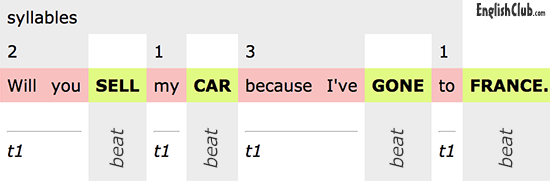
To explore this fundamental concept, let's watch the first part of a helpful video.
Sentence Stress in English Pronunciation
This video from Oxford Online English clearly explains the difference between content and function words, which is the basis of sentence stress.
Watch from 01:01 to 02:31. Pay close attention to how the speaker identifies the content words that carry the meaning. Try repeating the example sentence, emphasizing the capitalized words: 'how about we GO for a COFFEE THIS AFTERNOON?'
Let's apply this to a technical context you might encounter:
The CLIent CAN'T acCESS the SERver.
The content words are CLIENT, CAN'T, ACCESS, SERVER. Even if you only heard those four words, you would understand the core problem. The function words The and the are unstressed and said quickly.
Test your understanding!
Read the following sentence out loud. First, identify the content words. Then, say the sentence, making sure to stress only those content words.
"The new router needs a different configuration."
Show answer
The content words are new, router, needs, different, and configuration.
Your pronunciation should sound like this: "The NEW ROUter NEEDS a DIFFerent configuRAtion."
2. Creating Contrast: The Key to Natural Rhythm
Knowing which words to stress is only half the battle. The natural rhythm of English comes from the contrast between the stressed and unstressed words.
- Stressed words are said more slowly, loudly, and with a higher pitch.
- Unstressed words are said quickly, quietly, and often with a reduced vowel sound (like the "schwa" /ə/). For example, "to" becomes /tə/ and "for" becomes /fər/.
This is why native speakers can sound very fast. They aren't necessarily speaking more words per minute; they are just compressing the time spent on the unstressed function words.
Let's watch the next part of the video, which explains this idea of contrast.
Sentence Stress in English Pronunciation
This section of the Oxford Online English video focuses on the importance of the contrast between stressed and unstressed syllables. It encourages you to exaggerate this contrast during practice.
Watch from 06:05 to 08:43. Notice the advice to pronounce unstressed words faster and at a lower volume. Try repeating the practice sentences, focusing on creating a clear, rhythmic contrast.
3. Controlling the Meaning: Emphatic Stress
So far, we've covered the "neutral" rules of sentence stress. But this is where it gets interesting. You, as the speaker, can override these rules to emphasize a specific piece of information, correct a misunderstanding, or show a particular emotion. This is called emphatic stress.
By shifting the main stress to a different word, you can completely change the focus of a sentence. Let's look at a powerful example for a professional setting from the article "Mastering Stressed and Unstressed Syllables".
Mastering Stressed and Unstressed Syllables
This article from Intonetic has an excellent section that shows how changing stress can alter the meaning in a professional context. We will focus on one specific part.
Please read only the subsection titled 'How Stress Changes Your Message'. It starts with 'Sentence stress does more than just create a nice rhythm...' and uses the example 'I didn't approve the budget.' Notice how stressing a different word changes the implied meaning.
As you just read, saying "I didn't approve the budget" is very different from saying "I didn't APPROVE the budget."
Let's see this in action with more examples. The final part of the video we've been watching demonstrates this flexibility perfectly.
Sentence Stress in English Pronunciation
This clip shows how sentence stress is not fixed but changes based on the speaker's intention, whether to contradict someone, contrast ideas, or ask a specific question.
Watch from 08:43 to 12:48. Pay close attention to the examples where the speaker changes the stressed word in a question like 'Are YOU going to London tomorrow?' to express surprise or ask for specific information.
4. Practice for Professional Clarity
Now, let's practice applying emphatic stress in situations relevant to your work as an IP Engineer. Imagine you are in a team meeting. Say the following sentence out loud, but change the stress each time to match the meaning in parentheses.
Sentence: "I installed the security patch this morning."
- "I installed the security patch this morning."
(Meaning: It was me, not my colleague.) - "I INSTALLED the security patch this morning."
(Meaning: I did more than just download it; the job is complete.) - "I installed the SECURITY patch this morning."
(Meaning: Not the performance patch, the security one.) - "I installed the security patch THIS morning."
(Meaning: Not yesterday, as you might have thought.)
This skill is essential for avoiding miscommunication. When you report a status, troubleshoot an issue, or explain a configuration, using the correct sentence stress ensures your colleagues and clients understand the most critical part of your message.
Test your understanding!
You are talking to a client who is having trouble with their VoIP system. They say, "I think the router is broken." You have checked the router and it's fine, but you suspect the issue is with the firewall configuration.
Which of the following responses uses sentence stress most effectively to politely correct them and shift focus?
A) I THINK the router is fine, but we should check the firewall.
B) I think the ROUTER is fine, but we should check the firewall.
C) I think the router is FINE, but we should check the FIREWALL.
Show answer
C) I think the router is FINE, but we should check the FIREWALL.
This is the best choice.
- Stressing FINE confirms their idea about the router is incorrect, but does so gently.
- Stressing FIREWALL clearly and helpfully points to the new area of focus.
Option A is too focused on your opinion ("I THINK..."). Option B over-emphasizes the router, which is the topic you want to move away from.
Conclusion
Excellent work today! We've moved from the rhythm of single words to the music of entire sentences. You now have a powerful tool to make your speech clearer and more precise.
Key Takeaways:
- English has a stress-timed rhythm: we stress content words (nouns, verbs, etc.) and speed through function words (the, a, in, etc.).
- This creates a contrast between longer, louder stressed words and shorter, quieter unstressed words.
- Most importantly, you can intentionally change the stress in a sentence to emphasize a point, correct a misunderstanding, or change the entire focus of your message. This is a key skill for clear technical communication.
Preview of the next lesson:
Now that we understand word stress and sentence rhythm, we can add the final layer of polish for smooth, connected speech. In our next lesson, we will focus on linking, learning how to connect words together seamlessly (e.g., pronouncing "an apple" as "anapple"). This will help you eliminate choppiness and speak with a more natural flow.